
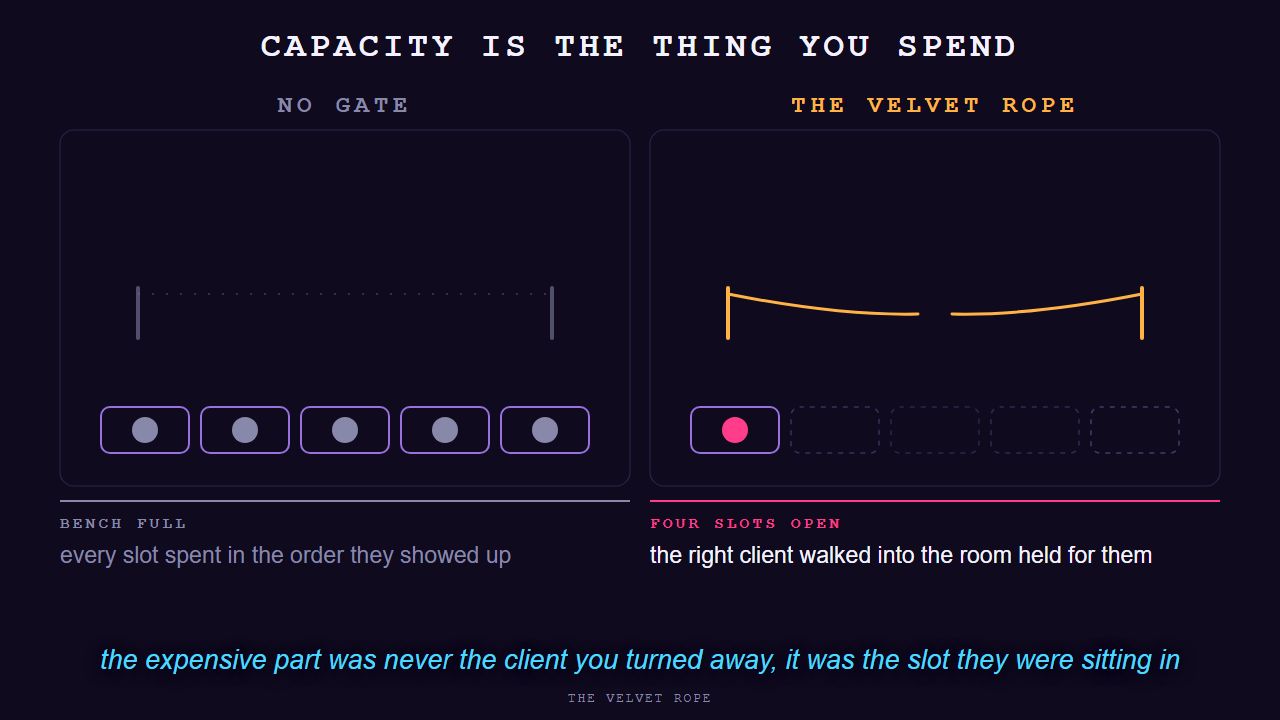
Every agency postmortem blames the funnel, the offer, or the traffic. Almost no one audits the qualification step. But wrong-fit clients are the most expensive line item in a solo operator's profit and loss. They consume disproportionate time, generate scope creep, pay late, and produce mediocre results that dilute your portfolio. The math is brutal in its simplicity. One wrong $5K-per-month client who chills your capacity for a right $15K-per-month client costs you ten thousand a month in revenue plus the compound cost to your positioning.
This essay is the standalone playbook for the qualification gate. It corresponds to People · Product · Process Stage 7. PPP gives you the full nine-stage diagnostic stethoscope. The Velvet Rope is what happens once you have used the stethoscope and confirmed that the leak is not in your message, not in your offer, but in who you let through the door.
Which revenue leak you actually have
Most operators in the $5K-to-$25K monthly retainer market run a Beggar identity without naming it. The Beggar takes every client because the alternative, a quiet calendar, feels more dangerous than a bad fit. The Beggar quotes whatever number the prospect breathes near. The Beggar keeps onboarding clients whose project briefs read like riddles and whose teams cannot name a decision-maker. The Beggar operates from scarcity, which produces scarcity. The Velvet Rope is the way out.
Before you reach for the rope, run a brief diagnostic. There are two distinct revenue leaks operators confuse for each other. The first leak is upstream: the wrong people are finding you, or the right people find you and bounce because your message does not land. The fix is positioning, message-market fit, offer clarity. That work lives in PPP Stages 4 through 6. The second leak is at the gate: the right people find you, your message lands, and you still close the wrong ones because you have no operational filter. That is what the Velvet Rope is for. If you have not done the upstream work, qualification will only let through a smaller pool of misaligned prospects. Diagnose first. Then choose your tool.
Andy says it plainly: you can help anyone, but you can't help everyone well. The Beggar reads that and feels the relief of permission. The Chooser reads it as an instruction and asks how the system gets built.
What the Velvet Rope actually is
The Velvet Rope is not a personality trait. It is an engineered system with three surfaces. The first surface is what your marketing communicates before anyone speaks to you. The second surface is how your intake process screens before they get on a call. The third surface is what you ask when you do.
The three surfaces compound. Each layer filters more aggressively than the last. By the time a prospect reaches your calendar, they have passed two disqualification checkpoints. You are not deciding whether they are worth a conversation; you are confirming what you already know.
The metaphor is the venue rope. A rope outside a club does not insult anyone. It signals that being inside the room is worth something. The line self-sorts. The people who know they belong stay. The people who are unsure leave. The rope says nothing. The environment does the work. The same logic applies to a service practice: when you describe your engagement clearly enough, the wrong fit reads it and walks away on their own. From Andy's transcript: bake those filters into your copywriting, discovery calls, and proposals so the wrong people quietly disqualify themselves.
What this section does not give you is a series of feel-good affirmations about being more selective. The next three sections are mechanics. Section 3 is the marketing layer. Section 4 is the application layer. Section 5 is the in-call layer. Sections 6 and 7 are proof and starting points.

The Go Away Method · marketing as filter
The Go Away Method is negative marketing. You write copy that explicitly disqualifies the wrong client. The tone stays descriptive rather than aggressive. You describe your engagement and your buyer in enough specificity that the wrong fit reads it and says that is not me. They filter themselves out. You never have to reject anyone in person.
This works at two levels. The first level is direct disqualifiers in your copy. Specific revenue thresholds. Operational maturity signals. Decision-authority requirements. Andy's homepage line is the canonical example: if you've spent more than $20K on agencies in the last year and you still can't name the specific reason your conversion rate is what it is, that's the engagement. One sentence filters out three classes of person at once. People who have not spent at that level are not the buyer. People who have spent and already know their root cause are not the service. People who lack the authority to write the check are a long meeting waiting to happen. The sentence does not insult any of them. It just describes a different room.
The second level is long-form applications as pixel training. The Lead-Gen Funnel Overhaul case study is the cleanest illustration. Andy ran paid acquisition at roughly $50 cost per lead with a short intake form. He replaced it with a long-form application of fifteen-plus questions that took serious commitment to complete. Two things shifted at the same time. Time-wasters self-filtered, because nobody fills out a fifteen-question form to kick tires. The pixel re-trained on the profile of people who actually completed it, and within sixty days the cost per qualified lead landed under ten dollars. The application was not just a filter. It was training data the platform consumed and used to find more of the same buyer. See Lead-Gen Funnel Overhaul for the full mechanics.
One question carries an outsized share of the disqualification load: how much profit do you want to add in the next 90 days? This is the financial ambition probe. If the answer is I don't know or some number under ten thousand, the prospect is not buying for return on investment. They are buying for reassurance or novelty. Both of those are the wrong job for a results-oriented retainer. Auto-disqualify. The question reads as innocent on the form and does most of the work the rest of the form is asking.
Three structural rules govern negative-marketing copy.
- State the problem you solve in outcome language, not feature language. Flat conversion rate with no root-cause diagnosis beats CRO services. The first describes a state the buyer recognizes. The second describes a category the buyer has to translate.
- Name who the engagement is for, in positive terms, then name a specific class of person it is not for. If your problem is X, this is for you. If you are still figuring out what your problem is, start here instead. The second sentence sends the misfit somewhere useful, which is the polite version of the rope.
- Anchor price before the call, not at the call. Not the exact number, the floor. Andy's verbatim is the cleanest version: this starts at $5K. Is that a problem? A yes or silence is qualification. A casual no opens the next gate. The buyer who would have wasted forty-five minutes hedging at the end of a call is no longer in your calendar.
The case study evidence stacks across multiple engagements. The Facebook Ads Coach work used a comparable application gate inside a coaching offer and produced sixty-to-seventy percent close rates on qualified calls (see Facebook Ads Coach). The accounting practice work used a paid audit as the disqualifying instrument before any retainer conversation began (see Accounting & Professional Services). The pattern is the same in each case. The filter does the work the pitch used to do, and the pitch becomes a confirmation.

The application gate · qualifying before the call
The discovery call is the most expensive surface a solo operator owns. It costs you thirty to sixty minutes per encounter, and the prospect knows it costs you something, which makes them feel like they have leverage going in. The application flips that frame entirely. When someone has to invest twenty minutes completing a serious intake, two things shift. Their psychological commitment increases, because sunk cost anchors them to completing the conversation they started. And you arrive on the call with data instead of questions, which means your time is spent confirming, not gathering.
A qualifying application covers six fields at minimum.
- Current revenue and growth rate. This clarifies whether the problem is real and whether the prospect can sustain the engagement at the floor price you stated in your copy.
- The specific problem statement, in their own words. This tests diagnosis-readiness. A buyer who can articulate the problem in concrete terms is closer to ready than one who writes we just need help with marketing.
- What they have already tried. This surfaces previous failure patterns and prevents you from repeating something a prior agency already burned. It also reveals whether the prospect understands their own history, which is itself a qualification signal.
- Revenue or profit target for the next 90 days. The poison pill question, embedded in the form, doing its work.
- Decision authority confirmation. Who else is in the room for the yes? If there is a CFO, board, or silent partner who has not been mentioned, the next conversation is informational, not a buying conversation. That is not disqualifying, but the next step changes.
- Timeline. Are they shopping or are they ready? Whenever it makes sense is shopping. Before Q3 or we miss the annual target is ready.
The application answers five of the six BANCE letters before the call begins. You spend the call confirming budget and deepening need, not gathering basic intelligence. From Andy's transcripts: I go seven levels deep into pain. The application surfaces level one and level two pain. The call goes deeper than that. But if a prospect cannot articulate level one in writing, the call is premature, and the right move is to redirect them to a piece of content that helps them get there before you spend an hour on it together.
The application also produces an artifact you keep. Even when the prospect does not close, you walk away with a documented snapshot of how a buyer in your market frames the problem at first contact. Twenty applications give you copy. Fifty applications give you a research corpus. The Lead-Gen Funnel Overhaul project (case study) drew from this exact pattern: the form was a filter, a pixel-training instrument, and a qualitative research feed at the same time.
BANCE · the in-call disqualification framework
BANCE is the in-call layer. Budget, Authority, Need, Timeline, Engagement. It is a disqualification audit. For every letter there is a threshold. Below the threshold means disqualify politely and redirect. At or above means continue.

Here is the question sequence verbatim, in the order it gets used.
Budget. This type of engagement typically starts at $[X]. Is that within range? Direct, no hedging. If the prospect cannot confirm budget in the first exchange, the call ends here productively. Andy says it cleanly: I ask directly. This starts at $5K. Is that a problem? Asking the question is respect for both parties' time. The Beggar dances around price for forty minutes. The Chooser settles it in ninety seconds.
Authority. Who else is involved in this decision? If there is a CFO, board member, or silent partner who has not been mentioned, the conversation you are in is informational, not a buying conversation. The right move is to acknowledge that, restructure the next step (a follow-up with the actual decision-maker present), and not waste another twenty minutes simulating a yes you cannot get.
Need. What specifically is broken? Not generally. What do you see happening right now that tells you this needs to change? Now you go seven levels deep. Surface: our revenue is flat. Second level: conversion rate dropped. Third: we changed our landing page three months ago. Fourth: the old page was written by someone who had talked to customers, the new one was not. Fifth: we have no process for capturing customer language before we write copy. By level five through seven, you know whether the problem is real, and whether it is the kind of problem you can solve. If the prospect runs out of road at level two, the diagnosis is incomplete and the engagement is premature.
Timeline. When do you need this solved? What happens if it is not? This surfaces urgency or its absence. We need this fixed before Q3 or we miss our annual target is a real timeline tied to a real consequence. Whenever it makes sense is shopping. Whenever means the project will get bumped by anything more concrete the prospect has on their plate. That is not your client.
Engagement. What does success look like to you at 90 days? This is expectations calibration. If the answer is vague or disconnected from the work you would actually do, the gap will become a scope-creep problem (see State Machine Everything for why scope drift is structural, not personal). If the prospect can articulate a specific measurable outcome, they have a results orientation and the engagement runs cleanly.
The disqualifier close is the part most operators flinch on. After you have run the five questions, you summarize fit or mismatch out loud. Based on what you have told me, here is what I am thinking. If X, Y, and Z line up, the next step is the proposal. If not, the better starting point for you is probably this audit, this reading, or this referral. You give the bad-fit prospect a graceful exit and a redirect. This is the move that cements the Chooser identity. You close the call, not the deal. Andy's anchor: the only person who wins a negotiation is the one who can walk away.
One more line from Andy that captures the ethic: I would always qualify. When you qualify somebody out, you do them a favor. The wrong-fit prospect who hires you and gets a mediocre outcome is worse off than the wrong-fit prospect you redirected with care. The redirect compounds your reputation. The bad engagement compounds the opposite.
What changes when you qualify
Three things change in the numbers when the Velvet Rope is operational, and one thing changes that does not show up in a dashboard.
Close rate goes up, not down. The Beggar's intuition is that filtering reduces volume and therefore reduces close count. The math runs the other way. When you talk to fewer people, you close a higher percentage of them, and the higher percentage often outpaces the volume drop. Andy's Facebook Ads coaching offer (case study) closed at sixty-to-seventy percent on qualified calls. That number is a function of who reaches the calendar in the first place, more than of anything said on the call.
Cost per lead drops, sometimes by an order of magnitude. The application gate trains the platform's audience model on the profile of buyers who actually complete it. The Lead-Gen Funnel Overhaul work moved CPL from roughly fifty dollars to under ten over a sixty-day window on the same ad spend (case study). The creative did not change. The targeting did not change. The intent signals fed back into the algorithm changed, and the algorithm responded.
The work gets better. When clients arrive with realistic expectations, clear timelines, and decision authority, the engagement runs differently. Fewer revision cycles. Fewer scope renegotiations. More results that look like results. Better testimonials. Better case studies. Better portfolio. The accounting practice work (case study) used a paid forty-nine dollar audit as the qualifier and the resulting retainer engagement compounded into eighty thousand within sixty days, because every client who walked through the audit had already proven they were the right buyer.

The thing that does not show up in a dashboard is the identity. The Chooser is the measurable output of running the system above. You become the Chooser when the system runs. The order matters. Most operators reverse it, try to feel selective without building the filter, and end up with the same Beggar calendar wearing different clothes.
Where to start
Three starting points, in order of difficulty and impact.
Easiest, do today. Add the poison pill question to your current intake form or your email inquiry template. How much profit do you want to add in the next 90 days? One question. It surfaces financial ambition and filters time-wasters with zero friction to your existing process. Run it for two weeks before you change anything else and watch how the inbound shape shifts.
Medium, this week. Audit your current marketing copy for explicit disqualifiers. Does your services page say who this is not for? If not, add one paragraph. Use the structure from Section 3: if you have done X and still cannot name Y, that is the engagement. If you have not done X yet, start here. Send the misfit somewhere useful. The redirect is the whole point.
Hardest, this month. Build the application gate. Replace your discovery-call booking link with a qualifying application that covers the six fields from Section 4. Route completed applications to a calendar link. Route incomplete or disqualified applications to a redirect resource (a wiki essay, a field note, an email sequence) that starts the right conversation for that prospect rather than the wrong one for you. The first version of this form will be ugly. Ship it anyway. The second version, written from twenty completed applications, will be sharper than anything you could design from scratch.
The Velvet Rope is PPP Stage 7. It works because the eight stages before it have been done. If you have not run People · Product · Process, run the diagnostic first. The rope is the gate at the end of a system, not a substitute for the system. For the full nine-stage context, see People · Product · Process.