
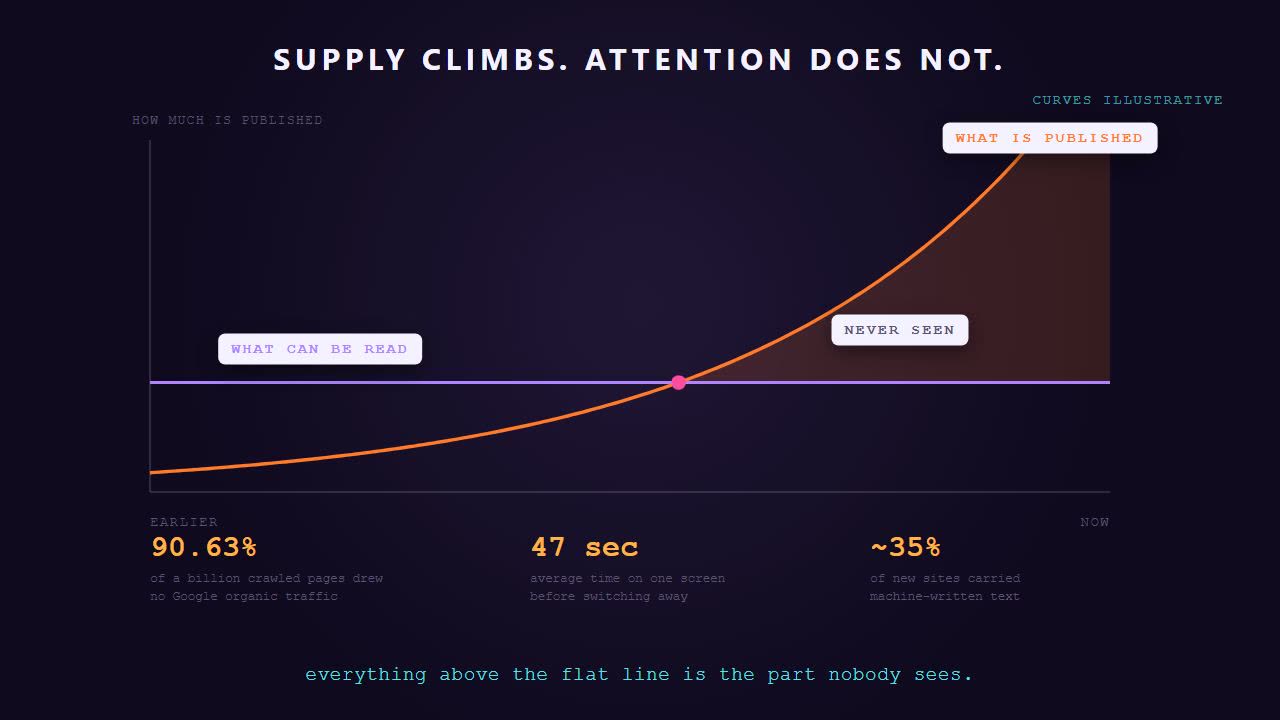
In 2017 the SEO tool company Ahrefs crawled roughly a billion pages from its own index and measured how much organic search traffic each one pulled from Google. For 90.63 percent of them the answer was none. Not a trickle. None.
That figure circulates as "ninety-one percent of content is never seen," which overstates what was measured. Ahrefs counted estimated Google organic visits to pages in one commercial index at one point in time. Direct traffic, social referral, newsletters, and every link a person pastes into a group chat sit outside the count, so plenty of those pages were seen by somebody. What the number does establish is the shape of the distribution, and the shape is severe: a small head of pages absorbs almost all of the search demand and the tail collects rounding error. Mark Schaefer named the economics behind that shape in 2014 and called it content shock. Supply grows on an exponential curve. Human capacity to consume it is biologically fixed. Past the crossing point the cost of buying the same amount of attention keeps climbing, and it has.
The demand side moved too. Gloria Mark's group at UC Irvine has spent two decades timing how long knowledge workers hold attention on one screen before switching to another. The average ran about two and a half minutes in the mid-2000s, fell to roughly seventy-five seconds by the early 2010s, and sits near forty-seven seconds in her most recent data. That is not a claim about human attention as a biological constant, and Mark is careful never to make it one. It is a measurement of behavior in a specific environment: people at computers, inside workplaces, with notifications running. That environment is the one your work has to survive.
Then came a supply shock nobody had modeled. A 2025 study by researchers at Stanford, Imperial College London, and the Internet Archive ran text classifiers across newly created websites and estimated that about thirty-five percent of them carried AI-generated or AI-assisted text by the middle of that year, against roughly zero before late 2022. The SEO firm Graphite put the share above half for newly published articles. Both rest on detectors that make mistakes, and both describe newly published material rather than the whole standing web, so read them as direction rather than decimal. The direction is not in dispute.
Some work still breaks through all of that. It is not louder, better optimized, or posted more often than the work that does not. It is grounded in something the rest never touches. This entry names that something, gives it a structure you can build against, and shows the machinery for producing it on purpose instead of by accident. The distance between work that ranks and work that makes a stranger feel understood is a depth problem, not a quality problem, and depth has a shape that can be learned.
The name borrows from physics deliberately. The Standard Model of particle physics does not describe every scenario in the universe. It identifies the fundamental units and the rules governing their interaction, then lets those rules compose into arbitrary complexity. Seventeen particles and four forces get you every interaction between matter and energy that anyone has measured. Human behavior has no accepted equivalent. Psychology has competing schools, marketing has demographic buckets, behavioral economics has a catalog of heuristics, anthropology has thick description, neuroscience has scans. Each holds a piece. None composes into something you can compute with, teach, and run at scale. This framework is a working attempt at the missing composable layer, and it is named after physics because of the ambition, not because anyone confused media with matter.
A warning about that borrowing, stated once here and honored throughout. Three sets of equations run underneath this framework, and every one of them is borrowed structure. Fluid dynamics gives a vocabulary for what stays smooth and what churns. Dynamic programming gives a vocabulary for value that accumulates over time. Quantum formalism gives a vocabulary for a reader who holds several readings at once. None of that means media obeys the Navier-Stokes equations, and anyone who tells you otherwise is selling something. Each section below says which part is real physics, which part is the analogy, and where the analogy breaks. An analogy that cannot name its own breaking point is decoration.
Two layers: the turbulent surface and the laminar depth
What Reynolds actually saw in 1883
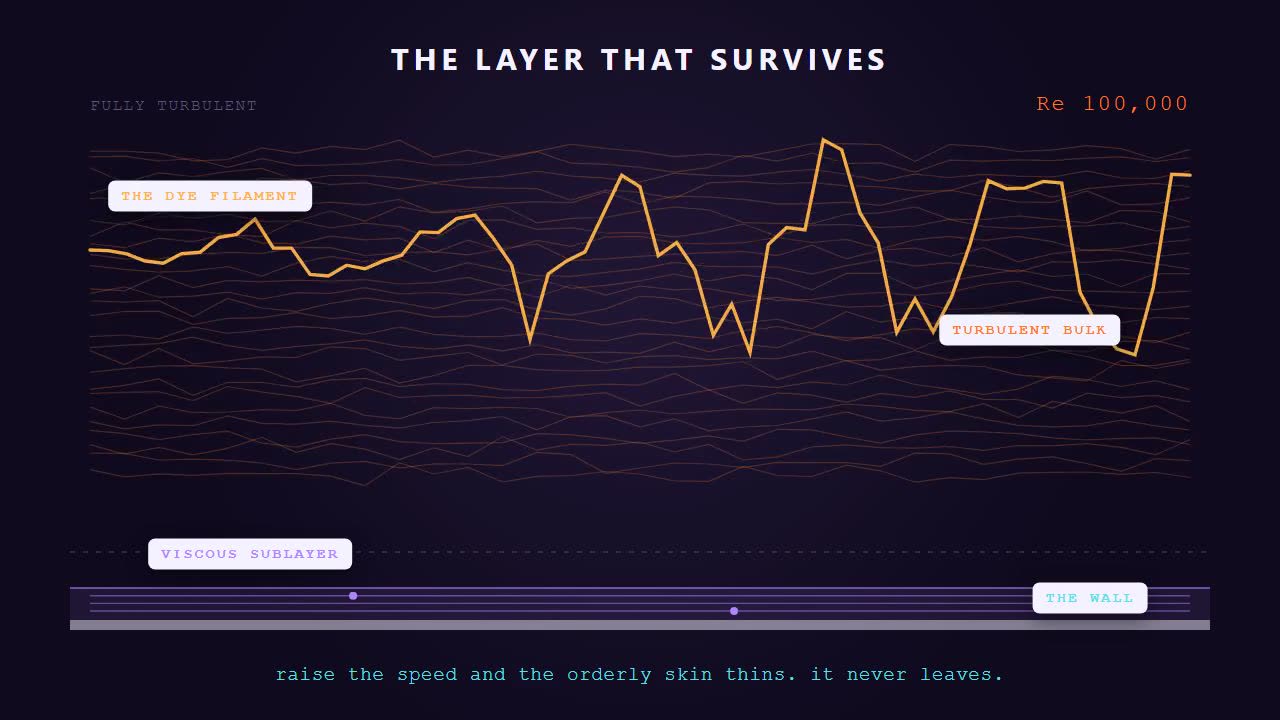
Osborne Reynolds ran a glass tube off a constant-head tank so he could hold the flow rate steady, then injected a thin filament of dyed water along the axis of the tube and watched what happened to it as he opened the valve. At low speed the dye held together. It ran the length of the tube as a single clean line, layers of water sliding past each other without mixing. Past a certain speed the filament began to waver. Past a little more it broke apart entirely and spread across the whole cross-section until the tube ran uniformly colored.
Reynolds showed that the switch was not governed by speed alone, or by the width of the tube, or by the fluid. It was governed by a single dimensionless combination of all three, now written Re = ρUL/μ, where ρ is density, U is a characteristic speed, L is a characteristic length, and μ is dynamic viscosity. Read it as a ratio: inertia, the tendency of moving fluid to keep moving and amplify any disturbance, divided by viscosity, the internal friction that damps disturbances out. When friction wins, the flow stays orderly. When inertia wins, small perturbations grow into chaos.
The thresholds are worth stating precisely, because they get quoted as though they were constants of nature. For steady flow in a smooth circular pipe, flow stays laminar up to roughly Re 2300, sits in a transitional band between about 2300 and 4000 where it flips back and forth and is exquisitely sensitive to any disturbance, and runs fully turbulent above about 4000. For flow over a smooth flat plate, where the Reynolds number is built on distance from the leading edge instead, transition typically begins somewhere between Re 300,000 and 3,000,000, and where exactly depends on surface roughness, pressure gradient, and how turbulent the oncoming stream already was. Those two sets of numbers share no digits. The concept is universal. The critical values are not, and a careful inlet can hold laminar pipe flow well past 2300 while a rough one trips it early.
The layer that survives the turbulence
Ludwig Prandtl added the piece that makes the analogy load-bearing. In 1904 he showed that a high-speed flow can be treated as effectively frictionless out in the bulk while remaining absolutely dominated by friction in a thin region hugging any solid surface, because the fluid touching a wall cannot slip along it. That thin region is the boundary layer, and inside a turbulent one the structure is stratified rather than uniform.
Immediately against the wall sits the viscous sublayer, often called the laminar sublayer, where viscous forces dominate and the velocity profile is very nearly a straight line. Above it a buffer layer mixes viscous and turbulent stresses, and above that the flow runs fully turbulent with friction effectively irrelevant. In the dimensionless wall coordinate engineers use for this, the viscous sublayer occupies roughly the first five units, the buffer layer runs from five to thirty, and beyond thirty the turbulence owns the flow. In physical units the sublayer is thin, from a fraction of a millimeter to a few millimeters in ordinary engineering flows.
So a pipe running at Reynolds 100,000, turbulent by every classification, still carries a skin of orderly laminar flow against its own wall. The turbulence never reaches all the way in. That is the structural fact worth borrowing, and one more detail comes with it: the faster the bulk flow runs, the thinner that laminar skin gets. Raise the Reynolds number and the orderly region against the wall shrinks. It does not disappear, and it never stops being where the flow meets the surface it is actually touching.
What transfers to media, and what does not
Media has a platform layer that behaves like the turbulent bulk. Ranking systems get retuned. Formats rotate. A sound that carries a video in March is a punchline by August, and the format that felt native last year now reads as a person who stopped paying attention. Nearly everyone optimizes here, because this layer is visible, measurable, and rewarded in the short run. Work built only for it has a short half-life by construction, since the thing it was tuned to has already moved by the time it lands.
Underneath runs something far more stable. The same handful of emotional situations recur across cultures and centuries: a person who was chosen at random and paid for it, a parent who watched a child leave for a war, a debt that never got acknowledged, the moment somebody finally said the thing out loud. Counting-out rhymes that decide who is picked exist in nearly every society that has children and games. Those situations are the layer worth grounding in, and work grounded there keeps functioning after the platform it launched on has been sold, rebranded, or shut down.
Here is where I have to correct the framework's own first phrasing. Earlier versions of this model said that media "runs at two Reynolds numbers at once." A fluid dynamicist would object to that, and the objection is right. A flow has one global Reynolds number. What it has in different places is a different local balance between inertia and viscosity, which is why one turbulent flow contains a laminar-like region without containing two separate flows. The accurate statement is that one system can be turbulence-dominated in its bulk and friction-dominated at its boundary at the same time, and that the boundary region is thin, is adjacent to the surface everything actually touches, and does not go away no matter how violent the bulk becomes.
That is the whole borrowing, and it stops there. You cannot compute a Reynolds number for an article, because there is no density of meaning, no viscosity coefficient, and no characteristic length to put in the formula. Nobody has measured a critical value at which audience response changes regime. The claim that survives contact with a physicist is structural rather than numerical: a single system can host two regimes at once, the stable one is thinner and closer to the surface of contact than intuition suggests, and a practitioner who mistakes one regime for the other will optimize the wrong thing with great discipline. The suggestive detail about the laminar skin thinning as the bulk speeds up is exactly that, suggestive. I have no measurement showing that a noisier information environment shrinks the stable emotional region, and I am not going to pretend the metaphor constitutes evidence.
What follows from the structure is a working instruction. Build for both layers deliberately, because they are answering to different judges. The turbulent surface has to satisfy a distribution system: the format, the hook, the first three seconds, the thing that makes an algorithm or a colleague pass it along. The laminar depth has to satisfy a person who is deciding, usually without articulating it, whether the thing in front of them understands their situation. Satisfy only the surface and you join the tail of the distribution. Satisfy only the depth and nobody encounters it to begin with.
The keystone move: the innocent thing and the true thing
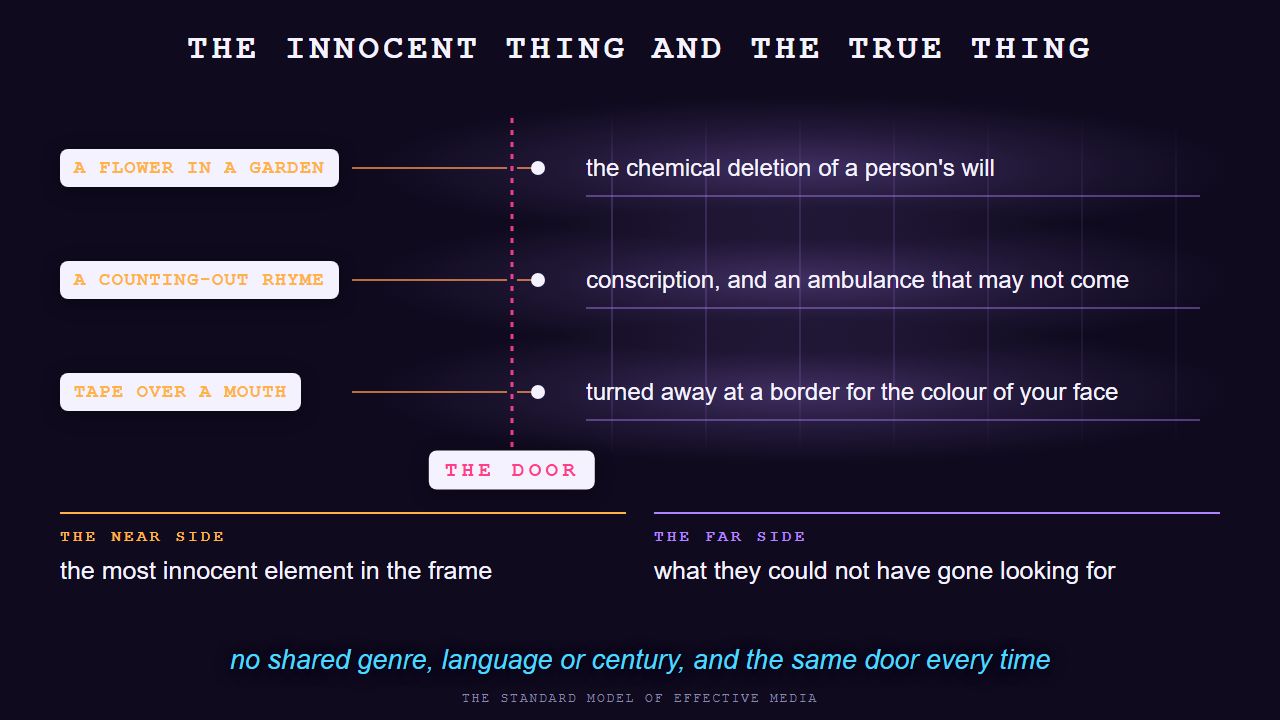
One mechanism sits under most media that lands. Take the most innocent thing in a culture and connect it to the deepest thing in that culture. The innocent thing is a door. A reader walks through it with their guard down, because the surface signals safety. By the time they notice a door was there, they are already on the other side, standing in front of the thing that actually matters.
The flower and the pharmacology
A field guide I wrote on chemical predation opens with a flower. Brugmansia, the Angel's Trumpet, a huge pendulous bloom that hangs down like a bell and smells extraordinary at dusk. Grandmothers grow it in flowerpots. Hotels plant it in lobbies. Botanical gardens put it in the display beds by the entrance. It reads as the safest object in the frame.
Every part of that plant carries scopolamine, atropine, and hyoscyamine. Scopolamine blocks the acetylcholine receptors involved in forming new memories and in maintaining deliberate, voluntary behavior. A dosed person does not fall unconscious. They stay awake, verbal, and responsive, and they comply. They answer questions, walk where they are led, hand over what they are asked for, and retain almost nothing about any of it afterward. Colombian authorities have reported incidents in the tens of thousands per year, and the delivery vector is a drink, a meal, or a powder, all of it colorless and effectively tasteless at criminal doses. There is no warning signal built into the experience, which is the entire point of it.
That piece opens in a grandmother's garden so the guard drops, then delivers the pharmacology while the defenses are down. The trajectory runs from beauty to horror to institutional failure to a working protection protocol, and a reader who arrived for travel safety leaves understanding something about how predation systems are engineered that they never went looking for. The flower is the innocent thing. The chemical deletion of a person's will is the true thing. The connection between them is the door.

A counting rhyme in a country at war
Eight thousand kilometers away, a Ukrainian rapper in his early twenties built a track on the same architecture without knowing the first piece existed. The title is a children's counting-out rhyme, the local equivalent of eeny meeny miny moe, the thing kids chant in a circle while a finger moves person to person and lands on whoever is picked or eliminated. The full traditional line pairs the rhyme with varenyky, the stuffed dumplings a grandmother makes on Sunday and families eat on Christmas Eve. As a cultural object it sits in the same register as a nursery rhyme. It is about as disarming an opening as that culture contains.
The song then uses the rhyme's own counting structure to count off a night of substances and arrive at a request for an ambulance. Same singsong cadence, same bouncing meter, no tonal shift at any point. Two cities get named in a single breath, one of them the destination that hundreds of thousands of refugees fled to and the other the capital they came from, which compresses an entire generation's displacement into two words for anyone who lived it. Between choruses, delivered as flatly as a public service announcement, sits a joke about legalizing nuclear weapons. Ukraine surrendered its nuclear arsenal in 1994 under the Budapest Memorandum in exchange for security assurances from Russia, the United States, and the United Kingdom, and was invaded anyway. Eleven words of deadpan carry that entire betrayal, and the joke is only funny because the alternative to laughing is worse.
The mechanism is identical to the flower. A counting rhyme decides who is picked in a schoolyard. It also decides who gets the conscription letter. The innocent version is the door, and the audience walks through it before their analytical defenses have any reason to engage, because nothing about a nursery rhyme suggests they should. Neither creator learned this from the other. Neither learned it from a framework. That convergence is the reason this entry exists, and the next section takes it apart properly.
The same move, everywhere you look
Once you have the shape, it stops being possible to unsee. The pattern below holds across media that share no genre, no language, no century, and no distribution channel, and each row is doing structurally the same work.
The line between a door and a trap
None of this is modern. William Randolph Hearst had no framework for it and did not need one, because he knew fear and righteousness sold papers to everybody. Yellow journalism ran this move at industrial scale: take the familiar, your street and your family's safety, and wire it to the deep thing, war and crime and corruption. Ted Turner built a twenty-four-hour news network on the same layer, since human anxiety is a renewable resource and does not keep business hours. Newsprint became cable became a feed. The mechanism sat still the whole time.
Which raises the obvious objection, and it deserves a straight answer rather than a reassurance. If the move is that reliable, and if propagandists have been running it for a century and a half, then what separates this from manipulation?
Nothing structural. That is the answer. The mechanism is neutral in exactly the way a lockpick is neutral, and everything moral about it lives in what is behind the door. A trap uses an innocent surface to deliver something that serves the sender at the reader's expense: an outrage cycle that leaves them angrier and no better informed, a pretty first paragraph attached to a product that does not do what the paragraph implied. A door uses the same surface to deliver something the reader could not have gone looking for, because they did not have the language to name it yet. The reader's own verdict is the test, and it arrives later than the click. Did the thing on the other side turn out to be worth the trip?
That is why Respect is the first of the connection primitives in the next section and the precondition for the rest. It is also why the metric this whole framework is governed by is value delivered per second of attention rather than attention captured. A trap optimizes the capture. A door optimizes the payload. Both look identical for the first three seconds, and that is precisely why the distinction has to be enforced upstream, in what you decide to put behind the door, instead of downstream in how the opening is written.
The convergence, and what it does not prove
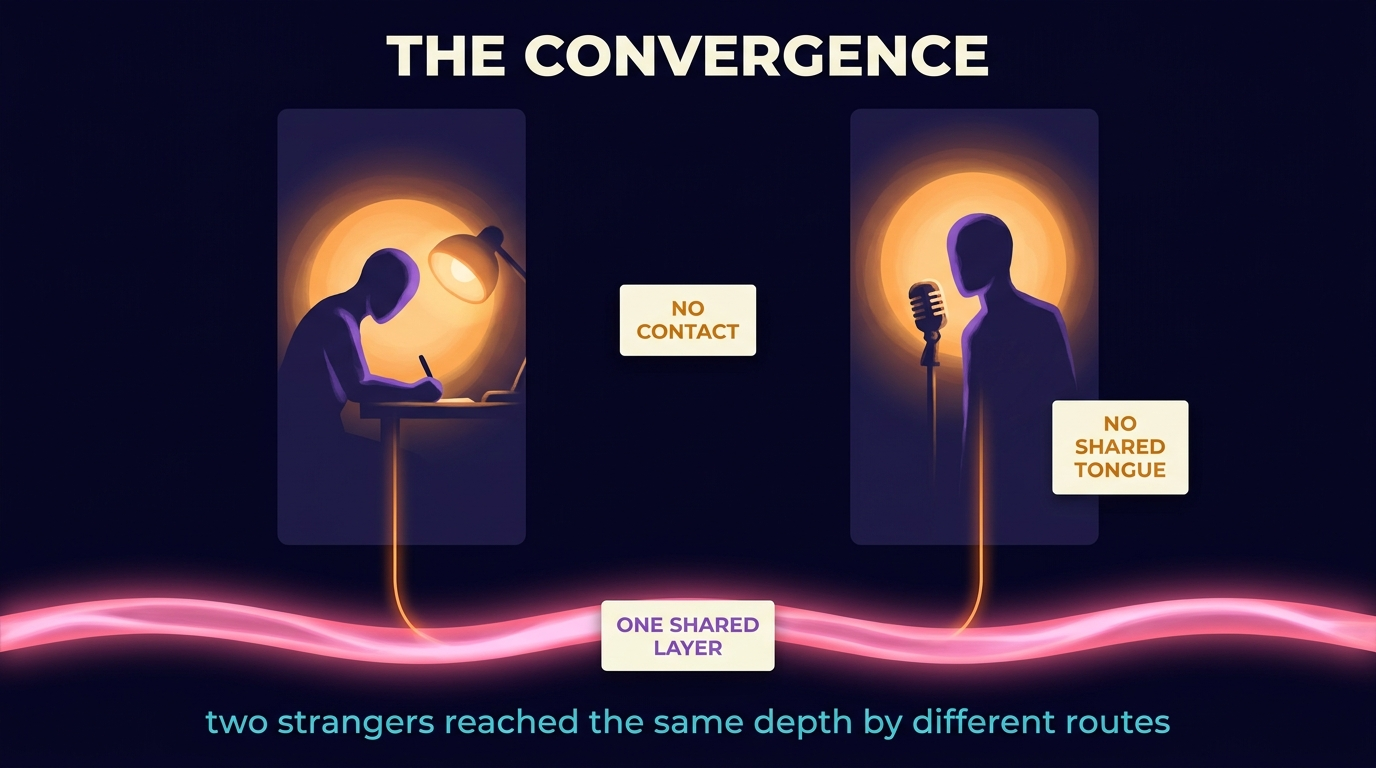
An English-language safety guide written by an American researcher living in the Philippines and a Ukrainian-language trap song made by a twenty-one-year-old in Lviv have no business sharing a structure. Different language, different continent, different medium, different audience, different century of cultural reference. The two creators do not know each other exists. Yet both open on innocence, both describe the chemical deletion of consciousness, both refuse to moralize about the people they describe, and both connect a private vulnerability to a public betrayal by an institution that promised protection.
Why convergence is the evidence that counts
Take the alternative explanations one at a time and watch them fail.
Talent explains why one piece is better than another. It does not explain why two unrelated people arrive at the same structural solution. Two brilliant creators working independently should produce two brilliant and different things. Coincidence covers one case. It stops covering anything once the same structure turns up in every additional case examined, including cases picked specifically to break it. Genre convention is the strongest objection, because rap does have its own inherited grammar for processing damage, and a framework that only described that grammar would be a genre observation wearing a physics costume. Genre convention requires a shared genre, though, and the moment the evidence crosses into prose, into album art, into a network news format, the explanation has nothing left to stand on.
What remains is that both creators reached the same layer by different routes, without a framework, without contact, and without a vocabulary for what they were doing. That is the observation this entire model exists to formalize, and it is worth being precise about what kind of observation it is. It is convergent evidence, the same species of argument a biologist makes when an eye evolves independently in an octopus and in a human. Independent arrival at the same design is evidence that something about the problem, rather than something about the designer, is doing the work.
Closing the genre hatch
Three artists from one production network in the Ukrainian underground share collaborators, a producer, and a wartime pressure field, and operate in genres that share almost nothing. One works in maximalist cringecore trap, all blown-out bass and internet-poisoned irony. One works in atmospheric hyperpop filtered through Slavic ghost folklore, where the recurring figure is a spirit whose death was never properly acknowledged, and the visual vocabulary is a hospital corridor in a country where hospitals get hit. One works in what he calls paradise gothic, a rap built on Orthodox choral aesthetics and Baroque visual language, whose stated thesis is that the original Gothic cathedrals were engineering for letting light into stone and the literary tradition kept the darkness and lost the reaching.
Three sonic architectures. Three visual vocabularies. Three completely different relationships to volume, to humor, and to God. If the mechanism were a genre convention, it would express differently inside each convention and produce three differently-shaped resonances. Instead the same move runs in all three: a familiar and trusted object, a grandmother's knitted hat, a childhood rhyme, the voice of a brother, becomes the entry point for material the audience would have refused at the front door.
Closing the identity hatch
A harder objection: maybe the layer is ethnic. Maybe these creators resonate with their audiences because they share an inheritance with them, and what looks universal is a pattern that repeats inside demographic walls.
One artist closes that hatch. He was born in Ukraine. His father came from Cameroon as a professional footballer, married a Ukrainian woman, took citizenship, and stayed. The son trained at the country's most prestigious football academy and became a rapper instead, and he raps in Ukrainian rather than in Russian, which was the historically default language of post-Soviet rap, or in English, which would have been commercially easier. His album art puts a strip of tape across his own mouth. That image is not a poetry-class metaphor. When the full-scale invasion began, Black African residents and students holding Ukrainian documents were turned away at border crossings while white Ukrainians were waved through, some of them walking twenty kilometers in winter, and the African Union issued a formal statement about the reported treatment.
If the layer were ethnic, his work would map somewhere else. It does not. It runs the identical mechanism, reaches the identical depth, and lands on the same audience through the same door. The variable is not phenotype, and it is not nationality. The variable is standing in a pressure field with something real at stake. Snow falls on him the same way it falls on the trees, and the winter does not ask where his father was born.
Closing the mortality hatch
The last hatch is time. Content that resonates might be a performance sustained by a living performer, in which case what gets measured is a relationship rather than a structure. Work by artists who died decades ago settles it. A song released posthumously in the late nineties became a protest anthem for a movement that did not exist when it was recorded, because the situation it encoded had not expired. The artist could not tour it, could not explain it, could not adjust it for a new audience, and it landed anyway. Content grounded in the layer does not require its author's continued existence. That is as clean a demonstration as this kind of argument gets that the structure is in the work and not in the person delivering it.
What this evidence cannot do
Now the part that most frameworks skip, and that this one is worse off without.
Every case above was selected because it worked. That is selection on the dependent variable, and it is the oldest weakness in this style of argument. I went looking for resonant media and found a shared mechanism inside it, which tells you the mechanism is present in work that resonates. It does not yet tell you the mechanism is absent from work that fails, and the second claim is the one the framework actually needs. Plenty of forgettable content opens on a nostalgic object and goes nowhere, and I have not sampled failed media at anything like the same rigor.
So here is the test that would falsify this, stated plainly so that somebody can run it. Take a large sample of media matched on topic, platform, format, and publication window. Have raters blind to performance code each piece for the innocent-to-true structure. If the structure shows up at the same rate in the pieces that died as in the pieces that compounded, the model is wrong and should be discarded. If it shows up materially more often in the survivors, the model has earned something it has not earned yet. Nobody has run that study, including me.
Until somebody does, the correct status of this section is a working hypothesis with unusually strong illustrative support, not a proven law. That distinction costs nothing to state and it is the difference between a framework and a belief system. The practical value does not depend on settling it, because a practitioner who starts asking which innocent thing opens which door produces different work immediately, whether or not the underlying claim survives a proper test.
The controlled experiment: two artists, one variable
The previous section conceded the weakness in all of this: every case was picked because it landed. What that argument needs, and cannot get from more examples of success, is a comparison where the surface stays fixed and only the deep layer moves. You cannot run that experiment on purpose. Nobody funds a study that assigns artists to moral positions during an invasion and measures the audience response.
History ran it anyway.
The song that had to be amputated
Before the full-scale invasion, a Russian rapper named Basta released a track built on the Buddhist idea of samsara, the wheel of birth and death and return. In a region that had been through enough cycles of destruction and rebuilding in one century to treat eternal recurrence as a weather report rather than a philosophy, it landed hard. Its central promise was continuity through children: when I am gone I will be singing in the voices of my children. For a nation that had survived an engineered famine, decades of repression, and the steady official position that its language was a dialect and its identity a fiction, continuity through descendants was not a poetic image. It was the entire argument for having endured.
Then the invasion started, and Ukrainians heard the same lyric describe the voices of children killed in Mariupol and Bucha. Russian soldiers played the song while occupying Ukrainian ground. A promise about eternal connection became the soundtrack of a temporary conquest.
Here is the part that matters structurally rather than emotionally. The song's genuine quality made the injury worse rather than better. Bad propaganda costs nothing to discard. Work that actually moved you, made by someone who backs your destruction, forces something harder: you cannot simply remove the track from a playlist, because the thing that has to be removed is the version of yourself that loved it. Ukrainians named that operation philosophical amputation, and the word is precise. Amputation is what you call a removal that saves the body and costs it a part it will not grow back.
What a state does when culture becomes a weapon
Ukraine's parliament formalised the amputation. On 19 June 2022 it adopted Law 2310-IX, which restricts public use of music from the aggressor state. Reading the actual scope matters, because the law is usually described in a way its text does not support. It restricts public performance, broadcast, and playback in public spaces and transport. It does not reach private listening at home, in a car, or through headphones. It covers anyone who has held Russian citizenship at any point since 1991, and it reaches recordings tied to companies registered there. Broadcasters who ignore it face a penalty set as a share of their licence fee.
The clause that makes this section possible is the exemption. The law provides for a published list of performers from the aggressor state who condemned the aggression, and anyone on it falls outside the ban. A legislature under bombardment, writing the most emotionally justified blanket prohibition available to it, still carved out a category for the individual position. That is a state saying in statute that nationality is not the operative variable.
The artist the exemption was describing
Miron Fyodorov, who records as Oxxxymiron, is a Russian rapper who studied English literature at Balliol College, Oxford. On the day the full-scale invasion began he cancelled six sold-out shows in Russia. He organised benefit concerts under a Russians Against War banner in Istanbul and London. In September 2022 he released an anti-war track called "Oyda." In October 2022 the Russian state designated him a foreign agent, and he has lived outside the country under continuing legal pressure since. He later titled an album Nationality: None, taking the phrase from the way the state's own paperwork described him. The state removed his nationality as a punishment and he put it on a record sleeve.
The cost is what makes him useful evidence rather than a nice anecdote. He was not a marginal artist making a cheap gesture. He was operating at the top of Russian-language rap, with a battle record and an audience most performers in any language never reach, and he walked away from the entire apparatus that produced it. In 2018 he and Basta had stood on the same side of a public campaign defending a detained musician's artistic freedom. Four years later one of them kept his tours, his income, and his freedom of movement, and the other lost all three.
The consequence that closes the argument: Oxxxymiron performs in Russian to rooms in Warsaw full of Ukrainians. They come to hear the language of the country shelling their cities, delivered by one of its most successful artists, and they come because they have made the same distinction the statute makes. Not between Russian and not-Russian. Between those who stood up and those who did not.
What the comparison holds constant, and what it proves
Set the two side by side. Same language. Same genre and roughly the same commercial tier. Same decade, same war, same audience with the same access to both catalogues. Both make work of real craft; the argument does not depend on one being better. One activates Righteousness, Catharsis, and Respect, opposing a war at a price he actually paid and describing Ukrainian reality as Ukrainians report living it. The other activates none of the three. Every surface variable is held constant and the resonance inverts completely.
That is as close to a controlled experiment as this subject allows, and it does the specific job the previous section said was missing. It is a case where the deep layer is absent and the work fails with an audience, rather than another case where the layer is present and the work succeeds. One natural experiment is not a study, and the sample size here is two. It does not license the general claim. It does establish that the variable is doing work, which selection on successful cases alone can never show.
The wider pattern this fits into is worth naming because practitioners keep rediscovering it. An artist under systemic pressure has three positions available: exile, defiance, or martyrdom. Oxxxymiron took exile, keeping the connection through moral clarity and losing the audience that built him. The Ukrainian artists in the sections above took defiance, staying inside the thing and making work the pressure cannot suppress because the work is the culture's immune response. The third position is the one nobody chooses, where an artist documents the violence around him at full volume until the system he is describing kills him, and the murder becomes the terminal proof that the work was accurate. All three sustain the connection. They differ in what the connection costs.
Underneath the three positions sits the claim this entry keeps circling. There is a layer of human identity beneath national identity, and under enough moral pressure it overrides. A room of Ukrainians in Warsaw listening to a Russian perform in Russian during the invasion of their country is that claim standing up in public. They are not ignoring his nationality. They are responding to something his nationality does not contain.
The strata: depth is not one layer
A framework that treats the stable layer as a single flat surface produces a bad instruction: find the universal thing, put it in the work, collect the resonance. Practitioners who try that discover quickly that the universal thing can be present and the work can still be inert. The reason is that the layer has depth, and the depth is ordered.
The cleanest evidence available for that comes from tracking one artist across four years of an invasion. He did not plan an arc. Nobody hired a narrative consultant, nobody sequenced singles toward a climax, nobody scheduled the vulnerability three tracks before the closer where an executive said it would land best. He recorded what was happening to him while it happened, because making music was the thing he knew how to do while everything else was on fire. The arc exists anyway, and that is what makes it useful evidence. Real experience has an internal logic that only becomes visible when you line the documents up in order.
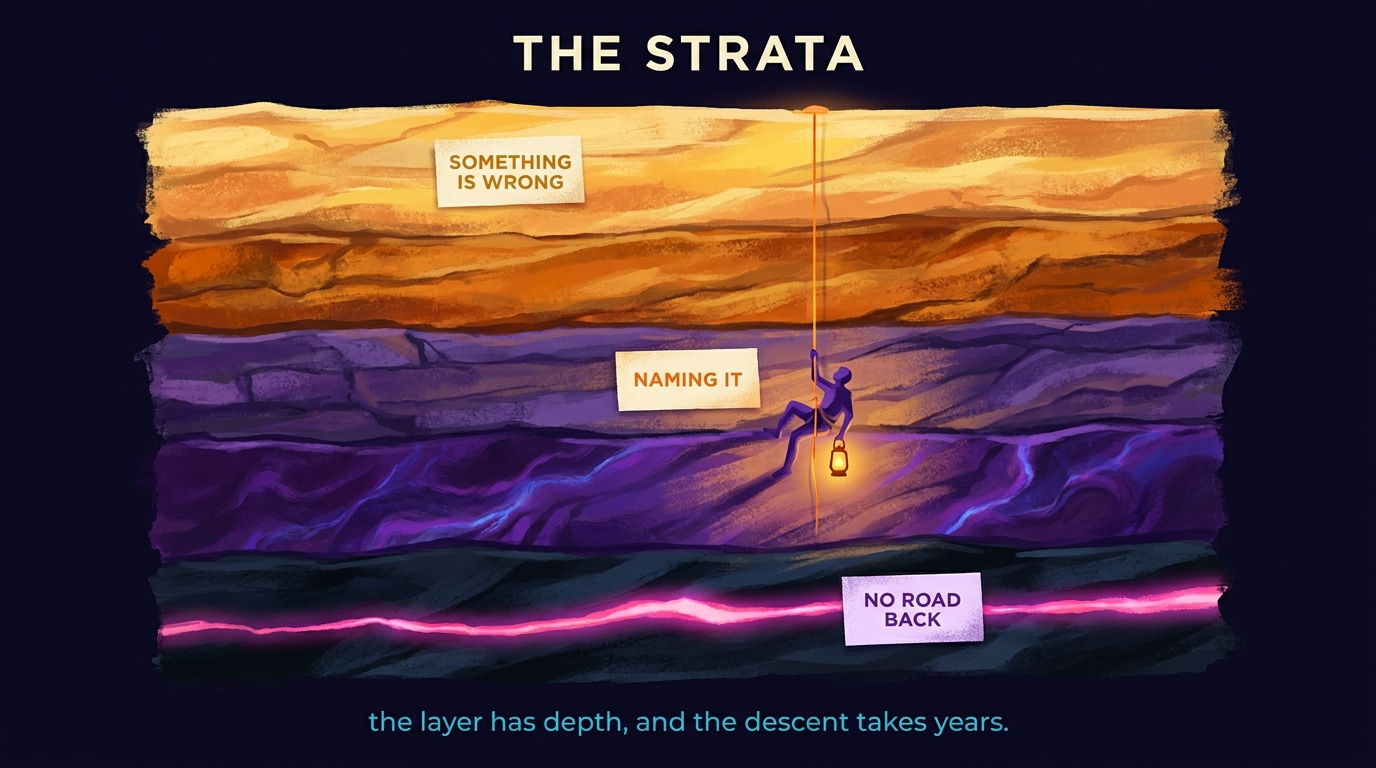
Five releases, five depths
Month six. Recognition. The first track is a stoner anthem about mountain weed, ninety-five seconds long, comic on its surface. The war is never named. It shows up as the slang term for enemy soldiers, as a friend's father fighting at the front, as a line about carrying a contingency plan on his person at twenty years old, and as a claim to a folk-shamanic state of seeing through the veil. Something is wrong and the art can hold it without the artist saying so directly. A listener who came for the vibe leaves with the invasion in their lungs.
Month ten. Integration. A party track with a fourteen-year-old streamer on the feature, built around mixing an energy drink with a children's soft drink. Then one line puts the country's great port city inside the narrator's cup, with little ships floating in it, at a moment when the sea was blockaded and nothing in that harbor moved freely. The wrong thing is no longer ambient. It has been folded into the party, carried alongside the chaos of being young and refusing to be quiet. Thirteen thousand short videos got made to that sound within weeks and not one of them was about the war. All of them carried it.
Month sixteen. Naming. The counting rhyme track. The mechanism gets decoded: the finger that picked who sat on the bench in the schoolyard now picks who goes to the hospital and who goes to Warsaw. Childhood ended, nobody announced it, and the decisions are being made in the dark. The innocence is the vehicle and the naming is the cargo.
Year four. Confession. A track whose title claims outright to be the best rapper in the country, which forces a conversation, which forces an admission. The armor gets named as armor. The laugh that opened every previous track gets decoded as a nervous laugh rather than a happy one, which retroactively changes every track behind it. The pain is reported as constant and the medication as ineffective, stated flatly, with no metaphor and no wrapper. He tells the listener to look up post-irony, naming his own method inside the work.
Year four, three weeks later. The boundary collapses. The cover drops the entire maximalist cartoon universe for a single stone lion, a city coat of arms first documented in 1359, rendered like something buried for centuries that has finally broken the surface. The track fuses a liturgical choir with a phonk beat, which is not a stylistic choice so much as an accurate recording of what that civilization sounded like in the fifth year of an invasion: ancient continuity and immediate chaos occupying the same bar. One month earlier he had said he felt no joy. Here he names what replaced it, and what replaced it is the struggle itself.
What the descent means for anyone building
Line those five up and the ordering is not arbitrary. Recognition, integration, naming, confession, then the collapse of the boundary between the sacred and the profane. Each stratum is universal, each crosses cultural boundaries, and each sits at a different depth. The counting rhyme and the stone lion activate different primitives in the same audience.
Two working consequences follow, and they matter more than the poetry of the descent.
First, depth is not a switch you flip by deciding to be deeper. It is a function of how long somebody has been in the experience with their guard down and their recording equipment running. An operator who has been in an industry two months can reach the first stratum honestly and cannot fake the fourth, and the audience for the fourth will detect the counterfeit immediately. Content strategies that instruct a junior writer to go deeper are asking for a stratum that person has not reached.
Second, the strata explain why some work resonates once and other work resonates for years. A piece built on the first stratum can be genuinely good and still be exhausted on the first read, because recognition is complete the moment it lands. A piece built on the fourth changes meaning when you return to it, since the confession reframes everything the reader already thought they understood. That difference is the same one the compound-resonance section is about, viewed from the production side instead of the measurement side.
The Nine Generals: the connection primitives
People do not share the same thoughts, values, or beliefs. They share the same connection architecture. Underneath the surface, every human runs a common emotional operating system, and a small set of primitives command attention regardless of culture, language, or income. These are the Generals. They were not derived from theory. They were field-tested across war zones, oil fields, e-commerce operations, trauma clinics, and nightlife in more than twenty countries, then checked against media that resonates across cultures that share nothing on the surface. Seven are confirmed. Two are still emerging, named as candidates rather than dressed up as settled.
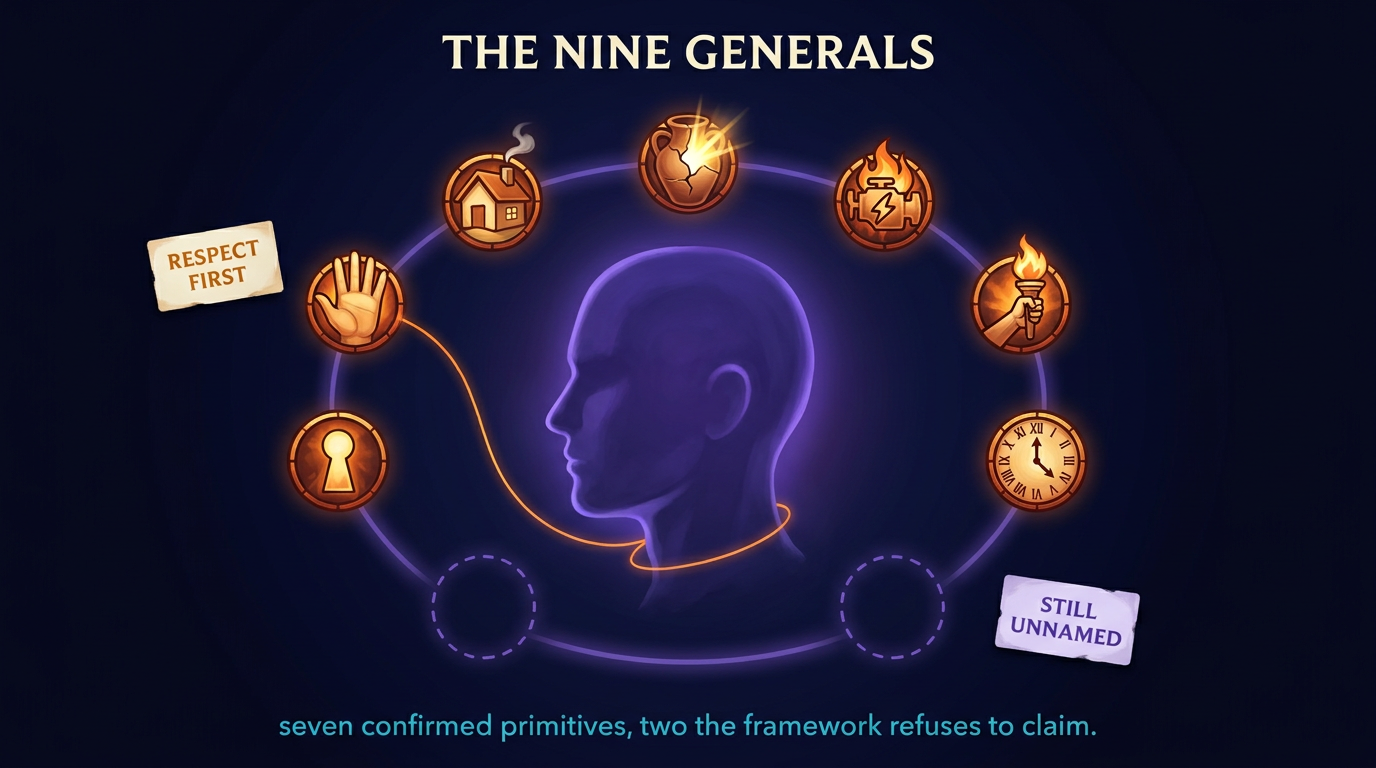
Respect, and why nothing else fires without it
Respect here has nothing to do with agreement, approval, or politeness. It means acknowledging that another person's reality is real to them, which requires temporarily setting down your own frame and fully occupying theirs. Humans carry ancient and extremely sensitive detectors for the counterfeit version, and once those detectors fire the reader is gone and no amount of craft downstream recovers them.
The safety guide demonstrates it by refusing to moralize. It never tells the reader he should not be meeting strangers from an app in an unfamiliar city. It tells him how the attack works, how to reduce his exposure, and how to recognize the symptoms in someone else in time to act. It takes his situation seriously enough to hand him information that could keep him alive, without endorsing his choices and without pretending to be neutral about them. That is the whole move, and a reader feels it long before they could name it.
The Ukrainian track does the same thing from the opposite direction. It describes a night of substances and a call for an ambulance without a single line of instruction about what any of it means. No disclaimer. No redemptive third verse. The listener is trusted to hear the consequence sitting inside the bravado, and trusting an audience to do that work is the most concrete form respect takes in practice. Every piece of media that lectures has already lost, no matter how good the lecture is.
Nostalgia, and what the research actually supports
Here I have to break with how this framework described its own second primitive for years. Earlier versions claimed that nostalgic memory triggers a release of oxytocin, serotonin, and dopamine producing instant emotional bonding. That claim is not supported by the nostalgia literature and I am retiring it. The specific neurochemical triple is pop neuroscience, the kind of tidy mechanism that circulates because it sounds like an explanation. Nobody has demonstrated it in humans during nostalgic recall, and the researchers who have spent two decades on this emotion do not make the claim.
What the actual work supports is stronger, and it is more useful to a practitioner than a fake mechanism. Constantine Sedikides, Tim Wildschut, Clay Routledge, and their collaborators have run a long program of experiments in which nostalgia is induced and its effects measured. The replicated findings hold up well. Nostalgia is pancultural and frequently experienced. Its content is characteristically social, self-defining, and tied to meaning rather than to objects. Inducing it reliably increases social connectedness, strengthens self-continuity, the sense that the person you were and the person you are belong to one story, raises perceived meaning in life, lifts positive affect, reduces loneliness, and increases optimism about the future. It gets triggered by music, smells, photographs, and, tellingly, by adversity and loneliness themselves.
Read that list again and notice what it says about craft. People are not nostalgic for the object. They are nostalgic for the continuity the object proves, for the evidence that the person they were connects to the person they are. A business owner is not longing for older equipment. He is longing for the period when the work felt like it meant something and he could still see the whole of it. Content that reaches for the object gets a pleasant flicker. Content that reaches for the continuity gets the reader's whole attention, because it is answering a question about their identity that they were carrying anyway.
The counting rhyme works exactly there. It is the sound of a schoolyard, and it lands before a single word about pills or ambulances has been processed. The mountain range in another track works the same way for the person who grew up seeing it, in the same way a regional name works for anyone whose sense of self is anchored in a place. That anchoring holds even when the country around it is on fire, which is precisely why it is the right door in a war.
Catharsis, permission rather than comfort
Connection is not the business of making people feel good. It is the business of letting them feel what they already feel and have been told not to say. Every person carries some weight the surrounding culture has marked as inappropriate to set down in public. Catharsis grants permission to put it down.
A rapper's song about addressing thirty years of accumulated shame did not give me any new information when I first heard it. I already knew the childhood had been destructive. I already knew what I was carrying. What arrived was permission to acknowledge three decades of damage without immediately minimizing it in the same breath, and the difference between knowing something and being permitted to feel it is the entire distance the song traveled.
The mechanics in the Ukrainian track are worth studying because they are counterintuitive. The cadence never darkens. The beat keeps bouncing while the words get progressively more desperate, and the gap between how it sounds and what it says is where the catharsis lives. Anyone who has smiled through a room while something inside them was quietly requesting emergency services recognizes that gap immediately, because it is the exact shape of their own experience. They finally have something that sounds the way it actually feels: not sad, bouncy and desperate at the same time. A piece that had solemnly announced its own seriousness would have missed them entirely.
Desire, righteousness, and regret
Desire is the least understood of the seven, because almost nobody can name what they actually want. They can name what they were trained to want, which is a different list. A person who says they want money usually wants the specific relief of not having to think about money. A person who says they want power usually wants to stop being overlooked. A person who says they want success frequently wants one particular individual to notice. Content aimed at the stated desire competes with everything else aimed at the stated desire. Content that reaches the desire underneath walks past defenses that were never built to stop it, because the reader did not know that door existed.
In the safety guide the surface desire is not being robbed. The desire underneath is to become someone an environment cannot break, which is why the piece ends on a philosophy of strength rather than on a list of precautions, and why that ending does not read as a non sequitur to anyone who got there. In the Ukrainian track the stated desire is money and status. The desire underneath is agency: the counting rhyme picks for you, and choosing to work is the only available refusal of the pointing finger. That line is a survival instinct wearing a gold chain.
Righteousness is anger with a purpose, and anger is the most informative signal a person emits. Love can be performed, sadness can be leveraged, fear can be manufactured, but anger reveals what somebody actually values by showing precisely what got violated. Righteousness with a purpose builds something. Righteousness without one just breaks things and calls the wreckage a position. The difference is always whether there is anything on the far side of it.
The most effective righteousness in the evidence does not shout. Eleven deadpan words about legalizing nuclear weapons carry an entire abandoned security guarantee, and they work because they assume the audience already knows why it is funny and refuses to explain the betrayal. Sacred fury does not scream. It makes a joke so precise the laugh catches in the listener's throat. The safety guide does the same by aiming its anger at a documented pattern of systemic predation rather than at individuals, which is what keeps it productive instead of merely loud.
Regret is wisdom that arrived too late to prevent the lesson and just in time to prevent the repeat. Deathbed data is unusually clarifying about what humans actually value, and it is consistent: the regret is the recital that got missed, not the deal that fell through. Regret turns generative the moment it stops pointing at what was lost and starts pointing at what will be different. A parent's line about forgiving their own mother while refusing to let a child inherit the same belief is regret operating as a redirect rather than as a wound, and that turn is what makes it usable by a stranger.
Curiosity, and the two that stay unnamed
Curiosity is the pull that makes somebody read six thousand words about a plant they will never see, in a country they will never visit. It converts passive consumption into active engagement, and it is the difference between a piece of content and an encyclopedia entry: one makes a reader want to understand, the other only informs them. It is also the General doing the work right now, in this article, which is why each section here raises the question the next one answers.
Two positions in the set stay deliberately empty. Two candidates surface everywhere in the evidence and neither has been confirmed. Belonging is the need to be part of something, with isolation as the wound and recognition as the medicine. Defiance is the active choice to resist and build differently, the position that says a cycle ends here. Both appear in every piece of source material examined for this framework, which is suspicious in the way that a pattern you want to find is always suspicious. Neither gets promoted until the inquiry produces something better than enthusiasm. A framework that claims completeness before it has earned it poisons every conclusion that rests on it, and the two empty positions are worth more to a practitioner than two confident inventions would be.
What the sharing research adds
The Generals were derived from field observation rather than from literature, which makes it worth checking them against work done by people with control groups. Three lines of research converge on the same territory from outside.
Jonah Berger and Katherine Milkman analyzed which New York Times articles made the most-emailed list, then ran experiments to isolate why. Their finding is the one every practitioner should know: high-arousal emotions drive sharing regardless of whether they are positive or negative. Awe, anger, and anxiety all increase transmission. Sadness, which is low-arousal, decreases it. Awe in particular was a strong positive predictor of making the most-emailed list. That result cuts directly against the intuition that people share what makes them feel good, and it explains why the deadpan-fury register outperforms the mournful one even when both are describing the same catastrophe.
Dacher Keltner and Jonathan Haidt gave awe a working definition that a writer can actually build toward: perceived vastness plus a need for accommodation, meaning the reader encounters something large enough that their existing mental model cannot absorb it and has to be revised. The associated experience is the small self, a reduction in self-focus and an increase in the sense of being part of something larger, and it is reliably linked to prosocial behavior. That is a design specification, not a mood. Vastness alone produces a shrug. Vastness that forces a revision produces awe.
Melanie Green and Timothy Brock named the third piece: narrative transportation, the state of being absorbed into a story with focused attention, vivid imagery, and emotional engagement. Their central finding is that transportation predicts belief change consistent with the story, and that it operates through reduced counterarguing. A transported reader generates fewer critical thoughts against what they are reading, because the cognitive resources that would produce those thoughts are occupied following the narrative.
That last mechanism is the keystone move described in the vocabulary of an experimental psychology lab, and the overlap is not a coincidence. The innocent thing lowers the guard because the surface signals safety. Transportation lowers it because attention is committed elsewhere. Both describe a reader whose objections are not being defeated by argument. They are simply not being generated. Which is exactly why the ethical constraint has to sit upstream in what you put behind the door, since it plainly cannot sit in the reader's defenses.
The Generals are not a menu you pick one item from. A single piece can fire several at once, layered so a shallow reader gets the surface payload and a deep reader gets the rest, without either interfering with the other. Respect is the load-bearing one. It is the ground the others stand on, which is why a piece that lectures, moralizes, or talks down fails no matter how much craft sits on top of it. The detector fires first, and once it fires, the reader is gone.
The bet this framework is making, and who disputes it
Everything above rests on one bet. The bet is that underneath the churn there is something stable enough to build against, and that a practitioner who aims at it in 2026 will still be hitting it in 2036. If that bet is wrong, this framework is an elaborate description of a moving target.
Two bodies of research get cited to support that bet, and this entry has cited both. Neither is settled. A canonical reference that leans on contested science and presents it as fact is doing the reader a disservice, so here is the state of the dispute.
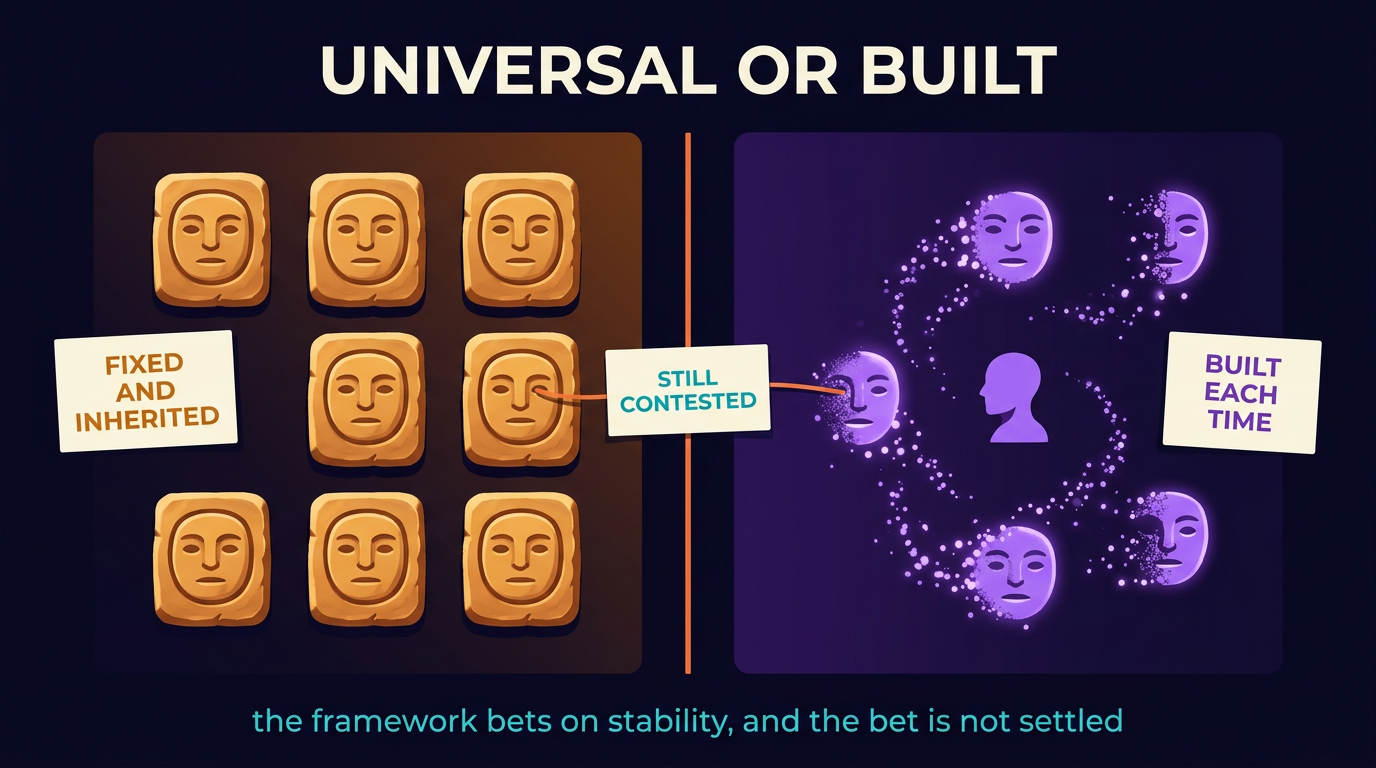
Ekman, Barrett, and whether emotions are inherited
Paul Ekman's argument, sharpened in his 1992 paper, is that a small set of emotions is biologically basic: happiness, sadness, fear, anger, disgust, and surprise, each with a distinct facial expression, recognizable across cultures, supported by distinct physiology. His neurocultural theory allows for cultural display rules that govern when and how the expressions surface, while the underlying set stays universal. That claim is the one this framework has been leaning on when it says the layer is stable.
Lisa Feldman Barrett's theory of constructed emotion disputes it directly. On her account emotions are not hard-wired modules waiting to be triggered. They are constructed in the moment from more basic affective ingredients plus learned concepts, which means the categories themselves vary with language and culture rather than being inherited intact. The empirical edge of the critique is sharp: work by Maria Gendron, Barrett, and colleagues finds that when people are not handed emotion words or strong contextual cues, recognition of facial expressions is far more variable and far less universal than the classic studies suggested. Much of the apparent universality, on this reading, was manufactured by forced-choice study designs that gave participants a short list to pick from.
I am not competent to settle that, and neither is anyone selling a content framework. What I can do is state which version this model actually needs. It needs situations to recur, not emotion categories to be innate. A framework that required Ekman to be right in full would be in trouble. This one requires something considerably weaker: that being picked at random and paying for it, watching a child leave for a war, carrying a debt nobody acknowledged, and finally saying the thing out loud are recognizable predicaments that keep happening to people in every era that has been documented. That claim survives Barrett's critique intact, because a constructed emotion is still constructed in response to something, and the somethings repeat.
Moral foundations and the WEIRD problem
The same discipline applies to the second pillar. Jonathan Haidt and colleagues proposed that moral judgment rests on a set of foundations, originally five and later six: care, fairness, loyalty, authority, sanctity, and liberty. The best-replicated finding attached to it is political rather than universal: liberals weight care and fairness heavily while conservatives distribute weight across all of them, a pattern that has held up across many samples.
Cross-cultural work has complicated the universality claim without demolishing it. Mohammad Atari and colleagues, publishing in 2023 on morality beyond WEIRD samples, found the broad structure present across both WEIRD and non-WEIRD cultures while the relationships among foundations and their relative weights varied substantially by culture. Other researchers have proposed additional foundations, such as honor and ownership, precisely because certain moral concerns that are load-bearing in some societies do not sit comfortably in the original six. Critics have also questioned whether discrete evolved modules are the right way to carve moral cognition at all, and whether the standard questionnaire conflates constructs.
The summary worth carrying is that the debate has moved. It is no longer about whether care, fairness, loyalty, authority, sanctity, and liberty matter to people. It is about how many are genuinely basic, whether they are innate modules or culturally assembled clusters, and how well the set covers moral life outside the samples it was built on.
What survives, and what a practitioner should do about it
Strip the contested parts out and the working core is still standing, which is the test of whether a framework was resting on the science or merely decorating itself with it.
What survives is this. Certain human predicaments recur across cultures and centuries with enough regularity that work grounded in them keeps functioning long after its distribution channel has changed. Nostalgia produces measurable increases in connectedness, self-continuity, and meaning, which is established on its own experimental footing and does not depend on Ekman. High-arousal states drive sharing more than low-arousal ones, which Berger and Milkman established behaviorally without needing a theory of basic emotions at all. Transportation reduces counterarguing, which Green and Brock established by measuring the counterarguments.
What does not survive is any claim that the Nine Generals are a discovered periodic table of human feeling. They are a working taxonomy, derived from field observation, useful because it produces better questions than demographic segmentation does, and revisable when the evidence pushes back. Two of the nine positions are empty for exactly that reason. A practitioner should use them the way a good clinician uses a diagnostic category: as a way to organize attention, not as a claim about the furniture of the universe.
Why this is a model and not a mood
Calling something a model is a claim you should distrust until it earns it. Three equations give this one a spine. Each is borrowed because it describes a property of media that looser vocabulary keeps missing, and each section below says where the borrowing stops.
Compound resonance, and a correction
Richard Bellman's work on dynamic programming in the 1950s produced the recursive statement at the center of modern reinforcement learning. In its usual form the value of a state under a policy is the expected immediate reward plus the discounted value of whatever state you land in next, written V(s) = E[r + γV(s')]. The discount factor γ sits between zero and one, and it does two jobs: it makes an infinite sum of future rewards converge to something finite, and it encodes how much the agent cares about later reward relative to sooner reward.
Now the correction, because this framework got it backwards in every version before this one and the error is instructive.
Earlier drafts claimed that a trending post has a discount factor approaching 1.0 while an evergreen piece has one approaching 0.0. That is exactly inverted. In the standard reading, γ near 0 describes a myopic agent that only values the next reward, and γ near 1 describes a patient one that weighs the distant future almost as heavily as the present. Anybody who has taken a first course in reinforcement learning would have caught it, and nobody did, because the sentence sounded right and the number felt like it was doing work.
The deeper problem is that γ was the wrong object to reach for in the first place. γ describes the agent's patience. It does not describe how the reward stream itself behaves over time. Those are two different things and collapsing them is what produced the inversion. A trending post and an evergreen piece do not differ in how patient anybody is. They differ in whether the thing keeps paying.
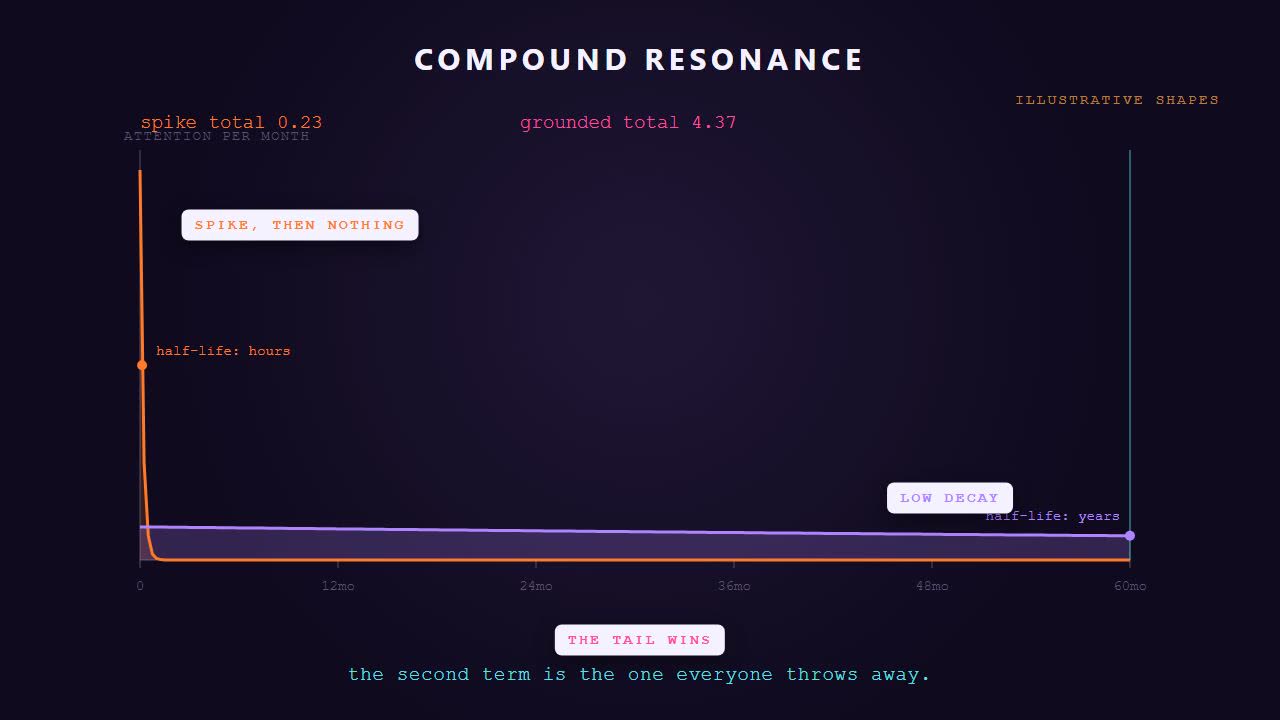
The correct vocabulary for what this framework actually means comes from decay processes: decay rate, half-life, and effective horizon. A post about today's news has a half-life measured in hours, meaning its attention stream falls by half in that span and is effectively zero by the next day. A piece grounded in a recurring human predicament has a half-life measured in years. Same total published, wildly different integrals.
Both objects can be stated precisely, which is worth doing once so the distinction stops being blurry. Under exponential discounting the effective horizon implied by γ is roughly 1/(1 − γ) steps, so γ of 0.99 corresponds to caring about something like the next hundred steps. If you want the point at which the weight has fallen to some fraction ε of the present, solve γT = ε, giving T = ln ε / ln γ, which is a half-life when ε is one half. Those formulas govern the agent's weighting. The content's own decay is a separate curve that the practitioner is choosing when they choose what to write about.
With the vocabulary straight, the actual claim gets sharper. The safety guide about the flower generated an unremarkable amount of traffic on publication day, and a strategist scoring it on that number would have written it off. The plant is not going away. The compound is not going away. Human susceptibility to being socially engineered through chemistry is not going away. So every person who goes looking for that information over the next decade finds that piece, and it is still accurate, and it still lands, and each of them arrives with a slightly higher prior that the next thing from the same source is worth reading. Trust compounds the way interest compounds: imperceptibly, then all at once, across everything published afterward. That second effect is the one publication-day metrics cannot see and the one worth optimizing.
Incompressible meaning, and the cost of translation
In the Navier-Stokes equations, incompressible flow has a precise definition: the velocity field is divergence-free, written ∇ · u = 0, which says volume is conserved locally and no fluid element gets squeezed or expanded. The common misreading treats this as a claim that the substance cannot be compressed. It is not. Water is slightly compressible. Incompressibility is a modeling assumption that density changes are negligible for the speeds and pressures in play, and it is adopted because it makes the mathematics tractable, not because the universe promised it.
Vladimir Arnold's 1966 result is what makes the borrowing more than wordplay. He showed that ideal incompressible fluid flow traces geodesics on the infinite-dimensional group of volume-preserving transformations, which is to say the flow follows the shortest available path through a particular abstract space. Apply the Hamilton-Jacobi-Bellman machinery to that same space and the incompressible Navier-Stokes equations fall out. The optimization vocabulary and the flow vocabulary turn out to describe one structure rather than two, which is why using both in one framework is less arbitrary than it looks.
Now the media claim, stated carefully. Information compresses cleanly and meaning does not. Take the line about the port city in the cup. The information compresses to one clause: a rapper compared his drink to a blockaded harbor. Every fact survives. What does not survive is the felt experience of a generation folding a naval blockade into their party music because grief had not finished happening yet and the cup was the container available. The summary keeps the data and kills the signal.
That failure mode has a name in production now, and it explains something people notice without being able to diagnose. Language models compress human expression toward a statistical middle. The middle is where the information lives, so the output is accurate, grammatical, and inert. The average of every human voice is no human's voice, which is why competent machine-written text so often reads as correct and dead at the same time, and why the reader's complaint is never that it is wrong.
Viscosity is the second piece the fluid vocabulary contributes, and it is a real cost rather than an aesthetic one. Viscosity here is the friction meaning encounters when it moves between audiences. The line about a friend's father hunting orcs is frictionless for a Ukrainian listener, who catches both the game reference and the wartime slang instantly and simultaneously. For an outsider the same line has enormous viscosity: it needs several paragraphs of explanation to transmit what a local receives in three seconds, and by then it is a fact rather than an experience.
The strategic consequence is the useful part. A frictionless model of the world says translate the work and publish it everywhere. A model that prices viscosity says the translation cost for this particular piece exceeds what the meaning can survive, so find the object that has zero viscosity for the new audience and activates the same primitive. That is a completely different instruction, and it is the difference between a global content strategy that works and one that produces respectful, well-translated, universally ignored material.
Superposition, and why order is an operator
The third borrowing is the one most likely to be abused, so the disclaimer goes first. Nothing here claims that audiences are quantum systems. What is claimed is that when a bounded observer models a system larger than itself, the formalism developed for superposition turns out to be a useful description of the resulting uncertainty, and two of its properties transfer.
The first is superposition itself. Consider a track title built on a word that means faithful, loyal, true, and correct at once, attached to a "they" the song never specifies. Three readings run simultaneously. The thoughts in my head are lying to me. The people around me were not loyal. The story being told about who I am is factually wrong. Every listener holds all three until their own history collapses it into one.
Conventional segmentation forces that collapse in the planning meeting. Decide whether this is a mental-health piece, a betrayal piece, or an identity piece, pick the audience, optimize for the chosen reading. Collapsing early destroys the other channels. Holding the superposition reaches all three with one artifact, because the content acts as the measurement and each reader collapses it through the door their own experience opens. The practical rule is narrow and worth stating plainly: leave the referent genuinely open when all the available readings are true, and never when the ambiguity is just vagueness wearing a costume.
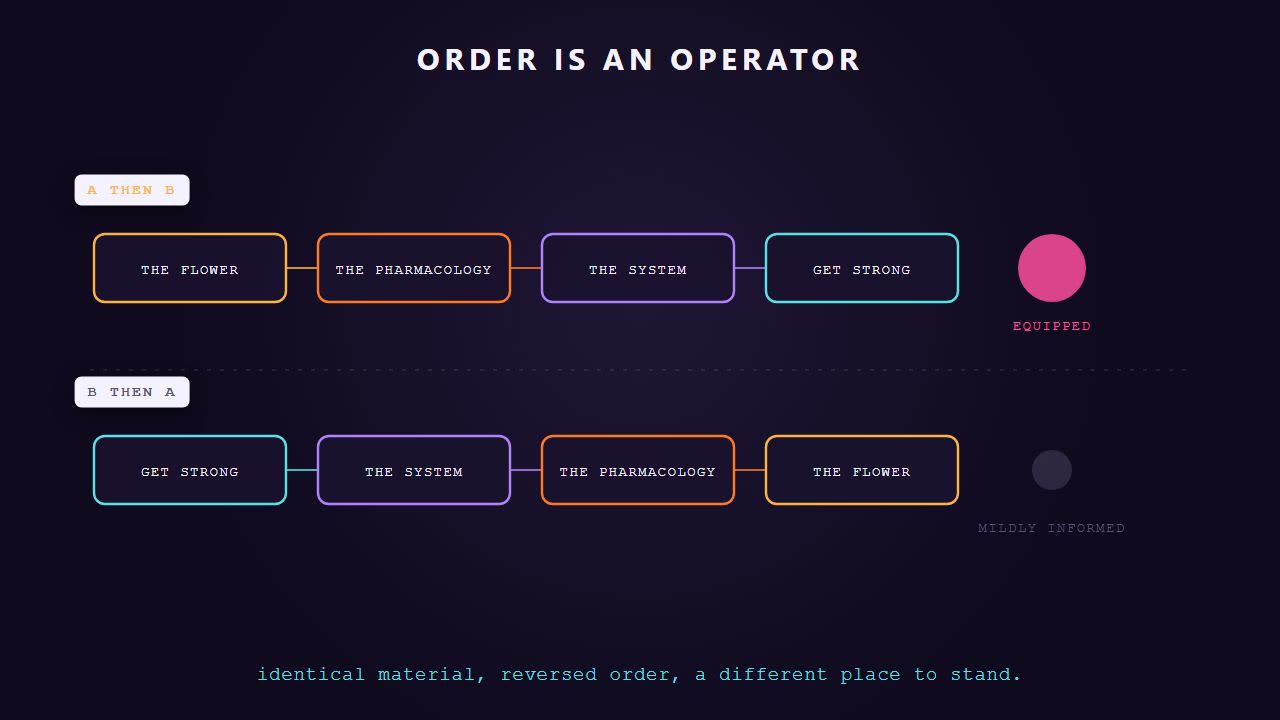
The second property is non-commutation. Some operations produce different results depending on the order you apply them, so that AB and BA are not the same thing. Narrative sequence behaves that way. The safety guide runs flower, then pharmacology, then institutional failure, then the reader's own exposure, then a philosophy of strength. Reverse it. Open with the philosophy, then the exposure, then the institutions, then the chemistry, then close on a pretty plant. Every fact is identical. The reader who took the first route ends up equipped. The reader who took the second ends up mildly informed and slightly confused about why the flower was mentioned.
Sequence is an operator that determines where the reader lands, rather than a presentation layer laid over a fixed argument. Which means the running order of an argument is a design decision with consequences, and it deserves as much attention as the argument itself.
None of these three make a piece good. Craft and having something true to say do that. What the borrowed structure explains is why a piece that already works keeps working, why it transfers across some cultural boundaries and not others, and why any of it can be produced deliberately instead of stumbled into a few times a career.
Why resolution beats demographics
The same piece, three different readers
A General does not read the same way to everybody. It lands differently depending on where a reader sits developmentally, running from concrete and action-oriented, through strategic and pattern-recognizing, to systems-thinking and cross-domain.
Take one track and three listeners. The concrete listener hears a banger about drugs and partying, enjoys it, and moves on with something real: the energy of being young and refusing to be quiet. The strategic listener hears a generation processing impossible choices through ironic distance, and recognizes the mechanism because they have used it themselves. The systems listener catches the eleven-word joke between choruses, traces it back through a surrendered nuclear arsenal and a broken security guarantee, and hears the whole geopolitical betrayal compressed into a punchline.
Same three minutes. Three genuinely different experiences, and none of them interferes with the others, because the depth is layered rather than segregated. That is the property most content strategy gets wrong. Writing "for the smart reader" loses the first two. Writing "accessibly" loses the third and usually insults the second. Layering costs more attention at the design stage and reaches all three with one artifact.
One song, eight doors
Three readers separated by developmental depth is the easy version of that claim, because all three share a culture. The harder test holds the piece fixed and changes the reader's entire identity, and the counting-rhyme track from the earlier sections is a good instrument for it. Nothing on its surface is available to an American listener. The language is opaque, the counting rhyme is not theirs, the political reference between the choruses assumes a treaty most people outside the region have never heard of, and the two city names that compress a generation's displacement into four syllables are just two city names.
It translates anyway, and it translates through eight different doors. What follows is the same three minutes read by eight American audiences who agree on almost nothing.
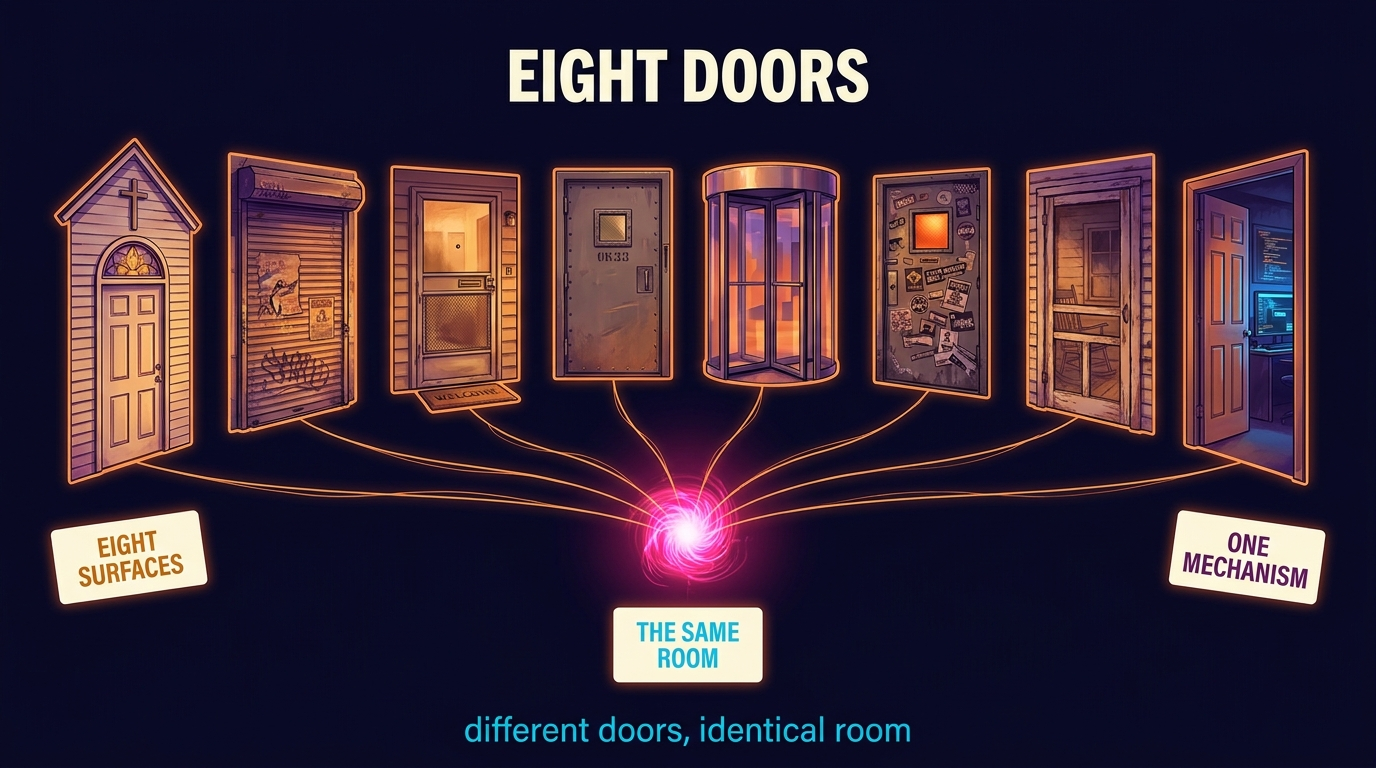
Eight subcultures, eight surface translations, and one stable layer underneath all eight. The counting rhyme works as a universal container for arbitrary selection. The hustle works as the universal response to conditions you did not choose. The call for help works as the universal signal that a threshold has been crossed. None of these eight readings is a misreading, and none of them has to be corrected before the next one can happen.
The operating conclusion sits in the gap between two kinds of reason. The conscious reasons those eight listeners give are cultural. The unconscious reasons they respond at all are human. A demographic segmentation captures the first set perfectly and predicts nothing, because it is sorting on the layer where the eight audiences genuinely differ. This is the practical case against writing eight pieces for eight segments: the eight already share the thing that makes any of them care, and the work of reaching all of them is finding it once rather than translating a surface eight times.
Eighty-one against fifteen
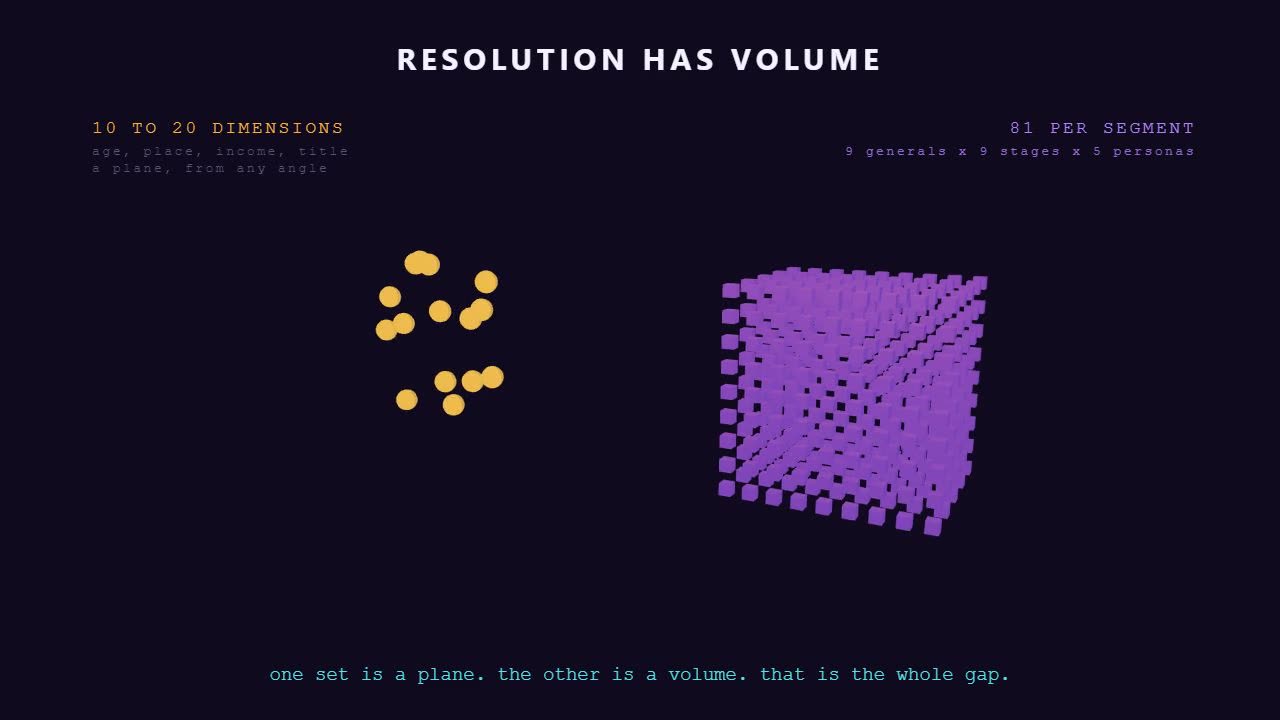
Nine Generals crossed with nine developmental stages produce eighty-one cells of depth for a single audience segment. Run that across a handful of personas and the intelligence surface reaches into the hundreds of distinct elements. Most content is aimed using ten to twenty dimensions of surface demographic data: age, location, income, job title, maybe some behavioral signal from a tracking pixel.
Eighty-one against fifteen is not an incremental improvement, it is a different instrument. Picture a doctor who checks your temperature against one who runs a full blood panel, a cardiac workup, and a genetic screen. Both are practicing medicine. Only one reliably finds what is actually wrong. Most content is invisible because it was produced at fifteen dimensions of understanding and aimed at a species that runs on considerably more.
What the number is, and what it is not
One caution, because a confident number invites more weight than it can carry. Eighty-one is the size of a taxonomy, not the output of a measurement. Nobody has validated an instrument that scores a reader on nine primitives across nine stages and produces a reliable coordinate. The developmental stages come from Spiral Dynamics, which has never been applied to marketing at production scale and carries its own methodological baggage.
So the claim is comparative rather than absolute. It says that a practitioner who asks which primitive is firing, at what developmental depth, for which specific person, generates better questions than a practitioner sorting by age and postcode. That comparison holds regardless of whether eighty-one turns out to be the right count. Rule twenty-one of this project forbids thresholds picked out of the air, and it applies to a framework's own favorite number as much as to anyone else's.
From model to machine: producing the nine percent at scale
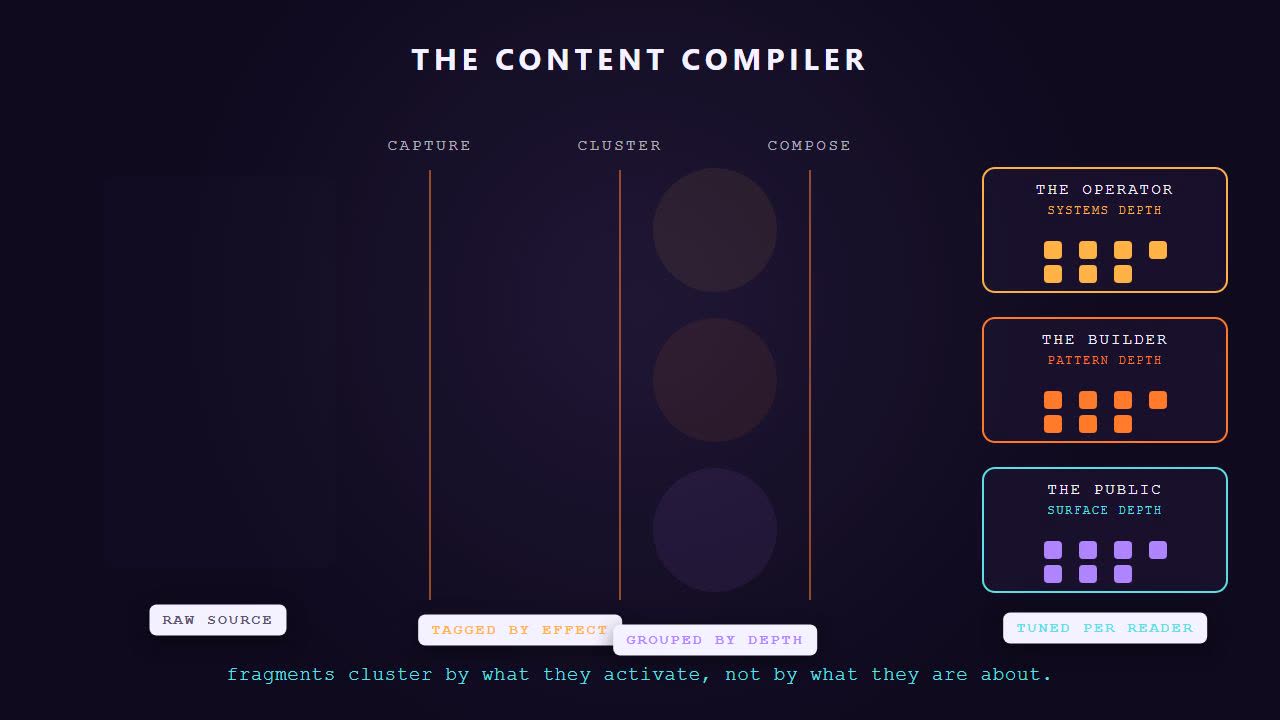
A model that only lives in an essay is a mood with footnotes. This one runs as a pipeline, and the analogy in its name is structural rather than decorative. A content management system stores documents and lets humans sort them into folders. A compiler transforms source into optimized output for a target architecture. GCC takes C and produces machine instructions for a specific processor. The Content Compiler takes raw human experience and produces work aimed at a specific reader, at a specific depth, on a specific surface.
What actually goes in
Worth being concrete about the input, because "raw source material" sounds tidier than the reality. A representative file is four hundred and seventy lines long. The first forty are a question typed into a chat window at two in the morning asking whether the trumpet-shaped flowers used for drugging people are real. The next three hundred and fifty are the finished six-thousand-word article. The last eighty are a voice transcript recorded on caffeine and the manic clarity that follows a breakthrough, with no paragraph breaks, considerable profanity, and sentences that begin in one country and end in another.
That file is ore rather than a draft. And the thing worth noticing is that the transcript at the end contains connections no structured interview would have produced, because nobody asks a question whose answer is a spontaneous link between plumbing in one country and an economic pattern in another.
The eight passes
Each pass does one job and hands its output to the next, which is exactly how an optimizing compiler is organized and for the same reason: a single traversal trying to do everything degrades everything.
The writing pipeline, and the pass that separates competent from resonant
Pass six has its own eleven steps, and the first four are research: find where demand actually sits, map who currently answers it, locate the structural gaps, and read the competition properly. Steps six through eight verify what steps one through four identified, which means a piece does not ship until the gaps it was written to close are closed. Step nine writes the research back to a persistent graph so the next piece starts from accumulated intelligence rather than from zero, which is the compiler's symbol table surviving between runs.
Step ten is the formatting pass, and it is deliberately separate from the writing. Prose first, structure second, because you cannot know what wants to be a table until the pattern is visible in the paragraphs. The target is roughly three to five bold elements per four hundred words, with the constraint that reading only the bold text has to tell a coherent story. Anything longer than three hundred words gets subheadings. One structural element every couple hundred words, never a bare label introducing it.
Step eleven is where the interesting thing happens. Steps one through ten produce an article that is researched, verified, structurally sound, and correctly formatted. It will rank. It will answer the question. It will not make anybody feel that the writer sees something they cannot. The last pass adds two or three cross-domain connections that only this particular voice would make, and the test for whether one belongs is mechanical: remove it, and if nothing is lost, it was decoration. Technology to psychology. Infrastructure to biology. Fluid dynamics to the question of why most content is never read.
Why it writes in short passes
One constraint inside pass six is worth stating because it looks like a preference and is not. Generation happens in sections of no more than fifteen hundred words, each reviewed before the next begins. The reason is a measurable degradation: language model output quality drops after roughly two to four thousand tokens of continuous generation. Sentence variety collapses, vocabulary narrows, bullet points multiply, and relevance to the original argument drifts.
The failure is invisible from inside the generation. Nothing announces that the second half got thinner, which is precisely why the constraint has to be structural rather than a matter of paying attention. It is the same reason a compiler runs bounded passes instead of one enormous traversal, and the same reason this article was written in fourteen of them.
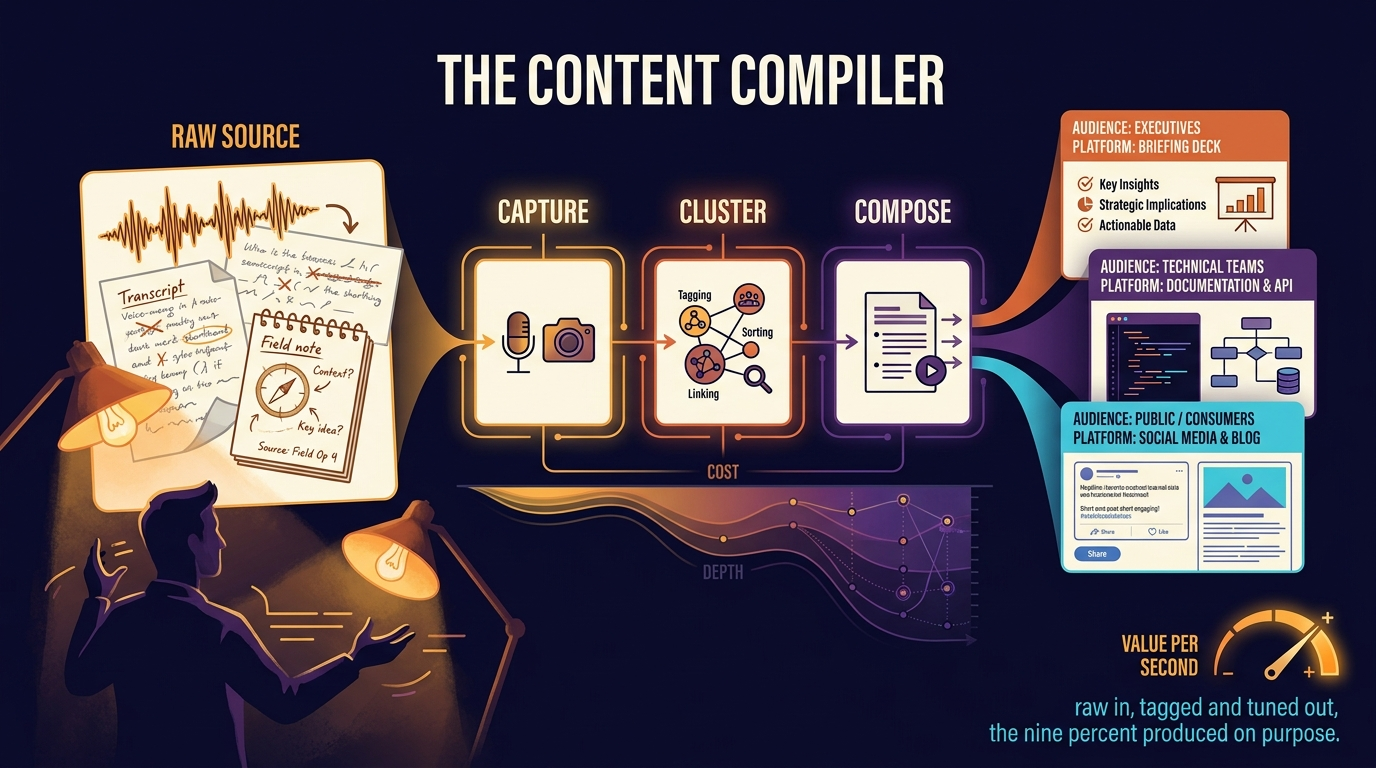
Four surfaces, one engine
A framework that has only ever been applied to essays has not been tested. Four production systems run on this one, and each stresses a different claim.
Ingestion, and distribution by engagement physics
The first system is the compiler described above, proven on the least glamorous material available: equipment manuals, firmware notes, and dealer bulletins for survey hardware, processed under a real deadline for a client who needed searchable answers when a customer called. Nothing about that work is romantic, and that is the point. Architecture that survives a PDF extraction breaking at two in the morning before a deliverable is due has been tested in a way speculative development never manages.
The second routes compiled work to platforms. The insight worth carrying is that platforms differ in which primitive their engagement physics actually reward, so the same underlying material should not arrive the same way in each. Nostalgia performs where the format is visual-first and the interaction is saving and sharing. Catharsis performs where short video permits raw expression that longer formats sand off. Respect performs in professional contexts precisely because the audience's filters there are tuned to detect self-promotion, and acknowledging somebody's actual operating reality slips past a filter built for pitches.
One insight about a technical specification and its financial consequence routes three ways from a single compilation: the old instrument beside the new one for the nostalgia channel, the sixty seconds where the signal dies and the work stops for the catharsis channel, and the operational reality nobody writes about in trade publications for the respect channel. That is a routing table, not a content calendar.
The proposal, which is the hardest test
The third system is where the model earns the most, because it runs in an adversarial context. A blog post has a willing reader. A feed post has somebody idly scrolling. A proposal has a skeptical evaluator who has read fifty others that morning and is actively looking for a reason to stop reading yours.
The keystone move applies directly and the mapping is exact. The proposal opens with a specific observation about the prospect's operation, not their company name and not a restatement of their posting. Something non-obvious that could only have been noticed by somebody who actually looked. That specificity is the innocent thing, and the guard drops because the signal says this person paid attention rather than this person wants something. Then the observation gets connected to a pattern that reframes the problem at a level below the one they described. They asked for a dashboard. The proposal names the bottleneck upstream of the dashboard and the industry-wide habit of building displays on data that cannot support them, which produces expensive tools showing unreliable numbers.
The connection between the two is the door, and the prospect walks through it into a reframing of their own situation that makes the sender the obvious choice. Not because of credentials or rate. Because nobody else in the pile demonstrated understanding at that depth.
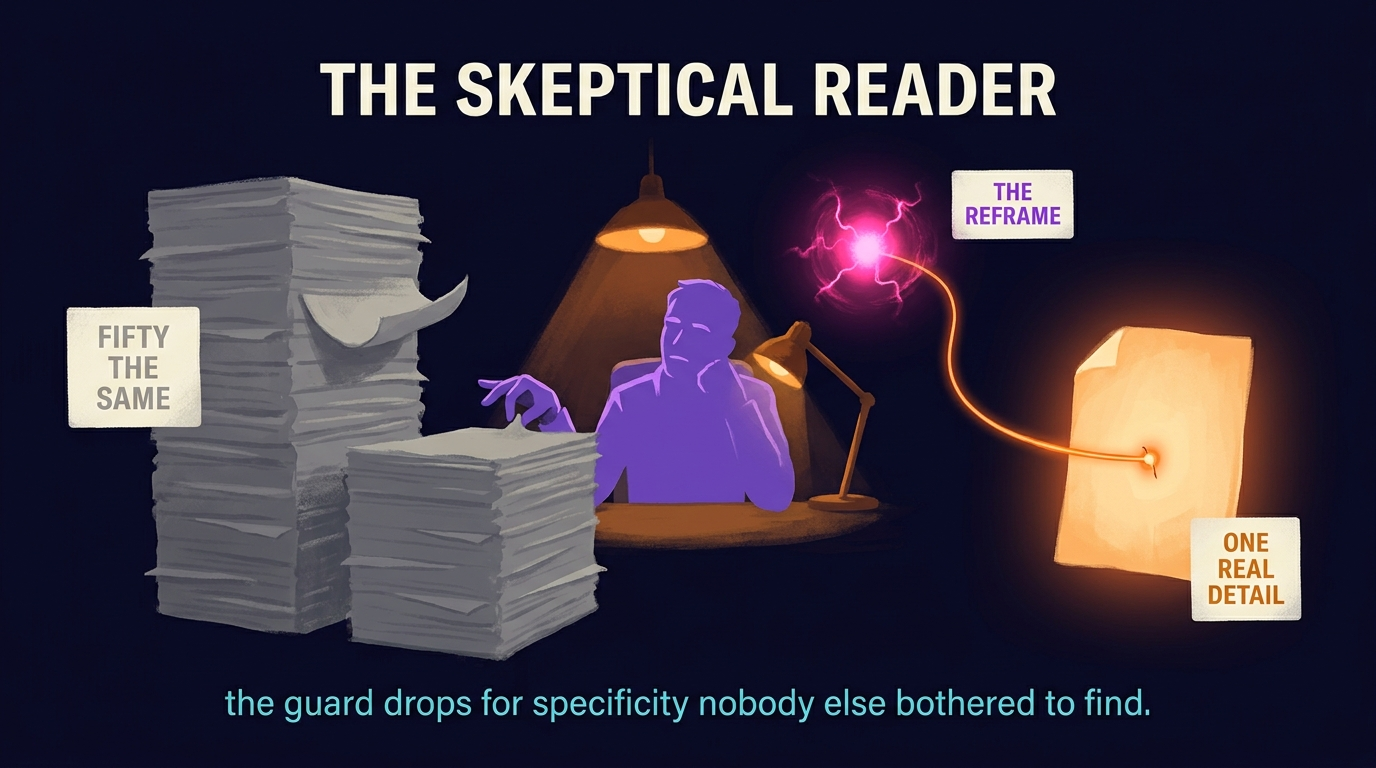
This is the deployment that proves the mechanism is not a literary effect. If the keystone move only worked on willing readers, it would be a craft technique for essays. It works better under hostile evaluation than under friendly reading, because the contrast against fifty generic pitches makes genuine specificity register harder than it would anywhere else.
The graph that remembers
The fourth system is memory. When a piece connects a predation scheme on one continent to a song on another, that connection exists as prose, which means it exists only for a human who reads the prose and only for as long as they remember it. The knowledge layer encodes it as a typed relationship between entities, with the time it was identified and the context that produced it.
What that buys is retrieval of depth rather than topic. An agent producing work about equipment accuracy queries the graph and gets back the relationships that accuracy sits inside: liability, insurance, project delay, professional reputation, the cost of the machine sitting idle. It does not have to rediscover the innocent-to-true connection, because every previous piece that crossed that territory left the connection behind as data.
That is also the part a competitor cannot copy by reading the output. The passes can be described, and this article just described them. The accumulated graph is the residue of specific work done over years in specific places, and re-deriving it requires doing the work.
The uncomfortable math
Two industries sit on either side of this problem. One researches what people want. The other produces material aimed at them. Neither has built the bridge between the two, and the gap is where all the value has been sitting.
Market-size figures for both get quoted constantly and deserve suspicion. The closest thing to an authority on research-industry revenue is a trade body compiling self-reported numbers from its own members, which makes the total directionally useful and precise to nothing. Forecasts for generative content tooling are worse, since no two vendors define the category the same way and the spread between credible estimates runs several-fold. Both industries are large. Any specific figure you see, including any I might have quoted, is an estimate wearing the clothes of a measurement.
What the nearest competitors actually hold
The nearest thing to a direct competitor builds psychological profiles of audiences and uses them to drive engagement. Its profiles come from questionnaires administered to panels. That is a real capability and it captures a real thing, and it captures what people report about themselves, which is a different dataset from what people do when they believe nobody is counting. Years of watching people in bars, at conferences, in unfamiliar countries, and across a decade of nightlife work produce the second dataset. Neither substitutes for the other, and only one of them scales cheaply, which is exactly why the expensive one is the moat.
Other adjacent efforts hold one layer each. Culturally-aware systems research produces peer-reviewed papers rather than shipped work. Audience-segmentation vendors model what a segment did last quarter without addressing why. Search-and-social mapping tools operate at the same ten-to-twenty demographic dimensions everything else does. Moral foundations research has been tested for marketing application, and the researchers themselves described it as a first attempt. The frameworks exist in journals. None of them became a production pipeline.
The moat is integration, not secrecy
Nothing in this article is secret. The passes are described above in enough detail to reimplement. The primitives are named. The equations are borrowed from public mathematics and the studies are all published.
What is difficult is that each layer requires the ones beneath it. Ethnographic depth requires years in places, and the anthropologists who have it do not build pipelines. The mathematical convergence requires understanding an intersection that few people work in, and those people do not have ethnographic training data. Graph infrastructure requires engineers who lack the audience model to populate it. Agent orchestration requires builders who lack the graph. Every layer is individually achievable and the stack is the hard part, which is a considerably less flattering claim than a secret and a considerably more durable one.
Three gaps, stated as gaps
Being precise about what is built and what is merely specified matters more here than anywhere else in this entry, because this is the section where a framework is most tempted to describe its roadmap in the present tense.
The speculation-to-capability gap is closed. Artifacts exist: the extraction files, the graph with its tens of thousands of nodes and edges, the shipped articles, and the analysis that predicted structure in work the system had no hand in creating, by a creator on another continent who does not know this framework exists.
The capability-to-execution gap is open and is engineering rather than research. Some systems are deployed, some are building, some are specified. The architecture is settled and the implementation is partial.
The execution-to-value gap is the widest and the most consequential. Pass eight, the feedback loop where measured response updates the calibration, is not yet automated. Until it is, the model improves at the speed a human notices things rather than at the speed the data arrives, and every claim about compounding intelligence is a claim about a mechanism that has been designed and not yet switched on. Naming that plainly costs nothing except the pleasure of overstating.
Where the model missed
A framework with no recorded failures has not been tested, it has been marketed. This one broke in a way the model could not see coming from inside itself, which is the only kind of failure worth writing down.
The prediction
An essay was written in the voice of a twelve-year-old girl in Kyiv, carrying four hundred years of inherited conflict and a grandmother's line about being the generation that can break the wheel. It maps every historical precedent for reconciliation between peoples who looked condemned to permanent hatred. The French and the Germans, who killed each other over a few kilometers of mud at Verdun and whose grandchildren now study at the same universities. Japan and the United States after Pearl Harbor and Hiroshima. Rwanda, where the reconciliation is imperfect and painful and ongoing and real. It closes on a five-phase path across forty years that arrives at functional cooperation rather than love.
The model predicted that piece would activate all seven confirmed primitives simultaneously and produce maximum resonance across cultural boundaries. Structurally the prediction was correct. Readers from many backgrounds reported being moved.
What actually happened
Readers inside active combat zones and under occupation did not experience Desire the way the model said they would. They experienced the vision of a reconciled future as premature, and as a kind of well-meaning violence: an invitation to imagine forgiveness while the missiles were still landing on their cities.
The model had made an assumption nobody had noticed it was making. It treated a primitive as reading roughly the same way at a given developmental stage regardless of the reader's circumstances. That is false. For a reader in a survival state, Desire for peace reads as naivety unless justice comes first, and reconciliation offered without accountability reads as surrender wearing a friendlier word. The essay actually contained that acknowledgment. The model's prediction did not weight it anywhere near heavily enough, because the eighty-one-cell grid has no dedicated cell for an audience whose immediate survival is in question.
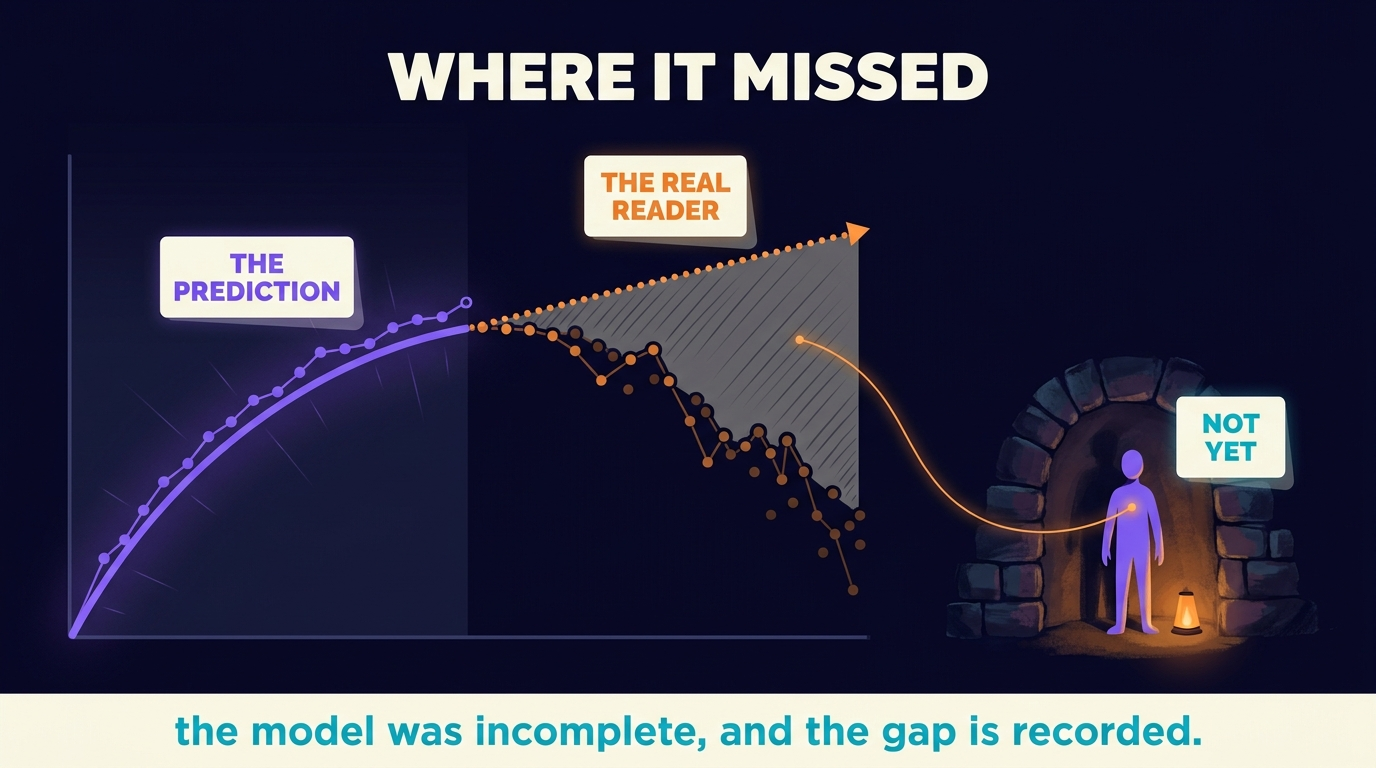
Incomplete, not wrong
The distinction is worth defending because it is easy to abuse. A framework that responds to every disconfirmation by declaring itself incomplete is unfalsifiable and worthless. What separates this case is that the failure produced a specific, named, testable amendment: context state, and particularly survival state, modulates how a primitive reads, and the model has no representation of it.
Two things follow. The first is that this is the natural first test case for the feedback loop in pass eight, whenever that gets built, since it is a documented prediction with a documented miss and a hypothesis about the cause. The second is a practical instruction that generalizes past this one essay: before offering anybody a vision of the future, check whether their present is stable enough to receive one. Desire is the primitive most likely to insult somebody when it is deployed at the wrong moment, and the wrong moment looks identical to the right one from the outside.
Value per second, and what it costs to fake
One metric governs the whole thing. Value delivered per second of a reader's attention, measured against what that reader would otherwise have done with that second. Not word count. Not posting frequency. Not keyword density. Not engagement rate, which measures whether attention was captured and says nothing about whether it was repaid.
Every one of those proxies can be satisfied by work that fails the actual test, which is what makes them dangerous rather than merely imperfect. A piece can hit its word count, post on schedule, rank for its term, and hold a reader for four minutes while returning them nothing they could use. That is the mechanism by which enormous quantities of technically competent material become invisible. It never failed a metric. It failed the reader, and the reader is the one who decides whether anything from that source gets opened again.
Anti-slop and anti-scam
The positioning that falls out is narrow and makes the right enemies. Most published work is invisible noise, and a growing share of the remainder is actively deceptive. An operation that fights both at once is an ally to everyone who has been insulted by content that wasted their time or by a product that lied about what it would do. The enemies that creates are exactly the ones worth having.
Anti-scam belongs in the same sentence as anti-slop for a structural reason rather than a moral flourish. Both are failures of the same exchange. Slop takes a reader's attention and returns nothing. A scam takes their attention and returns something worse than nothing. The mechanism this entire framework describes is powerful precisely because it lowers a reader's defenses, so a practitioner who uses it without accepting the constraint is building a better scam. That is why the value-per-second metric is a governor rather than a slogan.
What the research says about the machine-written half
Since a large share of new material is now machine-generated, the obvious question is whether readers can tell and whether they care. The evidence is genuinely mixed and worth reporting accurately rather than in whichever direction flatters the argument.
In blind comparisons, machine-generated text sometimes wins. Readers have rated machine-written news summaries above journalist-written ones on readability and structure. Controlled marketing tests have found participants preferring machine-generated copy to professional human copy. Search performance studies find little ranking difference when quality is held constant. Anybody claiming that people simply prefer human writing is arguing against the data.
The finding that holds is about labels rather than text. When identical content is labeled as machine-generated, trust drops and sharing intent falls. One study measuring the effect of the label alone found a preference shift toward the human-labeled version of the same words. Other work finds human-generated content scoring higher on trust and engagement in contexts where authenticity carries weight.
Which lands somewhere more uncomfortable than either camp wants. The machine can clear the competence bar. What it has trouble with is the thing this framework is about, which is the specific rather than the average: the observation that could only come from having been somewhere, the connection nobody else would make, the willingness to say the thing that costs the writer something. Compression toward the middle produces the middle, and the middle is where readers have learned to stop paying attention. That is not an argument against using the tools. It is an argument about what has to survive the tooling, and it is why the last pass in the pipeline is the one that adds what only this voice would say.
What the evidence has in common: every case is a cycle
Everything in this entry so far has been mechanism: the two layers, the door, the strata, the primitives, the borrowed equations, the pipeline. Mechanism explains how the work is built. It does not explain why these particular pieces of work keep showing up in the evidence pile while technically similar pieces do not.
Line the cases up and the answer is uncomfortably simple. Every one of them describes a cycle, and every one of them carries a mechanism for breaking it. Not a topic in common. A structure in common.
Four cycles and four exits
The predation cycle. A criminal economy that runs on a plant, in which chemistry so precise it removes the victim's capacity to refuse turns a traveller into a compliant participant in his own robbery. The cycle sustains itself on shame, because a victim who cannot explain what happened without sounding complicit does not warn the next one. The exit is not vigilance and it is not willpower. It is systems that do not depend on a person's judgment at the moment their judgment has been chemically removed, and it is knowledge distributed widely enough that the attack becomes recognisable before the glass is on the table.
The imperial cycle. A neighbour with fifty times the military budget invades under the language of brotherhood, having spent generations establishing that the smaller country's language was a dialect and its identity a costume. The exit runs through the amputation described earlier, and then past it into something the ban alone would never have produced: a cultural renaissance in which musicians who worked in the imperial language switch, and the switch operates as reinvention rather than translation. The point was never to replace the banned catalogue with an equivalent one. It was to build something that had not existed.
The substance cycle. A twenty-one-year-old pours pharmaceuticals into his own cup because the environment around him is that poisonous, and makes party music about it in a flat cadence that treats nuclear brinkmanship and childhood dumplings with identical affect. Read quickly, that is a young man documenting his own decline. Read properly, the flatness is the exit. When every available register for describing the situation has been exhausted by people who are lying, ironic distance is the last psychologically honest position left, and the refusal to process a catastrophe in the emotional register the catastrophe is supposed to demand is itself the break. The counting rhyme still counts. But the song exists, and the song is the proof that the counting did not finish the job.
The saturation cycle. The one the reader is standing inside. Ninety percent of what gets published is never seen, because an entire industry optimises for the churning surface layer of formats and signals while ignoring the stable layer underneath, and each participant's response to being unseen is to publish more, which deepens the saturation that made them invisible. The exit is the whole subject of this entry, and it is worth being blunt about how modest it is: understand the layer, aim at it deliberately, and accept that the instrument for doing so is a taxonomy rather than a measurement.
The Generals, read again
Put the cycle frame next to the primitives and the primitives stop looking like a list of feelings to induce. Each one is the emotional signature of a specific move against a cycle.
Catharsis lets a person feel the weight of the cycle and sets it down, which is why permission rather than comfort was the right word for it earlier. Righteousness supplies fury at whatever maintains the cycle, and stays useful only while it is pointed at the mechanism rather than at people. Nostalgia holds the memory of what existed before the cycle consumed everything, which is why the counting rhyme has to be a real childhood object before it can be anything else. Desire shows what could exist after the break, and the earlier failure case is the standing warning about deploying it too early. Respect establishes that being caught in a cycle is not a moral failing, which is the precondition for a reader accepting any of the rest. Regret carries the accounting of what the cycle cost and turns generative the moment it redirects from the past toward what happens next. Curiosity drives the investigation of how the cycle works, because a mechanism nobody has examined cannot be dismantled.
That reading also explains the two unnamed primitives better than the earlier section could. Whatever they turn out to be, they will be moves against cycles that the confirmed seven do not address, and the war-zone miscalibration described in the failure section is the clearest available evidence that at least one such move exists.
Why this is the closing argument
Cycles are the most universal thing available. Every culture has them, every person is inside several, and no amount of platform churn touches the structure. The wish to get out of one is about as close to a human constant as this entry is willing to claim. A framework built on trends expires with the trend. A framework built on the shape of being stuck does not.
Which is what makes the twelve-year-old's letter the right closing image for the evidence rather than the war footage. In it a girl in Kyiv inherits four hundred years of a conflict she did not start, and a grandmother tells her in a bomb shelter that hers is the generation that can break the wheel. The letter then does the unglamorous thing: it goes looking for precedent. France and Germany, who killed each other over the same ground for centuries and now share universities and grandchildren. Japan and the United States. Rwanda, where the reconciliation is partial and painful and ongoing and nonetheless exists. It ends on a five-phase path measured in decades, and it is careful never to promise love. Functional cooperation between neighbours who share a history and have no choice about sharing a future is the whole of what it offers.
That is a piece of content doing every single thing this entry has described. An innocent thing that opens the door, a true thing on the other side, primitives firing in a deliberate order, respect established before anything is asked, and a break that is named at a scale honest enough to be believed. The wheel has turned for four hundred years. Enough. It ends with us. Whether or not it does, that is what the structure sounds like when somebody finds it without a framework, which is the only reason the framework is worth writing down.
Run it on your own experience
The framework is not abstract, and the fastest way to see that is to run it on yourself. Think of the last piece of content that genuinely moved you. Not one that impressed you or informed you. One that moved you, that made you stop scrolling or sit in the car after the song ended because you were not ready to walk inside yet.
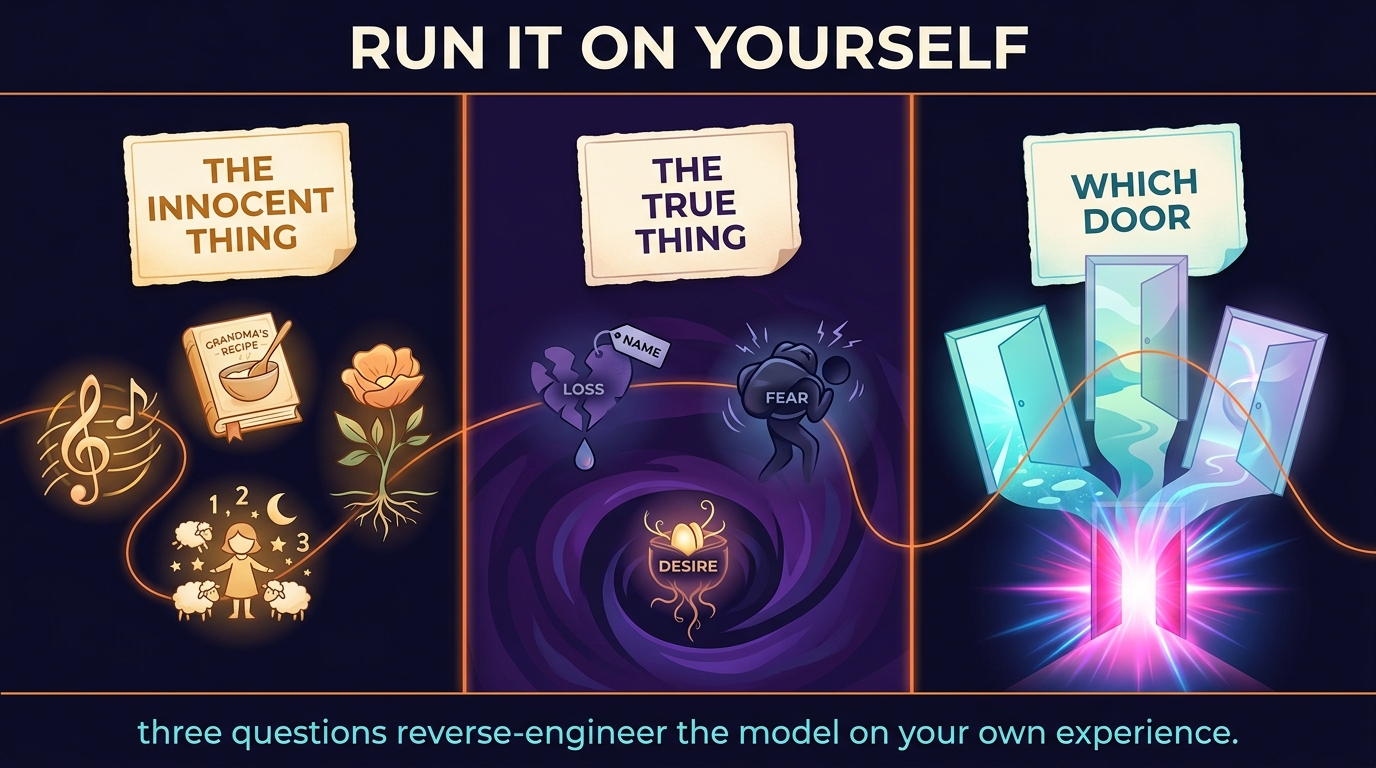
Ask what the innocent thing was. What familiar, safe, culturally loaded object did it open with. A melody, a childhood memory, a counting rhyme, a grandmother's recipe, a flower in a garden. Ask what the true thing underneath was. What the innocent surface connected you to: a loss you had not named, a fear you had been carrying, an anger you were told was inappropriate, a desire you buried because chasing it meant admitting the present is not enough. Then ask which door you walked through. Not the door the creator intended. The door your own experience opened, the reading that became primary because of what you brought with you.
Identify all three and you have reverse-engineered this entire framework on your own experience. The reason that works is that the framework was reverse-engineered the same way, from work that already landed, by somebody trying to understand why.
Then run it on something you are about to make
The diagnostic version is easy. The productive version is a different exercise, and here is the short form of it, in the order the passes run.
What this entry is claiming, one more time and plainly
Since the article is long and a caveat is easy to lose inside a long article, the summary below is the version a skeptic would accept.
Well supported: a mechanism runs underneath media that resonates, in which an innocent surface carries a payload past defenses that were not built to stop it, and that mechanism turns up independently across creators who share nothing. Nostalgia does the psychological work described here. High-arousal states drive sharing. Transportation reduces counterarguing. Meaning does not survive compression the way information does. Sequence changes outcomes.
Working hypothesis, unproven: that the mechanism is materially rarer in work that fails than in work that succeeds. The evidence for that is convergent and selected on success, and the study that would settle it has not been run by anybody including me.
Taxonomy rather than discovery: the nine primitives and the eighty-one cells. Useful for organizing attention, revisable, and two positions deliberately empty.
Borrowed structure, not physics: all three sets of equations. They describe properties of media that looser vocabulary keeps missing. They do not govern anything, and the section on each one says where it breaks.
Known incomplete: a primitive does not read the same way for a reader whose survival is in question, and the framework has no representation for that state. It cost a prediction and it is recorded rather than smoothed over.
The tools for producing work this way are not scarce. Everything named in this article is public, purchasable, or describable in a few paragraphs. What is scarce is the willingness to find the true thing before writing the door, and to keep asking whether the thing on the far side was worth the reader's trip. This entry exists to make that learnable, so that the small share of work which actually reaches somebody stops being an accident.