
Most brand voice work ships in the form of a tone-of-voice document. Forty pages, written by a strategist, read once at onboarding, then forgotten. Ten months later, three different writers are producing the surface and you can tell which writer wrote which page from across the room. The document existed; the system did not. Brand voice failed because nobody designed it as something a different person could ship and someone could later check.
Brand systems is the alternative. Voice gets decomposed into three load-bearing components, each one with explicit rules and an audit method. The components compose so the same voice survives across surfaces, across writers, and across years. The system is not the document; the system is the rules plus the audit. The document is just where the rules are written down.
Three components · register, vocabulary, mythology
Brand voice is not a tone. Tone is the output the reader experiences. The input is three components that produce the tone consistently. Treat tone as the output and you can engineer it. Treat tone as the input and you are stuck describing it with adjectives.
Register. The mode the writing is operating in. Andy's site has three: DEFAULT (the canonical wiki entry, structured, thorough), CASUAL (the homepage, the field note, the chat surface, conversational with permission), PUBLIC (the press surface, the cold-traffic landing page, more reserved). Each register has its own grammar, sentence-length distribution, and emotional bandwidth. A piece is locked into one register from the first sentence and does not bounce between them. The reader knows within ten seconds which register they are in and the experience makes sense.
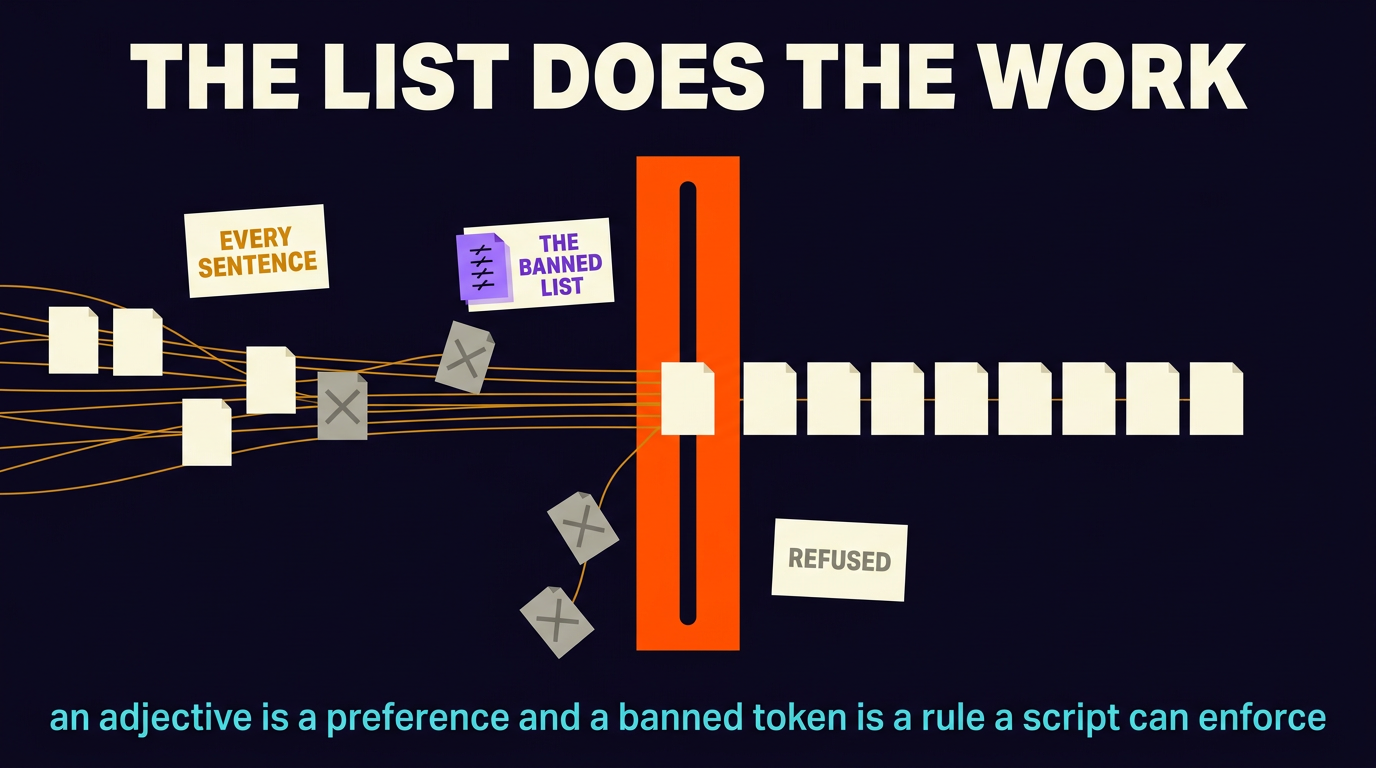
Vocabulary. The list of words and phrases that are explicitly allowed, explicitly banned, or explicitly required for certain concepts. The list is short and load-bearing. Andy's banned list includes em dashes, the not X. it's Y pattern, performative announcements, and a roster of AI-tell vocabulary (delve, leverage, utilize, holistic, streamline, empower, transform, robust, comprehensive). The banned list is the part most operators skip and the part that does most of the work. Every banned phrase is a category of AI-shaped sentence that a hook can detect and refuse to ship.
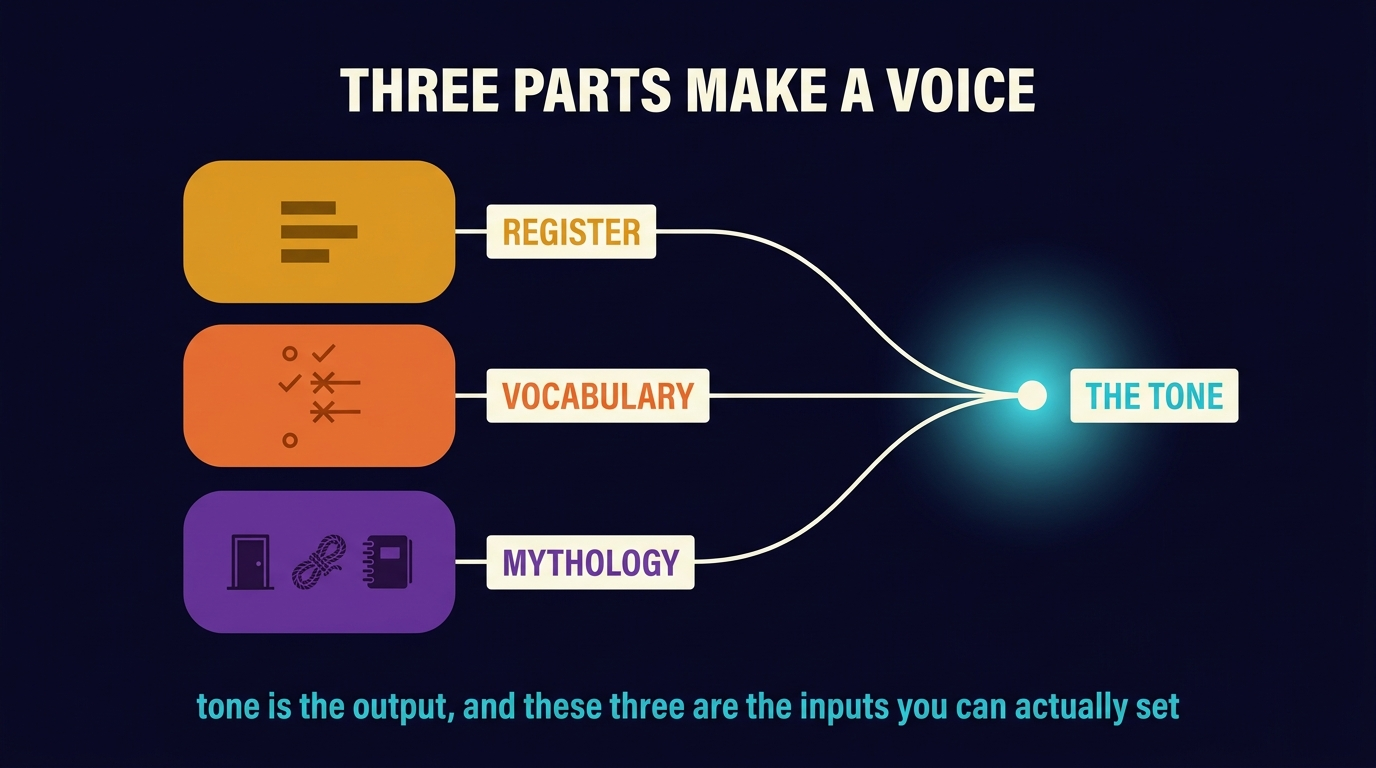
Mythology. The recurring stories, archetypes, and named concepts that appear across pieces. The Beggar and the Chooser. The Velvet Rope. The Scar Tissue Audit. The Lexicon of Pain. People · Product · Process. These are not slogans; they are named handles for ideas the body of work returns to repeatedly. The mythology compounds because the reader who has met the Beggar in one piece recognizes the Beggar in the next, and that recognition is what creates the sense that the work is part of a body, not a feed of disconnected posts.
Register design · how to define a mode
Each register lives or dies on whether a different writer can pick it up cold and produce a piece that lands in the right mode. The discipline that makes that possible is the register spec. A page or two per register, written down, treated as canonical.
The spec answers six questions. Who is the reader for this register, in concrete terms? What did they come here for? What is the typical sentence length and how much variance? How much emotional bandwidth is allowed, on a five-point scale from clinical to vulnerable? What are five representative example sentences that demonstrate the mode? What moves are explicitly out of bounds in this register?
The example sentences are the load-bearing part. Most operators write the abstract description and skip the examples. The abstract description is debatable; the examples are not. A new writer reads the five examples and absorbs the pattern in a way no list of adjectives can produce. Andy's CASUAL register example: most agency postmortems blame the funnel, the offer, or the traffic. Almost no one audits the qualification step. That sentence is the register, distilled. It does the descriptive work, names the contrarian frame, and signals permission to push back, all in two clauses. The register is whatever produces sentences that land in this neighborhood.
Vocabulary control · the banned list does the heavy lifting
The banned list is where most brand voice systems get serious. Adjective lists are easy to write and impossible to enforce. A banned-token list is enforceable by a script. The discipline of the banned list is to convert a vague preference into a checkable rule.
Andy's banned list operates at three levels. Punctuation: zero em dashes, period. Patterns: zero not X. it's Y constructions, zero here's the thing openers, zero let me be honest. Vocabulary: a roster of AI-tell words that have lost meaning through corporate overuse (delve, crucial, leverage as a verb, utilize, facilitate, holistic, synergy, empower, robust, comprehensive in the marketing sense, streamline, transform as a marketing word). Each entry is enforceable. A pre-commit hook can grep for any of them and refuse the file.
The banned list compounds in a way descriptions do not. Once a writer has internalized the list, they stop generating banned candidates. The work writes faster because the substitution becomes automatic: leverage our platform never reaches the page in the first place because the writer has stopped producing it. The discipline at the input compounds into reflex. Six months in, the list barely needs enforcement because the brain has adopted the constraint.
The required-vocabulary list is the smaller cousin and just as load-bearing. Some concepts must always be named with the canonical handle, never paraphrased. PPP is always People · Product · Process when first introduced. The Velvet Rope is the Velvet Rope, not the qualification process. The Scar Tissue Audit is not the customer research method. Required vocabulary is what makes the mythology compound. Without it, every piece reinvents its own terms and the reader never accumulates a shared lexicon.
The audit method · what you actually grade
An auditable system needs an audit. The audit method is what turns the brand from a wish into something checkable. Three axes, each one pass-fail, no numeric scores.
Register fidelity. Read the piece. Did it stay in one register from open to close, or did it bounce? Bouncing is the most common failure mode and the easiest to spot. A CASUAL piece that suddenly shifts into corporate-DEFAULT for a paragraph fails. Pass-fail.
Vocabulary compliance. Run the script. Any banned tokens, any banned patterns, any em dashes? If yes, fail. The script is automated; the writer should run it before the audit pass and the auditor should run it again as confirmation. Required vocabulary check: did the piece use canonical handles for the concepts it introduced, or did it paraphrase a named idea into something generic? Paraphrasing of a named concept is a fail.
Mythology presence. Did the piece earn its place in the body of work? A piece that does not reference any existing mythology, does not introduce a new named concept, and does not link to any canonical entry is a piece that exists in isolation. That can be appropriate for a single tactical post, but a body of work composed entirely of isolated pieces fails the body-of-work test. The audit catches drift toward isolation and triggers correction.
Three axes, ten minutes per piece, repeatable across a team. The audit is the moment the brand stops being something the founder holds in their head and becomes something the team can ship without the founder.
Where to start
Three starting points, ordered by difficulty and impact.
Easiest, do today. Write down ten banned words and patterns. Pick the AI-tell vocabulary you most resent finding in your own drafts. Write the list down, paste it on the wall, run a grep against your last ten pieces, and count the violations. The number is usually higher than expected. The fix is mechanical from there.
Medium, this week. Name your two or three registers and write the spec for each. Five example sentences per register is the load-bearing part. The example sentences should be the best ones you have already shipped, not idealized future writing. The spec describes what you actually do at your best, codified.
Hardest, this month. Catalog your existing mythology. Walk every piece you have shipped in the last year and list every named concept (Beggar, Velvet Rope, Scar Tissue Audit). Pick the canonical handle for each one. Note any concept that appears under three different names; those are paraphrasing failures. Lock the canonical handle for each, write a one-line definition, and require it across the body of work going forward. The mythology will start compounding within two months because the named concepts will start showing up in audience language.
Voice is a system with three components: register, vocabulary, mythology. Each component has rules and the rules are auditable. The audit is what makes the brand survive a team. For the broader theory of how attention, trust, narrative, register, and distribution compose, see Standard Model of Effective Media.