
Most paid-acquisition accounts run on hope. The budget gets set at a number that feels right. The campaigns get built off whatever the platform's setup wizard suggested. The reporting reads cost-per-click and click-through rate. Nobody can connect the platform numbers to actual revenue, which means nobody can answer the only question that matters: is this campaign going to make money over the LTV horizon, or is it bleeding budget into a black box. Andy's portfolio framing is the anchor: PPC shouldn't feel like feeding a slot machine. In 2026 it does, more than ever, because the platforms have aggressively automated the parts that used to be operator decisions.
This essay is the practitioner playbook for hypothesis-driven paid acquisition across Google, Meta, and LinkedIn. The sub-service explainer for the Paid Acquisition tile in the homepage Sales & Growth silo. Companion pieces: Conversion Funnel Design covers the architectural decisions that determine what a campaign should actually drive toward; Email Sequences covers the lifecycle layer that compounds paid traffic into LTV.
Hopeful spend is the dominant 2026 failure mode
Audited B2B SaaS accounts routinely carry a large share of wasted spend, often a third or more of the budget on a typical six-figure annual account. A common structural cause is that most of the accounts have no GCLID-to-CRM integration, which means the platform was optimizing toward form-fills and clicks rather than toward sales-qualified leads. Smart Bidding chases the proxy metric the platform can see; revenue lives downstream of where the platform can see; the optimizer drifts.
The AndyDataGuy Forensic Ad Audits case study generalizes the pattern across Facebook and Google: in most accounts audited, 10-30% of spend could be reallocated or cut without hurting revenue, often increasing it. The waste is structural, not tactical. It lives in the campaign architecture (overlapping audiences, legacy campaigns nobody pruned, attribution windows that miss the buyer's actual decision cycle) more than in the specific creatives or keywords being run. Andy's discipline: the audit is forensic, not aesthetic. Pull account exports, segment by objective, reconcile to revenue, flag the structural defects, deliver a prioritized action plan.
The 2026 wrinkle that sharpens the failure mode is the rise of black-box auto-optimizers. PMax (Google), Advantage+ (Meta), Predictive Audiences (LinkedIn) now consume 25%+ of total platform spend in many accounts. The platforms market these as "set it and forget it." The audit data says otherwise. PMax above 25% of spend without offline conversion feeds predicts heavy waste in top-quartile accounts, and 50%+ waste in bottom-quartile accounts. The automation does not save you from bad inputs. It compounds them faster.
Every campaign carries a hypothesis, a threshold, and a kill-switch
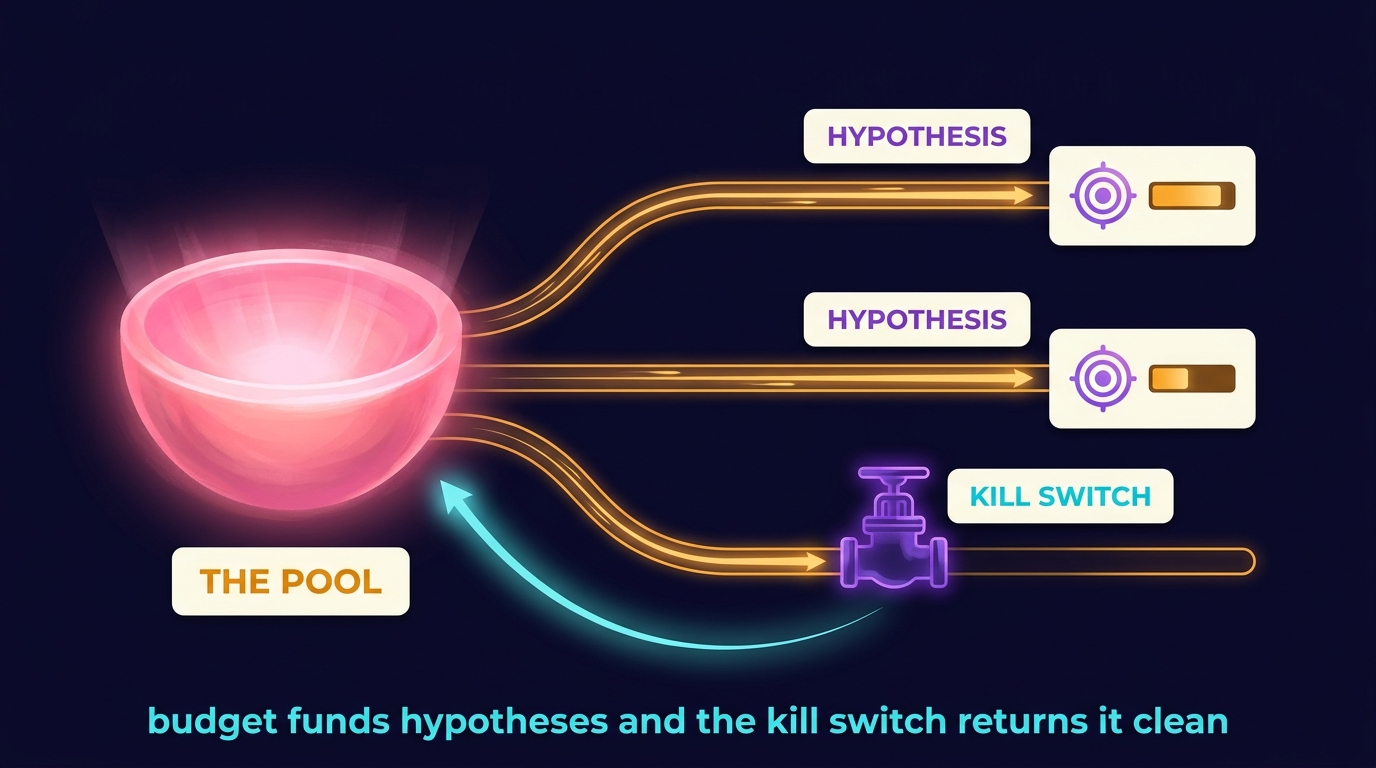
The architectural unit of paid acquisition is not the campaign. It is the hypothesis. A hypothesis names three things. The audience (who specifically). The reason they buy (the belief shift the campaign is paying to produce). The price they will pay (tied to LTV, not to the platform's CPA target). When all three are explicit, the campaign has something to falsify. When any one is implicit, the campaign is hopeful spend in a different costume.
Andy's discipline maps directly: we map who you're targeting, what intent they're in (cold, warm, hot), and what problem they believe they're solving when they click. Then product alignment: no more sending "just browsing" traffic to a high-commitment offer. Then process: we structure campaigns, budgets, and testing so there's always a clear hypothesis, a control, and a next action instead of random tweaks. The structure is People-Product-Process inside a paid-media envelope. The randomness gets engineered out.
Three components define a healthy hypothesis.
- Falsifiable claim. "If we target solar-curious homeowners in counties X with installer capacity Y, with offer Z framed around financing-first instead of equipment-first, the cost per qualified install lead lands under $A and the install close rate clears B%." That sentence can be wrong. Most campaign briefs are not wrong because they have not committed to anything specific enough to be wrong.
- Threshold tied to LTV-aware payback. Not the platform's default CPA. The threshold the business needs to clear so the customer's lifetime value covers acquisition cost three times over within the payback window the cash flow can sustain. The Solar agency work set thresholds against install value and capacity, not against cost-per-form-fill, and scaled to roughly $50K/day in install value at peak because the threshold reflected what the business actually monetized.
- Kill-switch. The condition that ends the campaign without further debate. "If by spend $X or by day Y the cost per qualified lead is above the threshold, the campaign pauses. No re-litigation, no creative refresh first, no 'let's wait another week.' Kill, document, move budget to the next hypothesis." The kill-switch is what makes the budget pool a structured experiment instead of a slot machine.
Three frameworks beyond ROAS
Platform-reported ROAS is the metric most accounts run on. It is also the metric most likely to mislead in 2026 because the underlying attribution has been hollowed out by privacy changes, MPP-style proxy events, and last-click defaults that miss multi-touch reality. Three frameworks survive the distortion.
Incrementality lift testing. Run a holdout. The test group sees the campaign; the control group does not. The incremental conversion rate is the difference. The incremental CPA is the spend divided by the incremental conversions, not by the platform-attributed conversions. Set a minimum detectable effect (15% lift is a common floor) and a sample-size threshold before the test starts. Most campaigns that "work" in platform reports show measurably weaker incrementality than reported, because the platform is taking credit for conversions that would have happened organically. The Forensic Ad Audit work is built around this distinction: the 10-30% reallocatable spend is precisely the slice that platform reports overweight.
Marginal CAC. The cost of the next customer at the next dollar of spend. Average CAC at the campaign level hides the diminishing returns at the edges. Marginal CAC exposes the ROAS cliffs that auto-optimizers gloss over. The Solar Portfolio Intelligence work across 54 client accounts identified marginal CAC patterns that crossed accounts: at certain spend thresholds, marginal CAC spiked because the audience pool exhausted; at certain campaign architectures, marginal CAC stayed flat because the buying signal had structural depth. Operators who watch marginal CAC scale into health. Operators who watch average CAC scale into the wall.
Marketing Mix Modeling. Channel-level credit allocation that does not rely on click-path attribution. Particularly load-bearing for B2B with long sales cycles (the 84-day average B2B decision window means 7-day attribution windows miss roughly 85% of attributable revenue). MMM uses spend, conversion, and external-factor data to model channel contribution at the aggregate level. Less precise than click-path attribution at the impression level; far more honest at the budget-allocation level. The two are complements, not substitutes.
Programmatic testing is the operational discipline
At budgets above $20K/month, manual testing cannot keep up with the hypothesis bank a healthy account generates. The hypothesis layer outpaces the implementation layer; backlog forms; tests die in spreadsheets; learnings stop being captured. The Programmatic Split-Testing Engine case study is the load-bearing reference here: structured naming conventions, automated campaign creation, templated experiment setups, results flowing into a central log of wins, losses, and context. The engine supported 100+ weekly tests without the team drowning, and over time the compounding gains in CTR, CPA, and LTV would have been impossible to find by hand.
The point of programmatic testing infrastructure is not to test more for its own sake. It is to make the cost of testing low enough that the operator stops self-censoring hypotheses. When testing is expensive, only the safest hypotheses get run, and the account drifts toward the local optimum that the platform's defaults already reach. When testing is cheap and structured, the riskier hypotheses get run too, and the wins compound because the surface area is bigger.
The auto-optimizer reality
Three platform-specific shifts deserve direct naming.
Google PMax. Performance Max combines search, shopping, display, video, and discovery into one campaign type that the platform optimizes opaquely. Run without offline conversion uploads, PMax optimizes toward the cheapest superficially-positive signal it can find: clicks, low-quality form fills, list-building noise. With offline conversions piped back from the CRM (closed deals, qualified opportunities, revenue events), PMax becomes one of the highest-leverage Google surfaces in 2026. The 93% of audited accounts that lack the GCLID-to-CRM integration are running PMax half-blind. Fixing the integration is the single highest-ROI move in most B2B Google accounts.
Meta Advantage+. Advantage+ Shopping and Advantage+ Audience apply similar automation logic. The same discipline applies: feed the algorithm operator-grade signal (Conversions API, offline event uploads, value-based optimization) or watch it converge on whatever in-platform proxy looks cheapest. The DTC Metal-Art work stayed deliberately structured around manual cohort discovery precisely because the platform's automated audience suggestions kept drifting toward the wrong buyer profile until the operator-grade segmentation was wired in.
LinkedIn Predictive Audiences. The same pattern in B2B: useful with high-quality conversion signal, expensive without. LinkedIn's CPMs are already premium; pairing them with weak conversion data produces the worst of both worlds.
The synthesis: the platforms have offloaded the tactical decisions to algorithms. The only remaining place for the human operator to add value is at the hypothesis and signal layer. Design the hypothesis. Feed the platform real signal. Let the algorithm execute the tactical optimization. Audit relentlessly. Kill cleanly. The operators who do this in 2026 outperform the ones who fight the algorithm or surrender to it.
Where to start
Three starting points, in order of difficulty and impact.
Easiest, do today. Write the explicit hypothesis behind your single highest-spend campaign right now. Audience, reason, price. If you cannot write all three in three sentences, the campaign is hopeful spend regardless of how it is performing. The exercise takes twenty minutes. The clarity it produces is what every subsequent decision will inherit.
Medium, this week. Audit your offline-conversion plumbing. Are you piping closed deals, qualified opportunities, or revenue events back to Google (via GCLID), Meta (via Conversions API), and LinkedIn (via offline events)? If 93% of audited B2B accounts miss this, the odds are you do too. Wiring it in is a one-week engineering job that lifts every campaign downstream of it.
Hardest, this month. Stand up kill-switch discipline as a written rule. For each campaign, document the threshold and the kill condition before the campaign launches. Maintain a public log of campaigns killed by threshold versus campaigns extended past threshold (the latter should be rare). The discipline takes a quarter to bed in. Once it does, the account stops accumulating zombie campaigns that nobody wants to kill because nobody set the trigger up front.
Paid acquisition is structured experimentation, not slot-machine spending. Every campaign carries an explicit hypothesis, an LTV-aware threshold, and a non-negotiable kill-switch. Three frameworks beyond platform ROAS carry the truth: incrementality testing, marginal CAC, Marketing Mix Modeling. The auto-optimizer era rewards operators who feed real signal and audit relentlessly; it punishes operators who surrender. For the architectural decisions upstream of paid traffic, see Conversion Funnel Design.