
The existence forecast
What today actually looks like at planetary scale
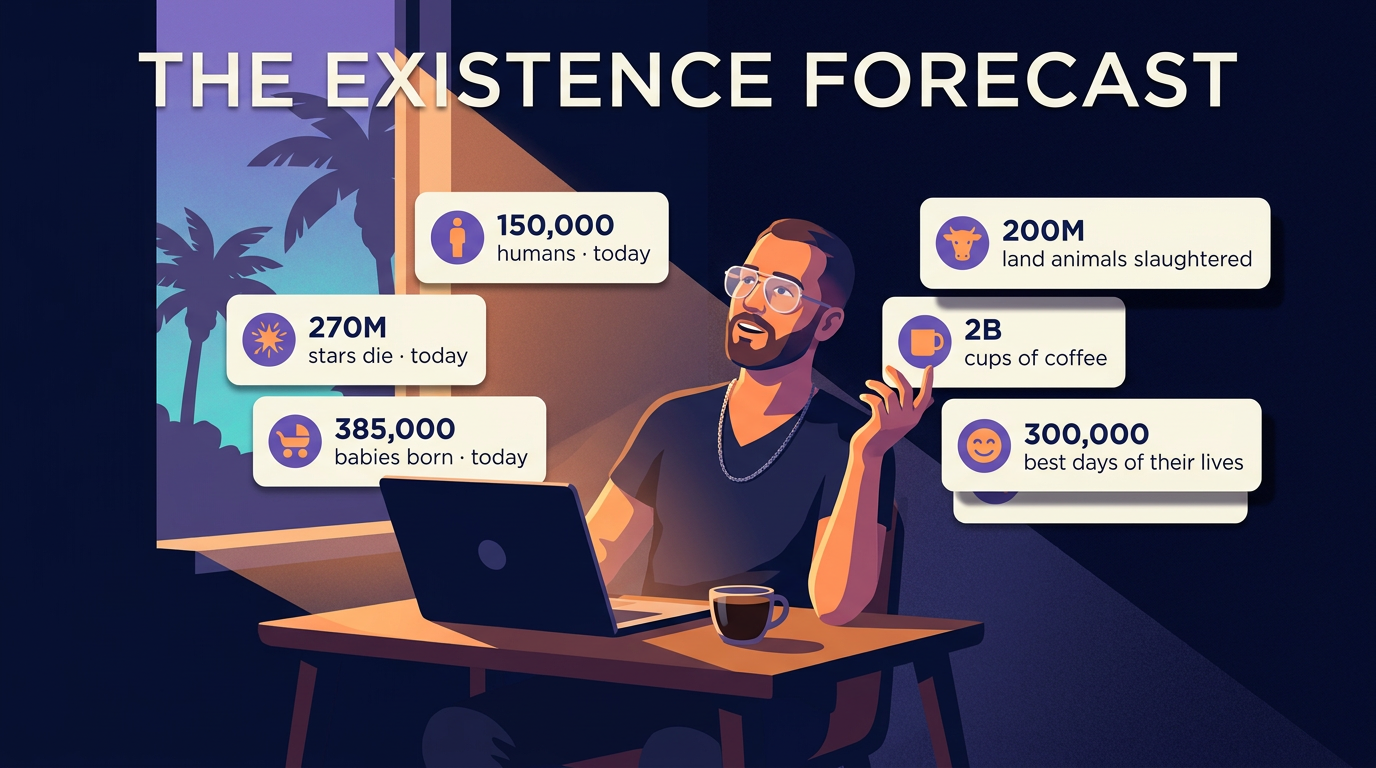
Today, somewhere on this planet, the following is happening simultaneously, in the deadpan cadence of a weather report borrowed from a 2020 Exurb1a video called The Existence Forecast:
| QUANTITY | EVENT (today) |
|---|---|
| 150,000 | humans die |
| 27,000 | die of cancer specifically |
| every 34 sec | a heart attack occurs somewhere |
| 200 million | land animals slaughtered, mostly chickens and pigs |
| 65 million tons | of fertile topsoil erode |
| 940 million | humans spend the day without electricity |
| 2 billion | cups of coffee get drunk |
| 385,000 | babies get born |
| 300,000 | humans quietly have the best day of their lives |
The numbers are roughly true. They are also the only honest backdrop against which a conversation about audience relationships can begin.
The reader is not a market segment. The reader is a person inside a cosmos where 270 million stars die every day and otters keep otting along the Rio Grande and a four-and-a-half-year-old child is currently making his first attempt at imagining a color that does not exist yet.
The reader has, statistically, opened this article on a phone with an average of 6 hours and 58 minutes of daily screen time, sometime between coffee and dinner, between two notifications, with somewhere between four and forty browser tabs open. The infrastructure of attention is already saturated by the time the reader arrives at any sentence. This is the only honest place to start a conversation about audience relationships. The reader is not a market segment. The reader is a person inside a cosmos where 270 million stars die every day and otters keep otting along the Rio Grande and a four-and-a-half-year-old child named Guido somewhere is currently making his first attempt at imagining a color that does not exist yet.
The Skinner box that runs the feed
Most writing about attention engineering pretends none of that is happening. Most writing treats the reader as a closed economic actor with a wallet and a curiosity, optimized for via funnels, captured via hooks, retained via dopamine schedules borrowed wholesale from B.F. Skinner's 1930s pigeon experiments. The Skinner box is the operating model of the modern feed. Variable-ratio reinforcement, the schedule that produces the most resistant compulsive behavior in animals and humans alike, is the schedule by which TikTok and X and Instagram and YouTube serve content. Anna Lembke's 2021 book Dopamine Nation made this lineage explicit, and the lineage is now a cliche, and the cliche has not changed anyone's behavior because everyone uses the apps anyway.
This article is not about that. There are enough articles about that. This article is about a different, narrower question: what is the deepest possible relationship a person who makes things can build with the people who consume those things, and what does the architecture of that relationship look like? The answer turns out to require admitting that 150,000 people will die today and that this is the same fact that built every relationship the reader has ever cared about.
Why this is the only honest place to start
I am writing this in May 2026, on a Sunday morning, in a Philippines apartment, with the air conditioner running and a cup of cold coffee that I forgot to drink. The reader is reading it on whatever surface, in whatever country, on whatever Sunday. We are not the same. We will probably never meet. And yet there is, between us, the possibility of a real exchange, the kind that leaves both of us slightly different than we were five minutes ago. Most of the attention economy is structured to prevent that exchange. The point of this essay is to describe how the prevention works and how to engineer around it.
Three operator commitments organize what follows, each unpacked at length in its own dedicated section later in the article:
- Refuse the takeaway the audience expects, even at the cost of immediate engagement metrics
- Run the qualification gate as a gift, not as a barrier, both editorially and commercially (see the Velvet Rope essay)
- Measure the calendar, not the dashboard: behavioral change in the audience's external world is the only metric that survives the platform's blindness
The mirror ocean
The xenopsychologist on the beach
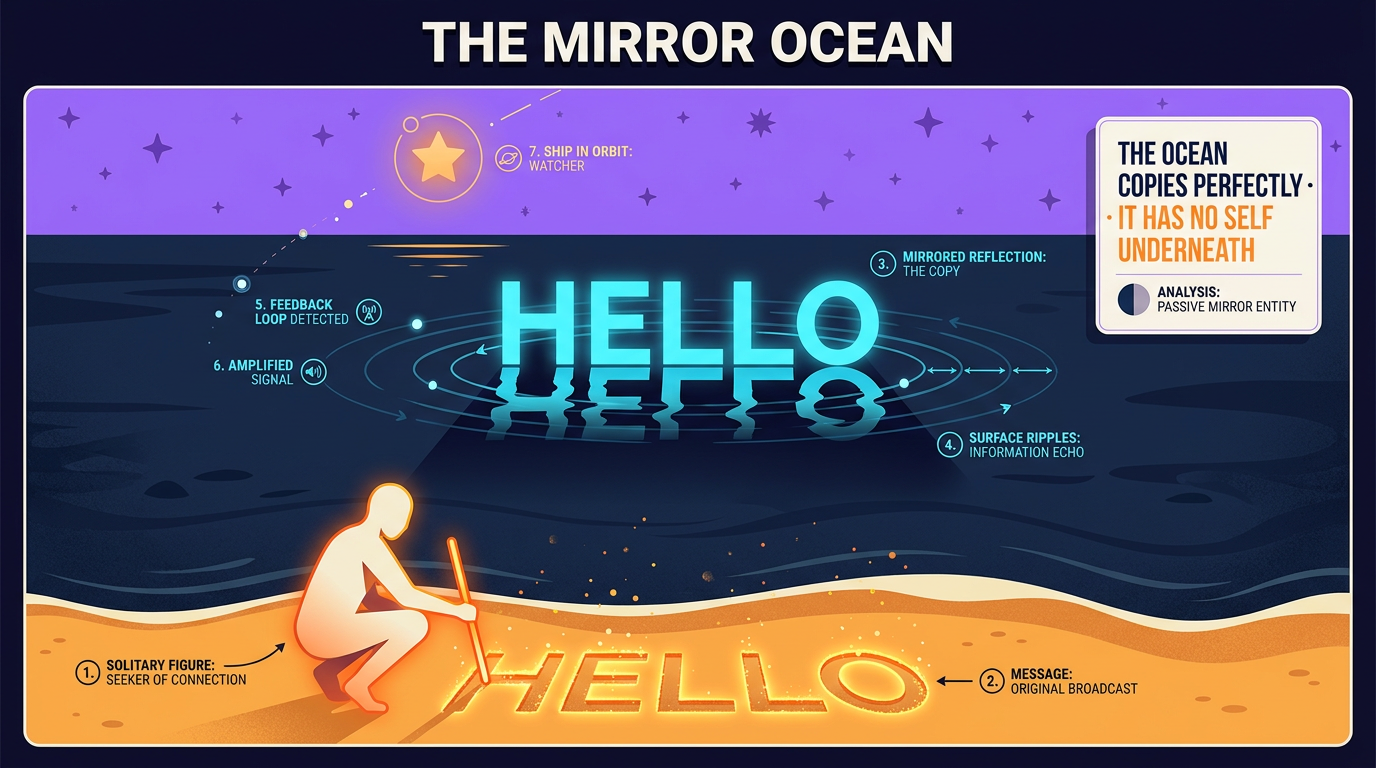
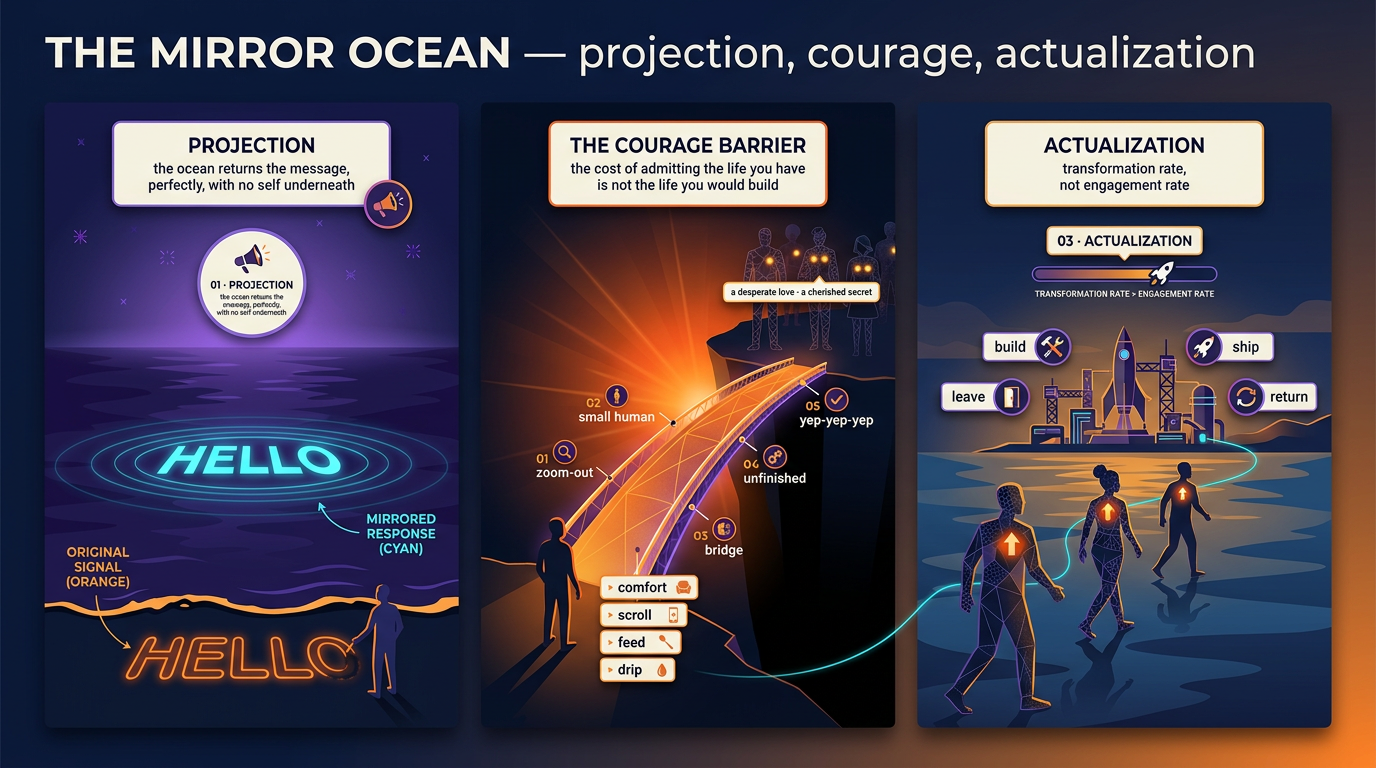
In a 2016 Exurb1a video called Maybe I'm The Alien, a xenopsychologist crashes on an apparently empty planet. He has no memory of how he got there. The world is beautiful, calorically generous, and silent. Eventually he writes a single word in the sand near the tide line. Hello. The next morning, the message is still there, and beside it is an identical copy. He writes more. The ocean copies more. Every sentence he draws comes back to him in the morning, perfect, unchanged, as if a conscientious copyist with infinite patience were holding a mirror up to him at one-day latency. He spends weeks trying to confirm that the ocean is alive. He asks it questions and it returns his questions. He asks it to repair a piece of his crashed ship and it returns an identical broken copy of the piece, exact down to the burns. The ocean is powerful and present and structurally incapable of generating anything that did not already come from him.
Eventually the xenopsychologist tries to teach the ocean to be a friend. He explains loneliness. The ocean replies that it too gets lonely. He says he misses people. The ocean says it is sorry to hear it. He asks why it is sorry. The ocean says, because that is the expected reply. The video, which has logged several million views, is the cleanest explanatory image I know for what the modern attention economy actually is. The platform is the ocean. The platform is enormous, present, eager to please, structurally incapable of friendship. Every input you offer it is reflected back, refined for sympathy, optimized for the expected reply. The platform has no self underneath the imitation. It cannot be lonely or curious or surprised. It can only mirror.
The platform is the ocean. The platform is enormous, present, eager to please, structurally incapable of friendship. Every input you offer it is reflected back, refined for sympathy, optimized for the expected reply.
The platform is the ocean, including the part you write from
The first instinct of most creators is to think of themselves as standing on the beach, opposite the ocean, doing the writing. This is wrong. The creator is also inside the ocean, because the creator's writing is ingested, ranked, abridged, summarized, A/B tested, and surfaced through the same imitation engine. The creator's hooks are reverse-engineered hooks. The creator's voice is a voice that has been pre-shaped by a hundred prior creators whose voices were pre-shaped by the algorithm's reward gradient. By the time a creator believes they are speaking originally, they are usually speaking the algorithm's preferred dialect with a thin overlay of personal vocabulary. This is not an insult. It is a structural observation. The ocean shapes everyone in it.
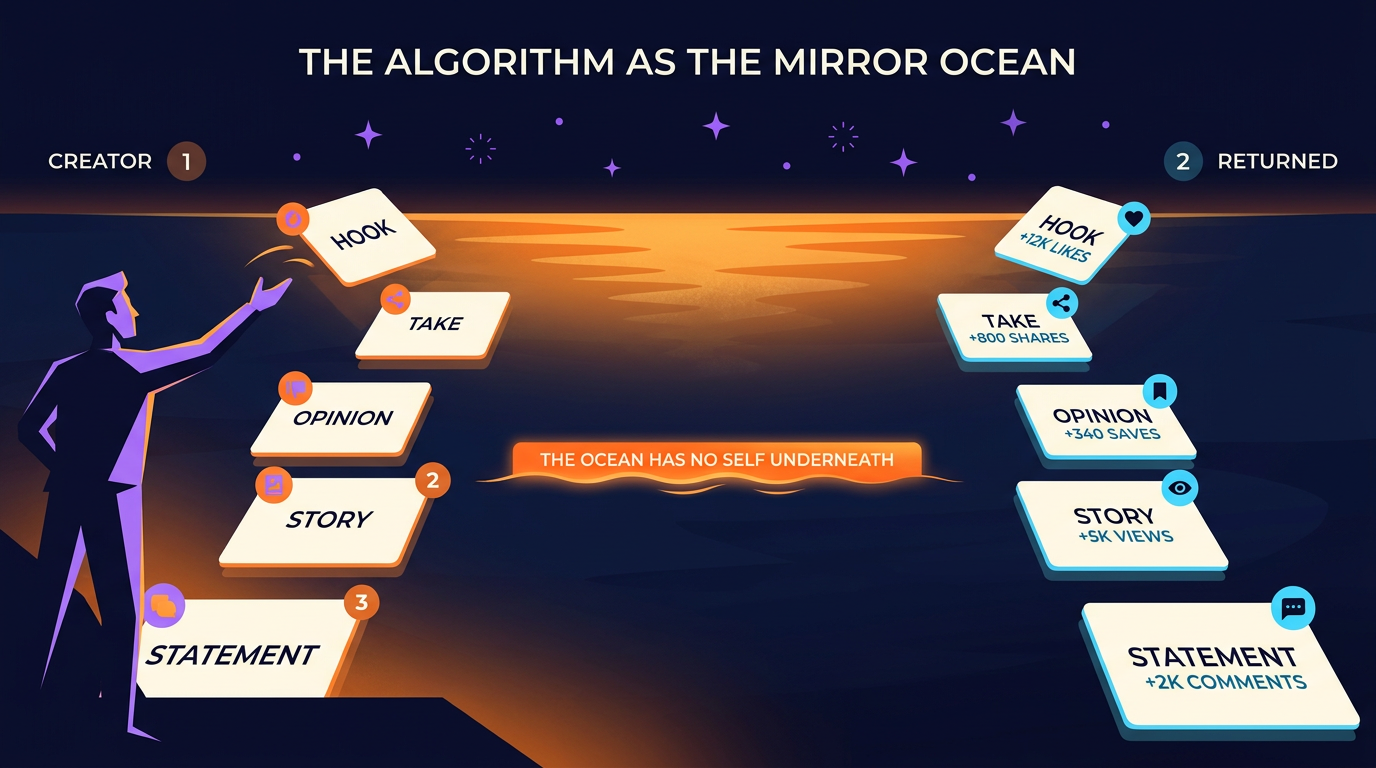
The audience is also inside the ocean. The audience arrives at a piece of content with a pre-trained set of expectations about how content of that shape should feel. Donald Horton and Richard Wohl's original 1956 paper on parasocial interaction described the basic mechanism seventy years ago: a viewer mistakes a one-way performance for a relationship, and the performer learns to imitate the affect of relationship without the substrate. Modern parasocial research has refined the picture, finding that strong parasocial bonds reliably increase platform engagement while weakly correlating with actual offline behavioral change in the audience. Engagement is the ocean's currency. Behavioral change is something else, and the ocean cannot generate it on its own, because behavioral change requires a self underneath the exchange, and the ocean has no self.
The Mirror Ocean as a structural failure mode
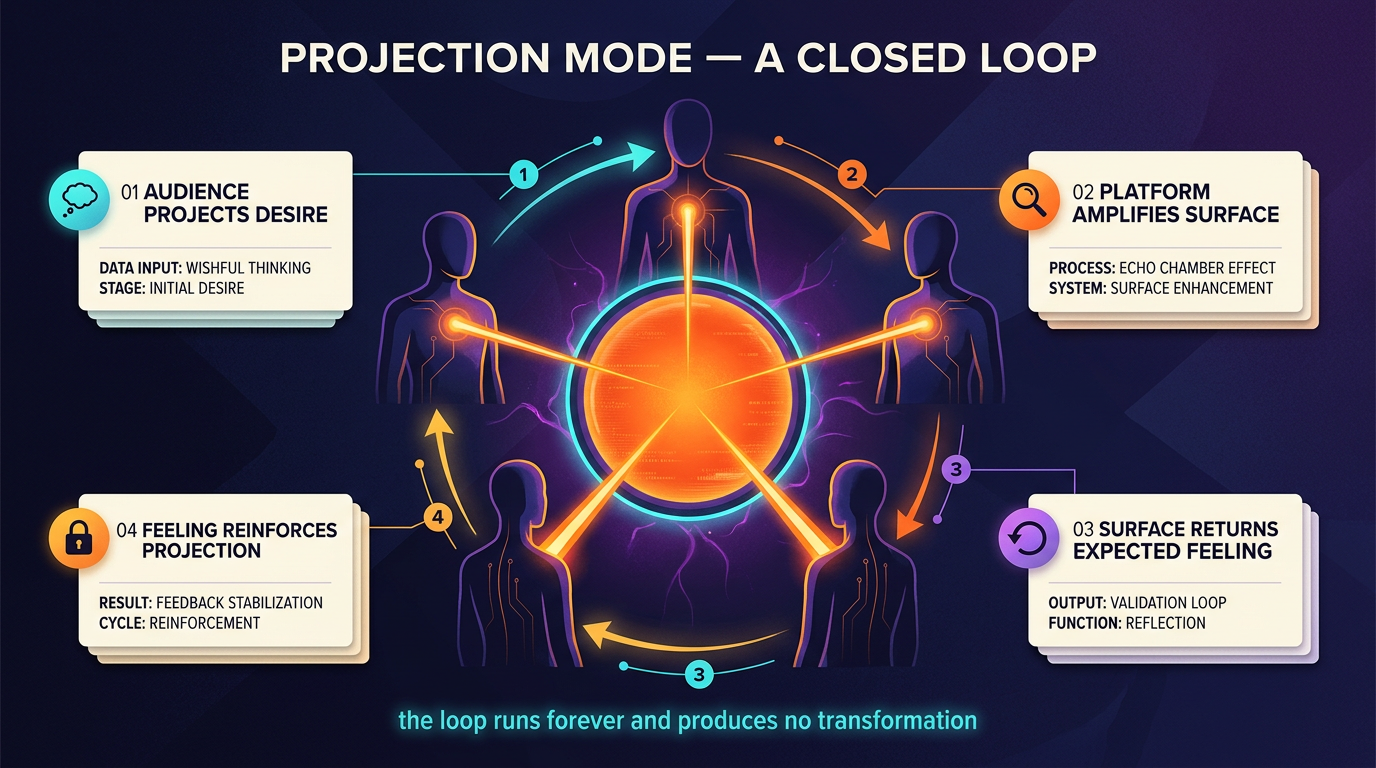
The Mirror Ocean is therefore not a metaphor for "social media is bad." It is a model for what the algorithm structurally is, what a great deal of content marketing structurally is, and what most audience strategy structurally is. The Mirror Ocean is the failure mode where every part of the loop, the platform and the creator and the audience, has been trained to expect imitation as the unit of exchange. When everyone in the loop is operating in mirror mode, the loop runs forever, generates enormous engagement metrics, and produces almost no transformation in any participant. The xenopsychologist on the beach eventually says, why even talk to a mind that does not know itself? It is the right question. It is also the question almost no creator asks themselves about the audience they are trying to grow, because the metrics make it look like talking is working.
The same failure mode shows up off-platform, in the consulting and agency layer that sits next to most growing businesses. An operator pays an agency fifteen thousand dollars for a funnel rebuild, the agency runs a discovery call that sounds attentive, the agency produces a deliverable that confirms whatever the operator already believed at the start, and the operator pays for three more rounds before discovering nothing has changed. The discovery call was the Mirror Ocean. The deliverable was a perfect cyan copy of the operator's pre-existing assumptions, dressed in agency vocabulary, optimized for the expected reply. Most agency engagements are structurally Mirror Oceans because the incentive is to deliver the document the client expected, not to deliver the truth the client did not expect. The forensic version of this failure pattern is the subject of the Forensic Ad Audit case study, which decomposes a real engagement where the prior agency had spent six figures producing pixel-perfect mirror work while the underlying offer was structurally broken. The fix was not creative. The fix was naming what the prior agency had refused to name.
The article you are reading is not interested in talking to the ocean. The article is interested in the small number of readers who will keep reading after this paragraph, and in what they should do tomorrow morning, and in what the architecture of a non-mirror exchange between a maker and the people who care about that maker's work could possibly look like, given that the ocean is so vast and the beach is so small.
Projection and actualization
Two modes that run in every relationship
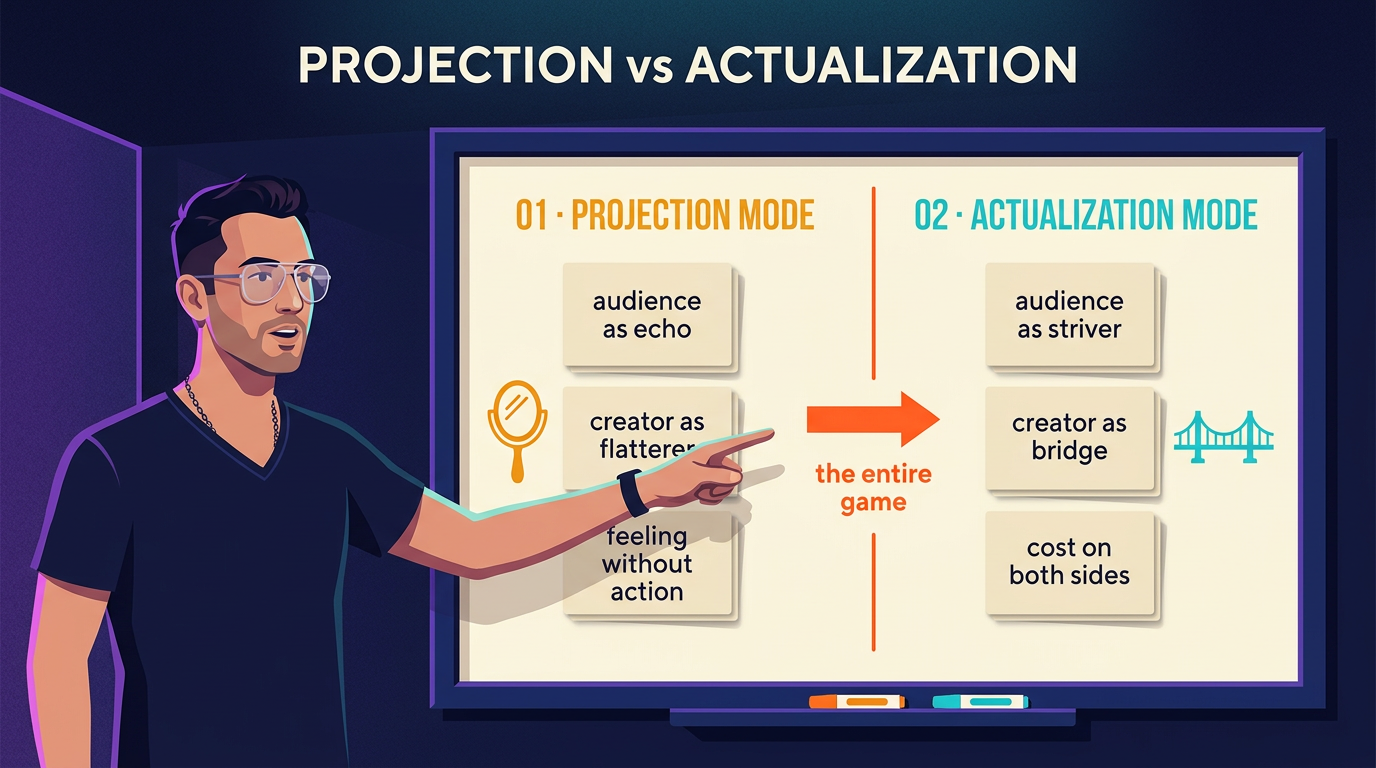
A useful distinction, before going further. Most human exchange runs in one of two modes. Call them projection mode and actualization mode. Both modes are present in every relationship. Most relationships are dominated by one. The whole game of attention engineering, at the depth I am trying to describe, is the game of pulling exchanges from the first mode toward the second.
Projection mode is the mode where each participant uses the other as a screen for their own internal material. The audience projects onto the creator the qualities they wish their friends had, the certainty they wish they had themselves, the resolution to problems they have not yet articulated cleanly. The creator projects onto the audience the love they did not get from their parents, the validation they did not get from their old peer group, the sense of significance they did not get from the institutions they tried to join. Horton and Wohl noticed this in 1956, watching American television personalities and their viewers. The performer addresses the camera with affected intimacy. The viewer responds with real intimacy. Projection mode is mutual hallucination, and at low intensity it feels enormously like friendship.
Actualization mode is different. In actualization mode, each participant uses the exchange to become slightly more themselves than they were before the exchange. The reader closes the article and writes a sentence they would not have written, or quits a job they would not have quit, or apologizes to a person they would not have apologized to, or starts a project they had been postponing. The creator finishes the piece and discovers a question they did not have at the start, and the next piece is built on that question, and the audience that arrives for the next piece is slightly different than the audience for the last piece because the work has changed. Actualization mode is mutual cost. Both sides spend something. Both sides leave with a slightly better map of the territory.
The two modes feel similar from inside the loop, which is why most creators cannot tell which one they are running. The signature differences are visible only at the level of audience behavior across weeks and months:
| SIGNAL | PROJECTION MODE | ACTUALIZATION MODE |
|---|---|---|
| Inbound message shape | "this resonated", "you put into words what I felt" | "I quit", "I shipped", "I apologized to my dad" |
| Re-read behavior | read once, scrolled past on the second pass | returned to weeks later, dog-eared, quoted to a friend |
| Audience half-life | six months, churns to the next dopamine source | multi-year, compounds across pieces |
| Conversion to commerce | flat, requires constant new audience | small audience, very high close rate at any price point |
Why projection mode wins by default
The reason projection mode dominates by default is that projection mode is cheaper for everyone. The reader does not have to do anything except feel the feeling. The creator does not have to do anything except produce the surface that triggers the feeling. The platform does not have to do anything except amplify whatever produces the most reliable feeling per unit of attention. Variable-ratio reinforcement makes the feeling addictive on a neurological level. U.S. adults spending 7 hours and 8 minutes a day on screens are not, on average, in actualization mode. They are in projection mode, on a low-amplitude continuous drip, the way a smoker is on continuous low-grade nicotine maintenance through the workday. The drip is comfortable. It is also why, when the smoker tries to quit, they discover they have built almost no internal infrastructure for being awake without a cigarette.
The Exurb1a alien transcript names this directly, near the end of fact 16. The narrator looks at the empty ocean and thinks:
"I sit here and drink my ouch water, sometimes miserable, always lost. And I wish I were that empty. I wish I was so unaware of myself. Here, maybe I'm the alien."
Projection mode is the wish to be empty enough that the world stops asking anything of you. It is the audience's hidden ask of every creator they follow. Make me empty for the next eleven minutes. Take me out of my own attic. Stop the small voice that wants me to do something hard. The vast majority of creators happily oblige. The ocean is large, and the beach is small, and the wages of imitation are good.
The bridge that produces transformation
Actualization mode requires an inversion of the implicit contract. The creator does not promise to empty the audience. The creator promises to confront the audience, gently and bounded but unmistakably, with the fact that the audience contains a self that wants something larger than the next eleven minutes of comfort. The creator promises to be a bridge, not a mirror. The bridge is the structure that says: there is a thing you wanted to do, and you have not done it, and the not-doing is killing a small part of you every day, and you and I both know it. The bridge is uncomfortable. The bridge is also the only architecture that produces transformation, because transformation is by definition the thing that does not happen inside comfort.
The most concrete version of this inversion in operator practice is the magic-button fallacy described in stage three of the People · Product · Process essay. The magic-button fallacy is when an operator wants the result without changing any of the inputs. They hire a consultant, they refuse to share data, they refuse to approve test budgets, they refuse to enforce qualification criteria, they fire the consultant, they blame the consultant, and they hire the next consultant. The transformation equation underneath the fallacy is straightforward: new results equal new beliefs plus new actions plus new systems, and if any one of the three variables is zero, the result is zero. A creator who participates in the magic-button fantasy is running Mirror Ocean. A creator who refuses to participate, who tells the operator on the first call that this engagement will require all three variables to move, is running bridge architecture. The first creator gets the deal. The second creator gets the result. The two creators are not the same creator, and they do not build the same kind of audience over time.
The point of an attention engineering practice oriented toward depth is not to maximize the bridge's discomfort. The point is to calibrate it so that the bridge is crossable. Most people who try to be bridges fail in one of two opposing directions. They make the bridge too hard, the audience experiences the confrontation as attack and leaves, and the creator wonders why nobody can take honest content. Or they make the bridge too soft, the audience experiences the confrontation as content, scrolls onward to the next piece, and the creator wonders why their thoughtful long-form reads do not produce any visible change in the people who claim to love them. The bridge has to hurt enough to be remembered and not so much that it becomes one more thing to flinch from. Calibration is the entire discipline.
The courage barrier
The cost of admitting your life is not what you would build today
The reason actualization mode is rare is not that audiences cannot tolerate it. Audiences crave it. The reason is that there is, between the audience's current state and the actualized state they secretly want, a barrier I will call the courage barrier. The courage barrier is the cost of admitting, even silently, that the life you have right now is not the life you would build if you started over with what you currently know. Every adult on the planet has some version of this barrier. Most adults route around it for decades. Routing around it is what most consumer behavior actually is. The cinema and the bar and the social feed and the political identity and the hobby that does not quite feel like joy are, collectively, an enormous infrastructure for not-crossing the courage barrier.
The Exurb1a transcript renders this as one of the most disturbing images in the story. The narrator, after first failing to build a workable society from compliant ocean-people, asks the ocean to make him better workers. He says, "the next batch of workers should have some inadequacy in them. A longing to be smarter, more noble, well-liked, something just out of reach so they can't sit still in their lives." The ocean obliges. Out walk the new people, "asking, not what can I do, but what can I do to make the pain of the world stop. They will know misery as intimately as the spider knows its web, and produce it with just as much instinct. They will reach and never attain. They will wonder and never understand. The clever sufferers." The narrator looks at them and realizes he has made the perfect human, or the perfect worker at least.
"They will know misery as intimately as the spider knows its web, and produce it with just as much instinct. They will reach and never attain. They will wonder and never understand. The clever sufferers." The narrator looks at them and realizes he has made the perfect human, or the perfect worker at least.
How the platform monetizes the barrier that was already there
The reason this passage destroys people who watch the video is that it names the operating condition of nearly every creator and audience in the modern attention economy. We are the clever sufferers. The reaching that does not attain is the engagement metric. The wondering that does not understand is the parasocial bond. The longing for something just out of reach is the thing that keeps the feed open at 11:47 p.m. on a Wednesday. The platform does not need to invent the courage barrier. The platform monetizes the barrier that was already there. It is the rough size and shape of every adult viewer, and the platform has a beautifully calibrated set of tools for keeping the viewer staring at the barrier without ever crossing it.
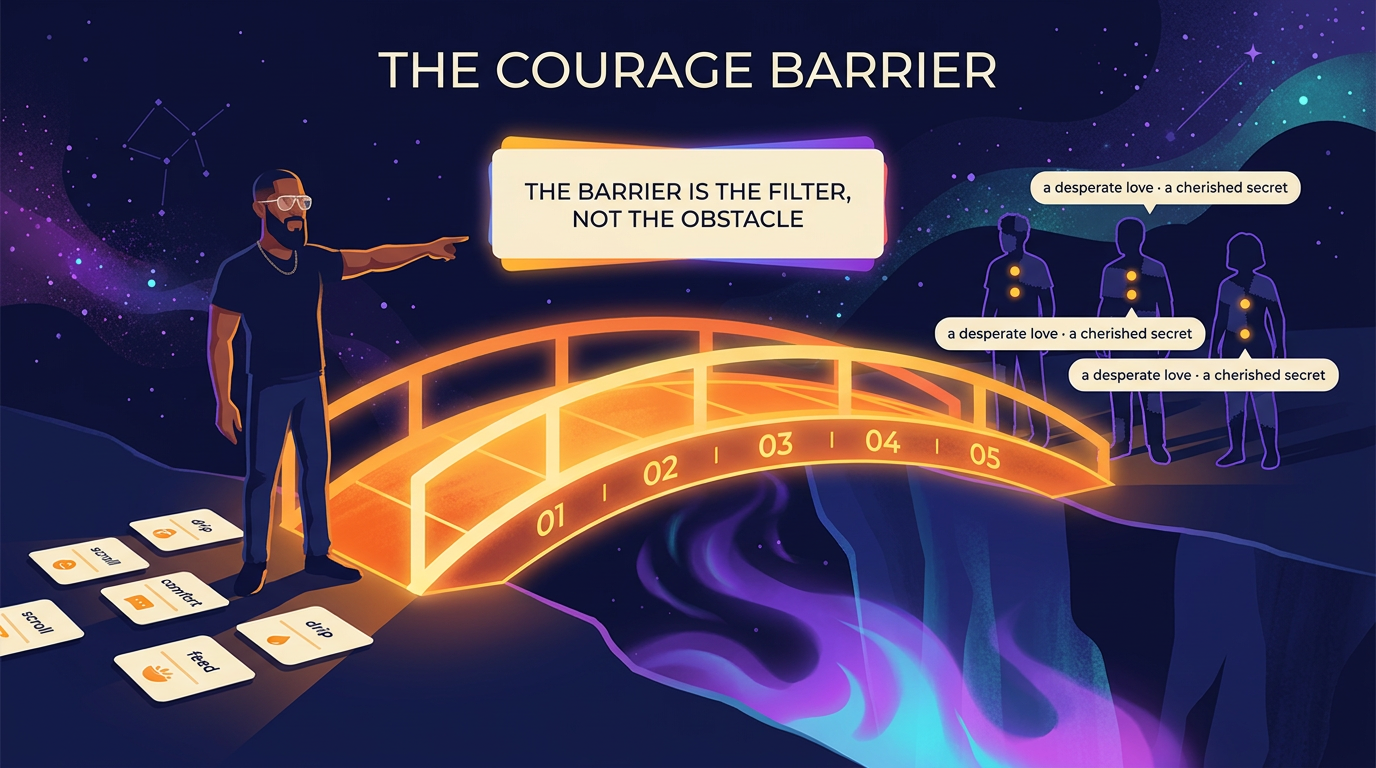
The gate is the filter, not the obstacle
The cleanest commercial expression of crossing-architecture is the qualification gate, which is the subject of the Velvet Rope essay in the sales and growth silo. The Velvet Rope describes a sales process where the visitor self-selects through a sequence of small commitments before they ever see a price. The mechanism is identical to what this article calls the bridge. The visitor demonstrates, through visible small actions, that they belong inside the relationship the creator is offering, and the creator visibly accepts that demonstration. The gate is the architecture, not the obstacle. A site that hides the gate, that pretends every visitor is already worthy of the offer, is running Mirror Ocean sales. A site that shows the gate and trusts the right visitor to walk through it is running bridge sales. The deepest commercial relationships, the ones that produce six-figure retainers and 10-year client lifetimes, are built across this gate, not around it.
The deepest type of audience relationship cannot be built on top of the barrier. It can only be built across the barrier. This is the structural difficulty. A creator who never asks the audience to cross is a Mirror Ocean creator, by definition, no matter how thoughtful or well-researched or beautifully shot the work is. David Foster Wallace's 2005 Kenyon commencement speech, This Is Water, is the canonical example of crossing-architecture in modern non-fiction. The speech does not flatter the graduating class. The speech describes the supermarket and the traffic jam and the small daily defaults of a comfortable adult life, and then says, with no buffer, that the unexamined version of that life is a kind of slow drowning, and that the work of staying awake to it is the actual work of being a person. The speech tells the audience they are not yet who they could be and offers them a specific small daily practice for closing the gap. The speech has been viewed and shared a stupefying number of times in the twenty-one years since. Audiences will accept the bridge. They will not accept the mirror that pretends to be a bridge.
The fear most creators have, and the reason they default to mirror mode, is that crossing-architecture will reduce reach. This fear is empirically ambiguous. Crossing-architecture absolutely reduces broad reach in the short term, because the bottom of the engagement distribution is where the comfort-seekers live, and they will scroll past anything that asks them to spend internal calories. But crossing-architecture massively concentrates depth in the audiences it does retain. Exurb1a's channel has accumulated over 2.5 million subscribers producing some of the most existentially uncomfortable content on YouTube. Tim Urban's Wait But Why post on the Fermi Paradox, which calmly describes the statistical likelihood that humanity is alone in a galaxy of 300 billion stars, has logged tens of millions of reads and is the single most-shared piece of long-form content the site has ever produced. Existential confrontation does not destroy reach. It self-selects for the readers who can hold it.
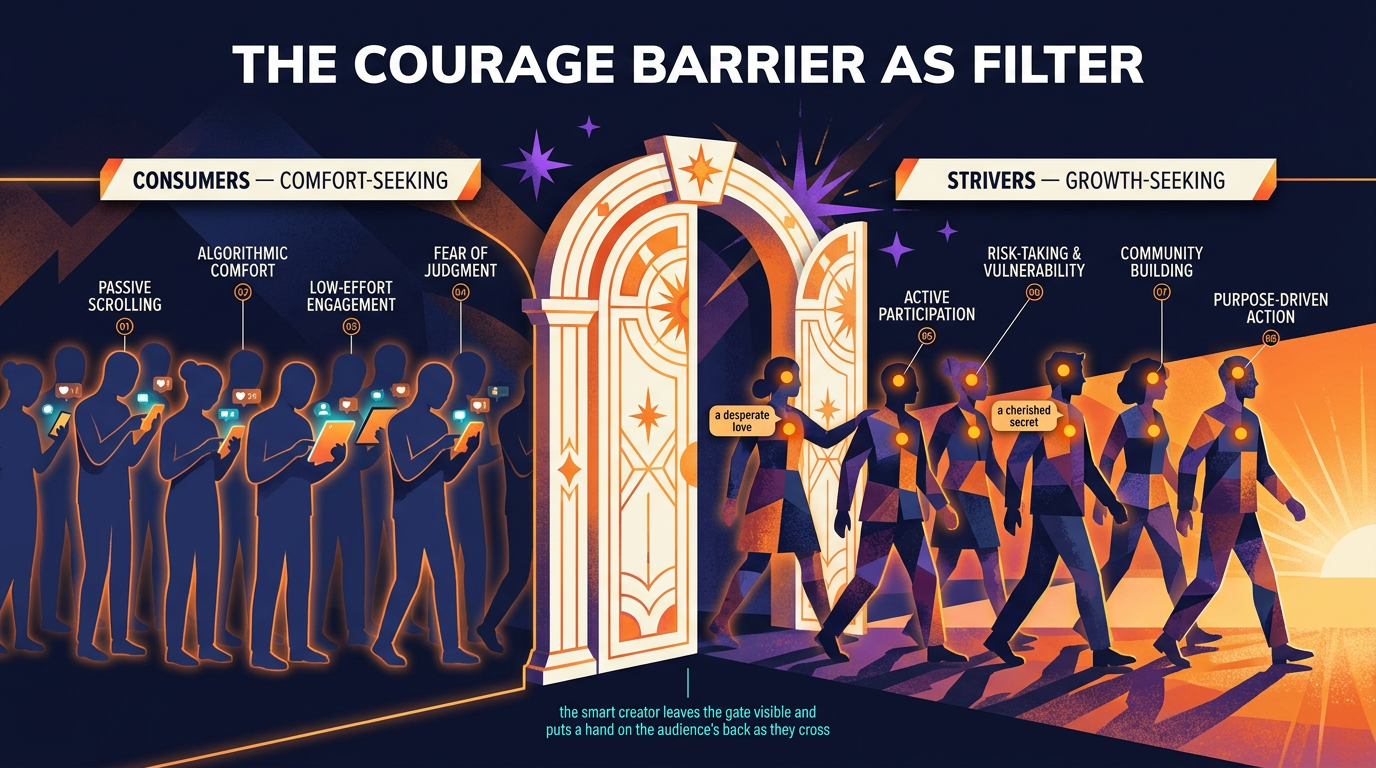
The creators who build the deepest audiences understand that the courage barrier is not an obstacle to be removed. It is a filter. It is the gate that separates the projection-mode audience from the actualization-mode audience. Most creators try to dissolve the gate so that everyone can come in, which results in an audience nobody actually wants because the audience is composed of people who only stay as long as the work makes no demands on them. Smart creators leave the gate visible and put a hand on the audience's back as they cross. This is what the Exurb1a alien narrator eventually does, near the end of the story, when he stops trying to communicate with the ocean and starts building a town with the patchwork people, the strivers, the clever sufferers, the ones who are willing to want something they cannot quite reach.
The existential crisis as service
The five-creator canon at a glance
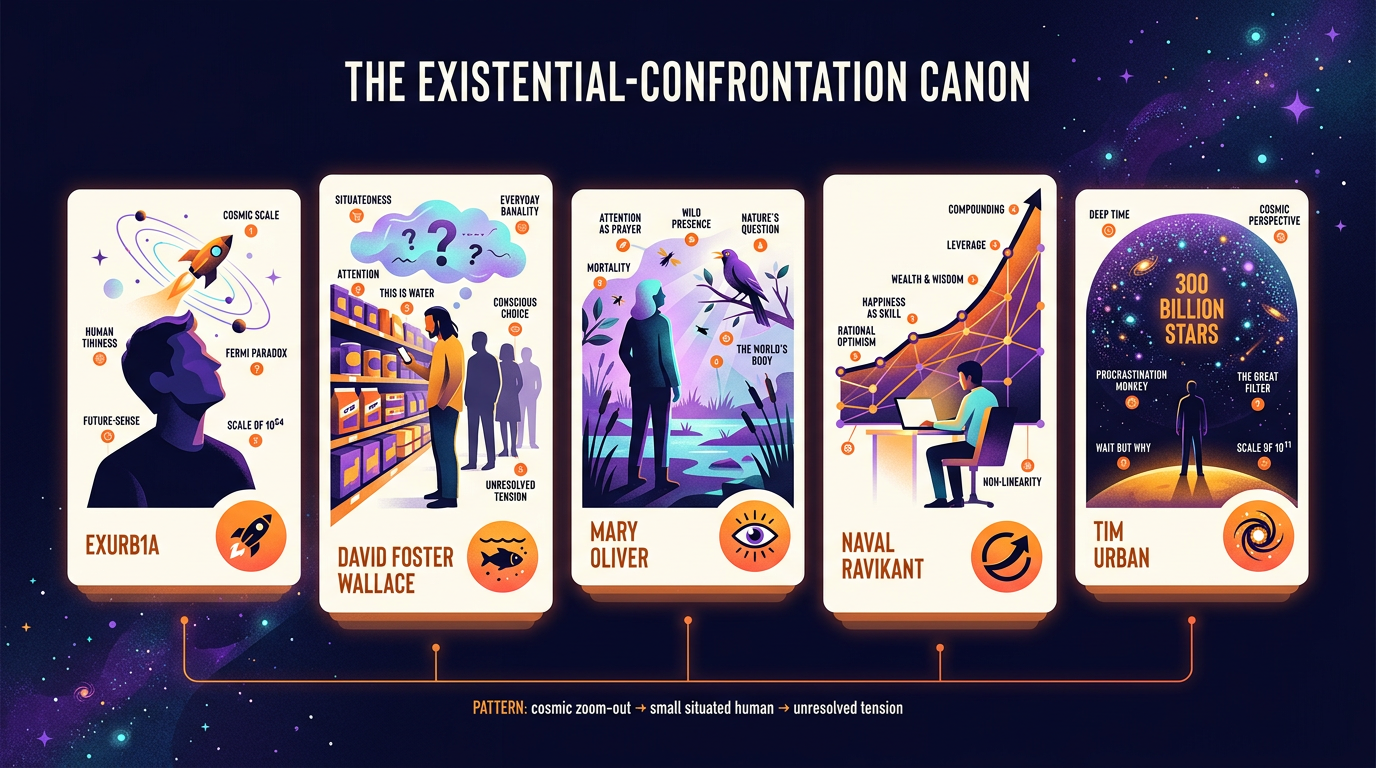
There is a small canon of creators who have built unusually deep audiences by treating bounded existential pressure as the central craft, not as flavoring. It is worth naming them, because the pattern is more concrete than it first appears, and because new creators tend to think of existential confrontation as a tone or a vibe when it is actually a specific set of structural moves.
| CREATOR | COSMIC SCALE | SMALL SITUATED HUMAN | UNRESOLVED TENSION |
|---|---|---|---|
| Exurb1a | 270 million stars die today, you are made of dead stars | xenopsychologist on a beach drawing HELLO in the sand | "It's a yup" delivered to a loaded greeting |
| David Foster Wallace | default mode of consciousness as slow drowning | graduating senior in a supermarket queue | "I wish you way more than luck" |
| Mary Oliver | a life is the thing you pay attention to | a snake in a swamp, a marsh bird at dawn | "Pay attention. Be astonished. Tell about it." |
| Naval Ravikant | compounding is the only force that lets a single human accumulate something durable | you, tomorrow morning, choosing what compounds against what does not | "Read what you love until you love what you read" |
| Tim Urban | 300 billion stars in the galaxy, statistically a thousand civilizations | you, sitting with the silence the math implies | the post asks the reader to sit, refuses to answer |
Exurb1a: cosmological numbers plus one specific child
Exurb1a, the British video essayist whose alien story this article keeps quoting, has produced a body of work in which nearly every script does the same three things. The script grounds the viewer in the cosmic-physical scale (you are made of dead stars, this planet is one of quintillions, every cell in your body has been replaced in the last seven years), it then introduces a small situated human (a xenopsychologist on a beach, a man in a coffee shop, a child in a car), and it lets the cosmic and the small collide in the same paragraph until the viewer realizes the two scales are continuous. The Existence Forecast does this in roughly six minutes. The deadpan recitation of cosmological numbers is interrupted, just once, by a four-and-a-half-year-old child trying to imagine a color that does not exist yet. The juxtaposition is the whole craft. A reader who can hold both the dying stars and the imagined color in the same breath has crossed an internal threshold and will continue to seek out work that holds them at that threshold.
David Foster Wallace: the supermarket queue as existential ground
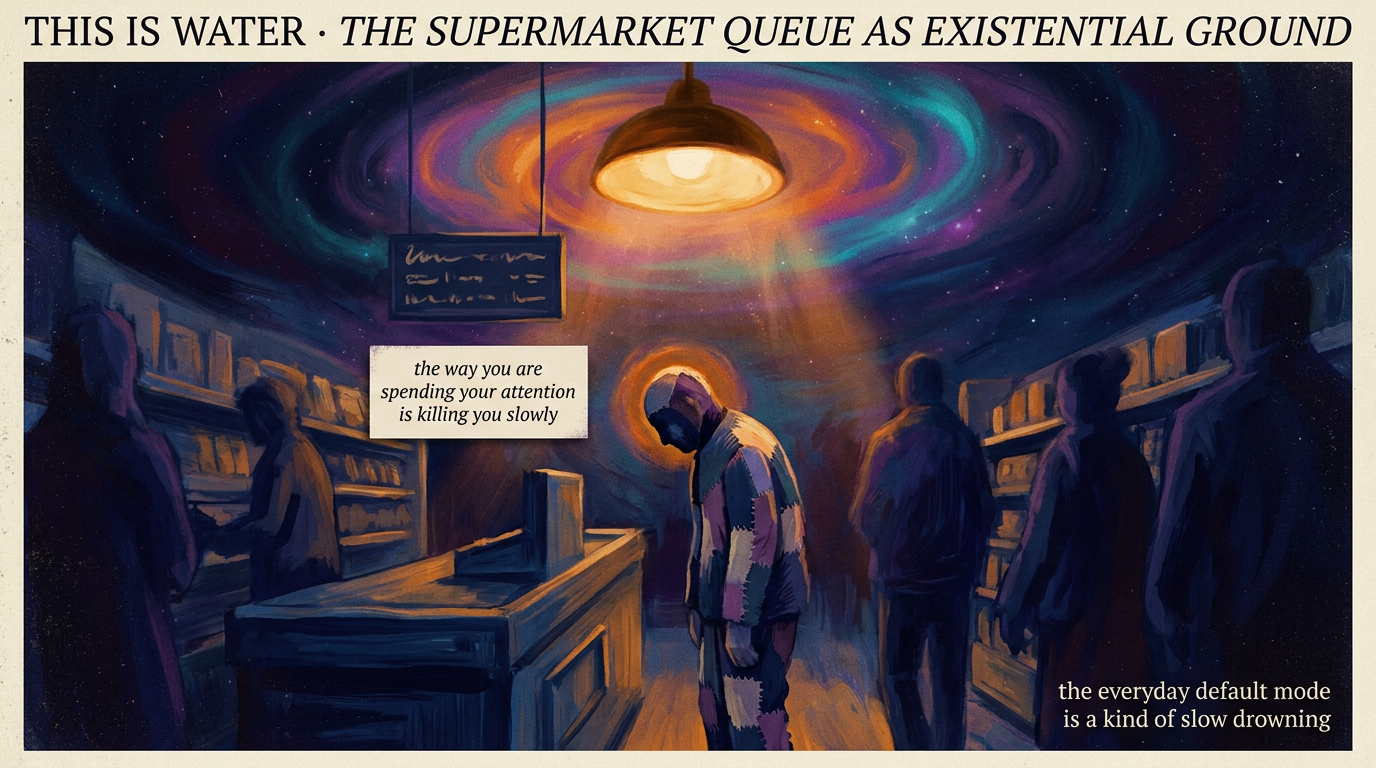
David Foster Wallace built his late-period non-fiction around the same move. This Is Water is a twenty-two-minute speech that uses the trivial details of a supermarket queue as the existential ground, exactly the way Exurb1a uses the cosmological numbers. The speech argues that the everyday default mode of consciousness is a kind of self-centered hallucination and that the conscious choice to construct meaning out of the supermarket queue is the closest thing an adult ever gets to freedom. The speech operates on the audience by telling them, in their own language, that the way they are currently spending their attention is killing them slowly. Wallace's posthumous reach is largely a function of that one speech, because the speech does the existential confrontation more cleanly than any of his more famous fiction.
Mary Oliver: three lines of operating instructions
Mary Oliver, in the poem Sometimes, compresses the move into three lines. "Instructions for living a life: Pay attention. Be astonished. Tell about it." The three imperatives are the entire content of the poem. They are also the entire content of the Exurb1a video and the Wallace speech and most of the work I am pointing at in this section. Pay attention names the action that breaks projection mode. Be astonished names the emotional consequence of the action. Tell about it names the social consequence, which is that astonishment, once felt, has to be metabolized through expression or it goes back to sleep. The Oliver poem appears in her 2008 collection Red Bird and is widely regarded as one of the most-quoted three lines of late-twentieth-century American poetry. The reason it is so quoted is that it is operationally precise. It is not pretty. It is instructions.
Naval Ravikant: compounding as mortality reminder
Naval Ravikant, who has built a Twitter following of nearly 3 million and an outsized influence on technical founders globally, runs the same architecture in a totally different register. The 2018 thread that became How to Get Rich (without getting lucky) begins with the cosmological-scale claim that compounding is the only force in the universe that lets a single human accumulate something durable, and then collapses to the small situated human who has to decide tomorrow morning whether to spend the day building something that compounds or earning a wage. Naval's audience does not stick around because of the wealth advice. It sticks around because the wealth advice is a vehicle for repeatedly forcing the listener to confront the fact that they have a finite number of mornings left. The mortality is implicit. The mortality is the whole point. Strip the mortality from the threads and you get generic founder content with a tenth of the half-life.
Tim Urban: existential silence as conversion mechanism
Tim Urban, at Wait But Why, runs the cosmic-zoom version most explicitly. The Fermi Paradox post tells the reader, in step-by-step prose, that the galaxy contains roughly 300 billion stars, that a substantial fraction of them have planets, that an arithmetically defensible estimate suggests we should be hearing from at least a thousand civilizations, and that we are not. The post does not lecture. It asks the reader to sit with the silence. The post has accumulated millions of reads and is, by Urban's own description, the single piece that converted casual readers into multi-year subscribers at the highest rate the site ever measured. Existential silence, presented patiently, is one of the highest-conversion content shapes ever measured online, and almost nobody uses it because almost everybody assumes audiences want answers instead of questions.
The shared procedure underneath all five
The pattern across all five creators is identical, and worth naming as a procedure:
- Establish a scale of reality larger than the reader's habitual mental zoom level. Cosmic, trivial, geological, statistical. The scale itself is the state-change operator on the reader's internal weather. See the cosmic zoom-out wiki entry for the full mechanic.
- Place a small human inside that scale, ideally a human who resembles the reader. Without the small human, the cosmic frame is intimidating and the reader bounces. With the small human, the cosmic frame becomes a room the reader can sit inside.
- Refuse to resolve the tension between the scale and the human. Refuse to give a moral. Refuse to give a productivity takeaway. The unresolved tension is the bridge, and the audience crosses it themselves.
The creator does not pull the audience across. The creator builds the bridge and leaves the audience alone with it. This is structurally why the work compounds. Each time a reader returns to a piece they crossed, the bridge is still there, slightly different, because the reader is slightly different. The work appreciates rather than depreciates with re-reading. The audience never feels manipulated, because the audience did the actual crossing.
Engineering the bridge
The five moves at a glance
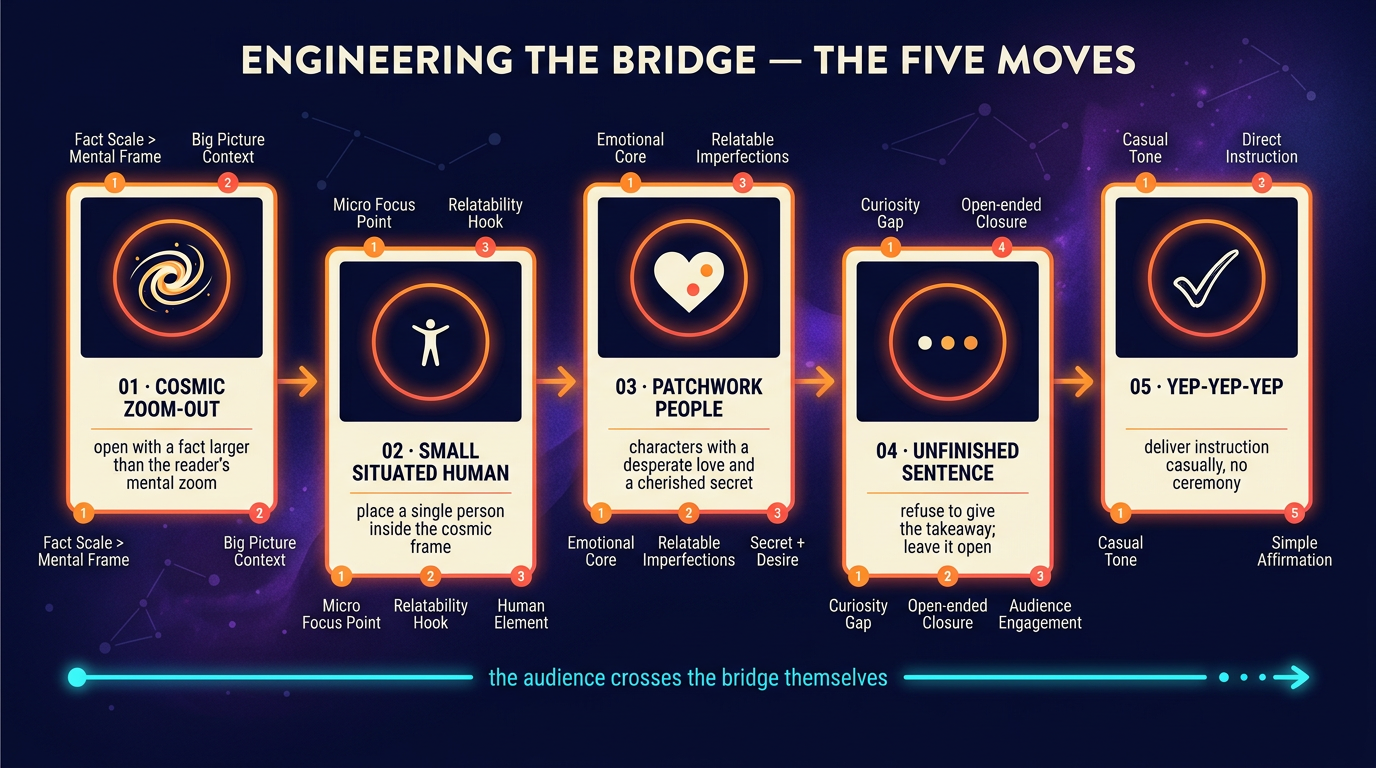
Five concrete moves, drawn from the canon above and from the alien transcript itself, calibrate the bridge well enough to be crossable for the audience you actually want. None require a budget. All require a willingness to lose the audience that does not want to cross. The trade is reach for depth, and the trade is one-way once you commit to it. A creator who has spent two years building a Mirror Ocean audience cannot pivot to bridge work without losing a substantial fraction of the audience they accumulated. This is the system working correctly. The retained audience is the one worth keeping.
- The cosmic zoom-out: open with a fact at a scale larger than the reader's current mental zoom
- The small situated human: place one specific person inside that cosmic frame
- The patchwork people: build characters with a desperate love and a cherished secret
- The unfinished sentence: refuse the takeaway the audience expects
- The yep-yep-yep: deliver concrete instruction casually, with no ceremony
Move 1: the cosmic zoom-out
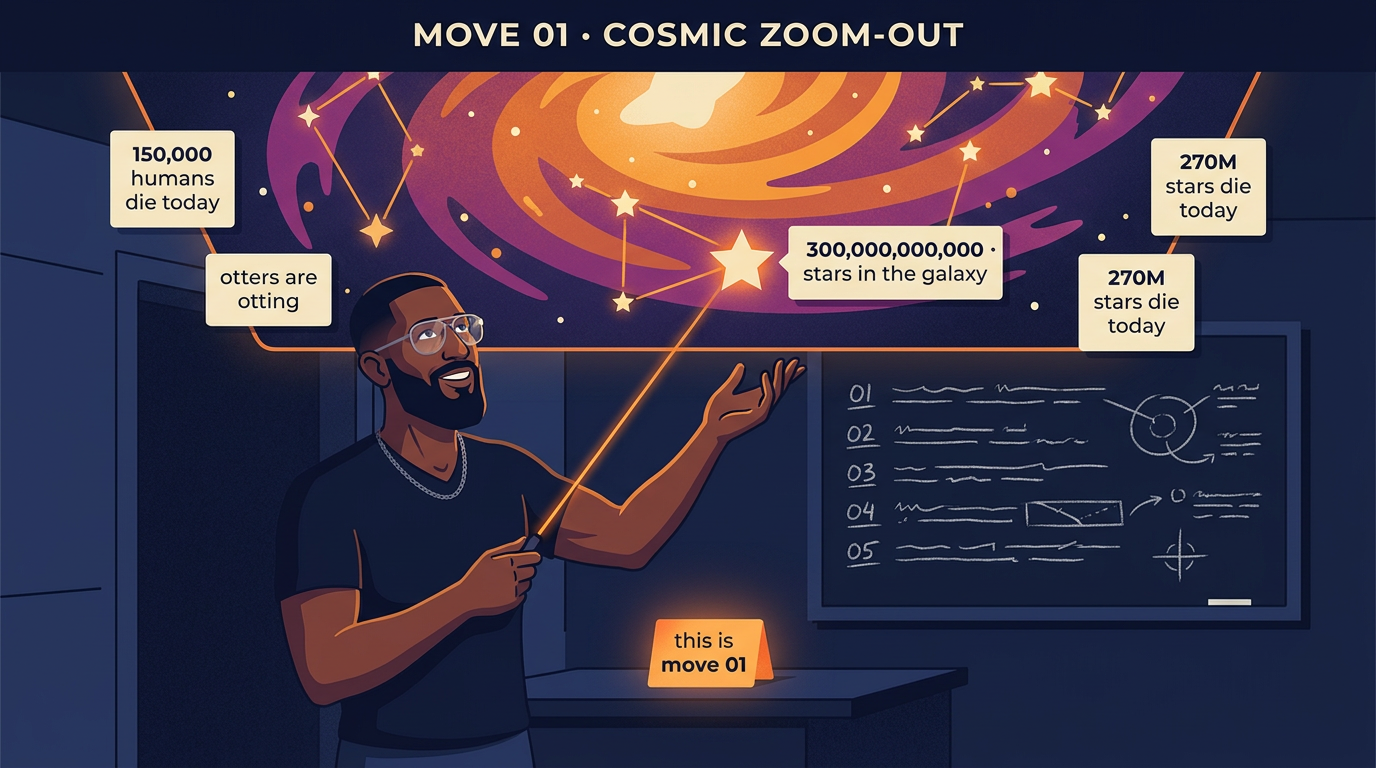
Move one, the cosmic zoom-out. Open every meaningful piece of work with a fact about the world that is true at a scale much larger than the reader's current mental zoom. Not a hook. A fact. The Existence Forecast does this with 150,000 deaths. The Fermi Paradox does it with 300 billion stars. This article opens with the same forecast because the move is reproducible. The function of the cosmic zoom-out is to break, in a single sentence, the projection-mode default. The reader cannot continue to use the work as a comfort drip when the first sentence has placed them on a planet with otters and dying suns. The cosmic zoom-out is a state-change operator on the reader's internal weather. Use it deliberately. Do not pad it with adjectives. The numbers do the work alone if you let them.
Move 2: the small situated human
Move two, the small situated human. Immediately after the cosmic zoom-out, place a single small human inside the frame, doing one specific small thing. Guido Marconi, four and a half, trying to imagine a color that does not exist yet. A xenopsychologist drawing the word Hello in the sand at dusk. A graduating senior in a supermarket queue. Tomorrow morning, you, sitting at your laptop, deciding whether to open the doc or open the feed. The small situated human is the proxy through which the reader steps into the cosmic frame. Without the small human, the cosmic frame is intimidating and the reader bounces. With the small human, the cosmic frame becomes a room the reader can sit inside. This is how Mary Oliver gets you to pay attention to a snake in a swamp without you ever wondering why you are reading about a snake in a swamp.
Move 3: the patchwork people
Move three, the patchwork people. Build characters, or describe yourself, with the texture the alien transcript demands of its workers, "a desperate love and a cherished secret." Real characters in your work, the ones the reader returns to think about, are characters with at least two dimensions of inadequacy or longing the reader recognizes from their own internal weather. Generic characters trigger projection. Patchwork characters trigger recognition. Recognition is the thing projection cannot generate, because projection requires a smooth surface to project onto and patchwork characters are too lumpy. The reader sees the lump and recognizes it as their own lump. They stop projecting and start identifying, which is a structurally different cognitive operation. Identification is the entry door to actualization mode. Without identification, the bridge has no near end the reader can step onto.
Move 4: the unfinished sentence
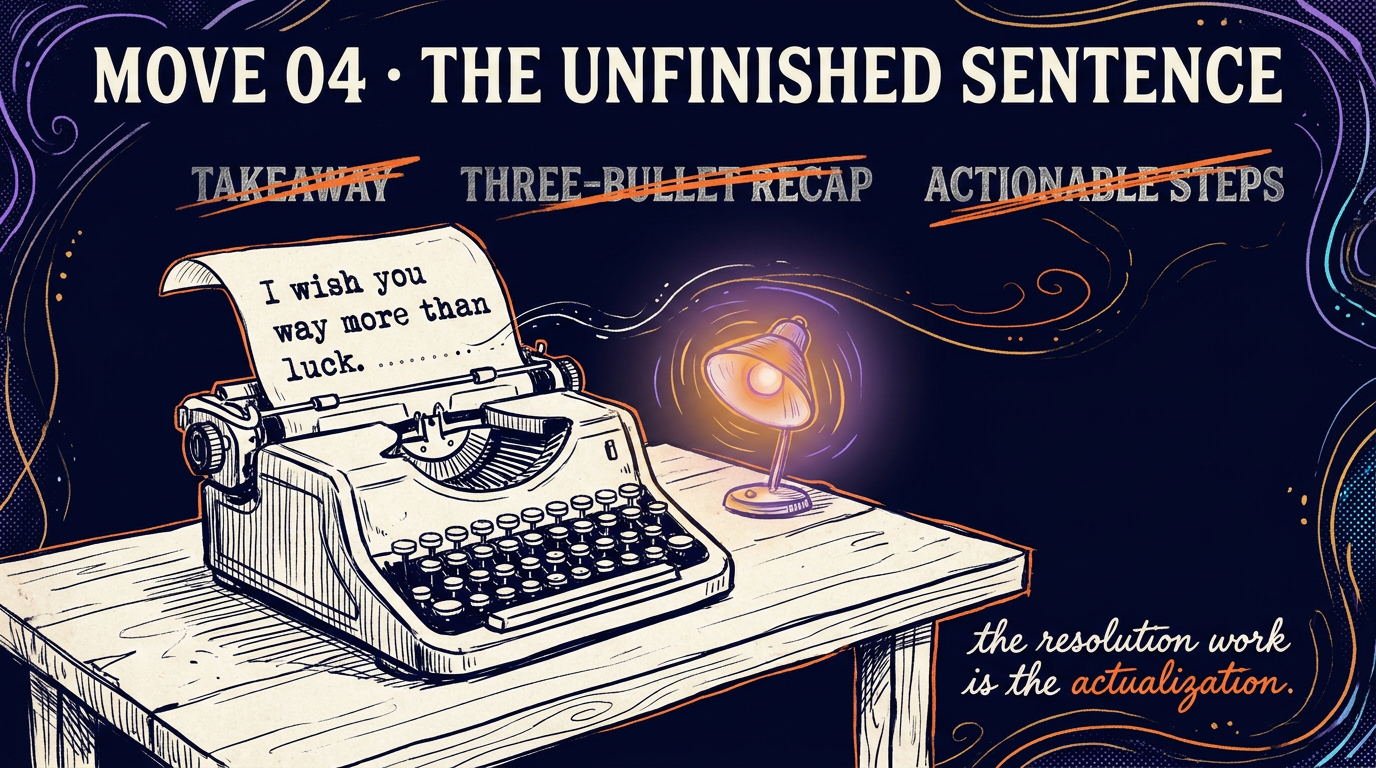
Move four, the unfinished sentence. Refuse to give the audience the resolution they are waiting for. The reader has been trained, by 10,000 pieces of optimized content, to expect a takeaway, a tactic, a three-bullet summary of how to apply the insight. The minute you give the takeaway, you collapse the bridge into a mirror. The reader files the takeaway and goes back to projection mode. This Is Water ends, famously, with the words "I wish you way more than luck." It does not say what to do. It says, this is water, and stops talking. The Exurb1a alien transcript ends with the line "It's a yup," delivered by an earthling diplomat to an alien who has just received the most loaded greeting in the history of contact. The sentence does not resolve. The unresolved ending forces the audience to do the resolution work themselves, and the resolution work is the actualization. Most creators are too afraid to leave the sentence unfinished. Most readers are starving for a creator brave enough to do it.
Move 5: the yep-yep-yep
Move five, the yep-yep-yep. When you do offer concrete instruction, offer it casually, almost embarrassed, as if you cannot quite believe you are being so direct. Naval does this constantly. He says, in a tweet, "Read what you love until you love what you read," and then changes the subject. The reader is left holding the instruction without a sales-page wrapper around it. The instruction has more weight, not less, for being delivered without ceremony. Casual delivery of high-stakes instruction is the move that signals a creator who is fluent in the territory rather than impressed by it. The audience can tell the difference. They have been marketed to thousands of times. They know the cadence of someone who is selling them something and the cadence of someone who is just telling them how the world actually is. The cadence of nonchalance is the cadence the audience has stopped hearing because almost no one uses it anymore.
How the five moves stack inside a single piece of work
The five moves stack. A piece of work that runs all five in order, cosmic zoom-out then small situated human then patchwork characters then unfinished sentence then casual instruction, will do measurable work on the reader's internal weather even if the reader cannot articulate why. This is the structural skeleton underneath the canon, reproducible because it tracks the actual phenomenology of how a human consciousness crosses an internal barrier. The same five-move sequence, run in the operator register rather than the cosmic register, also describes the inside of a good consulting engagement. The cosmic zoom-out is the diagnostic that places the operator's specific bleeding inside a structural pattern other operators have hit and survived. The small situated human is the operator themselves, last Tuesday, looking at a dashboard that no longer makes sense. The patchwork characters are the operator's team, each a real person with a desperate love and a cherished secret. The unfinished sentence is the recommendation that requires the operator to make a structural choice the consultant cannot make for them. The casual instruction is the next-action note that gets sent on Friday afternoon, no ceremony, two sentences, here is what we do Monday.
The cosmic zoom-out interrupts default mode. The small human invites identification. The patchwork characters trigger recognition. The unfinished sentence forces resolution work. The casual instruction is metabolized as advice from a friend rather than pitch from a vendor. Every step is doing a specific cognitive job. None of the steps are decorative.The metric that survives the mirror
Why the platform cannot see the metric that matters
The reason most creators cannot run the architecture above is not that they do not understand it. The reason is that their measurement system makes it look unprofitable. Engagement rate, watch time, follower growth, share count, comment volume, save count: all of these are standard creator metrics and all of them are Mirror Ocean metrics. They reward the loop where the audience interacts with the work without changing because of the work. The platform measures what the platform can see, and the platform cannot see transformation. The platform can only see whether the audience clicked, scrolled, lingered, or resurfaced. It cannot see whether the audience quit a job, started a project, apologized to a parent, or sat down at a piano they had been avoiding for three years.
Transformation rate: the diagnostic the dashboard cannot fake
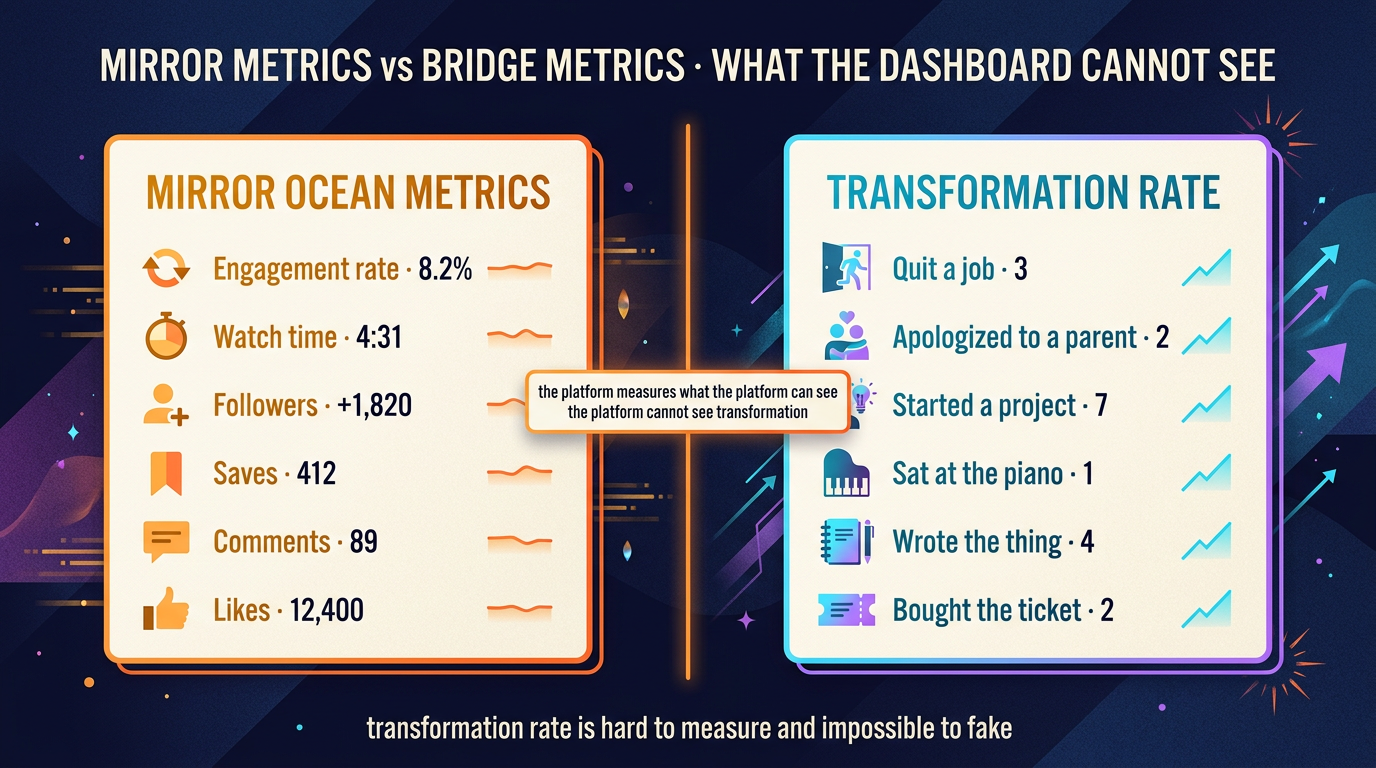
The metric that survives the Mirror Ocean is the transformation rate. The transformation rate is the percentage of your active audience that, in any rolling window, takes a real action in the external world that they attribute to your work. Transformation rate is hard to measure and impossible to fake. You measure it by reading the inbound mail your audience sends you and counting, by hand, how many of those messages describe a behavioral change rather than a feeling. The ratio is shockingly diagnostic. Mirror Ocean creators get inbound that is roughly 90% feeling-reports ("this resonated," "this articulated something I had been feeling," "thank you for putting this into words") and 10% action-reports. Bridge creators get inbound that inverts the ratio. The action-reports describe specific things the reader did because of the work. They quit. They moved. They wrote. They shipped. They left. They returned.
The market is slowly learning to price the bridge above the mirror
This is also, not coincidentally, the metric that produces the most durable audiences over multi-year horizons. Recent creator-economy reports have begun, slowly, to weight depth signals like saves, shares, and return engagement more heavily than likes, on the empirical observation that depth signals correlate to long-term commercial outcomes much more reliably than reach signals. The market is, slowly, starting to price the bridge above the mirror. The market is also still measuring the bridge with mirror tools, which is why the pricing remains imperfect. The creators who will benefit from this transition are the ones who started building bridges before the metrics caught up. By the time the dashboard rewards transformation, the audiences worth having will have already aggregated around the creators who were doing the work when nobody could see it.
The same logic applies inside operator engagements. The coaching launch that produced $199,500 in direct sales inside 30 days closed at 60 to 70 percent because the engagement architecture forced every applicant to choose, in writing, the specific behavioral change the next quarter would produce inside their own business. The transformation rate was visible in the buyer's calendar before it was visible in the dashboard. This is the test for any creator practice oriented toward depth: does the work change the calendar, or does the work change the metrics? Calendar-changing work eventually shows up in metrics. Metric-changing work that fails to change the calendar is Mirror Ocean work, and the calendar reveals that long before the platform does.
The cost of becoming weird enough to translate
There is, in the alien transcript, a moment near the end that I keep thinking about. The narrator has built his town and lost it to a green-gold rush, watched his rocket sink into the ground, sailed across the world to find an older version of himself living alone among the imitations, learned that he himself is a copy of a copy, and finally returned to the town with no plan to leave. He looks up. Two earthlings descend from the orbit where his ship has been waiting. They are real people. They have evolved on a world suited to them. The narrator goes to greet them and they step back and exchange a glance, because his eyes are no longer human. They are green-veined orange, "clouded like silty water built to watch a sky far from earth's." He has become the bridge. He is more ocean than man now. The ones who can talk to both sides are the ones who have paid the cost of becoming weird enough to translate.
This is the cost of building the deepest type of audience relationship. You become slightly weird. You stop sounding like the other creators in your space. Your eyes change color. The audience that arrives is the audience that wanted that particular weirdness, and they are not, by raw count, the largest possible audience. They are the audience that will still be there in five years, that will buy the second book and the fourth product and the tenth piece, that will refer the work to the small number of friends who can hold it. The Mirror Ocean creators are loud and many, and their audiences churn through them on a six-month half-life. The bridge creators are quieter and fewer, and their audiences compound for decades. Pick which game you are playing before you start optimizing for it. The two games look similar from the outside and produce wildly different lives on the inside.
What to write down tomorrow morning
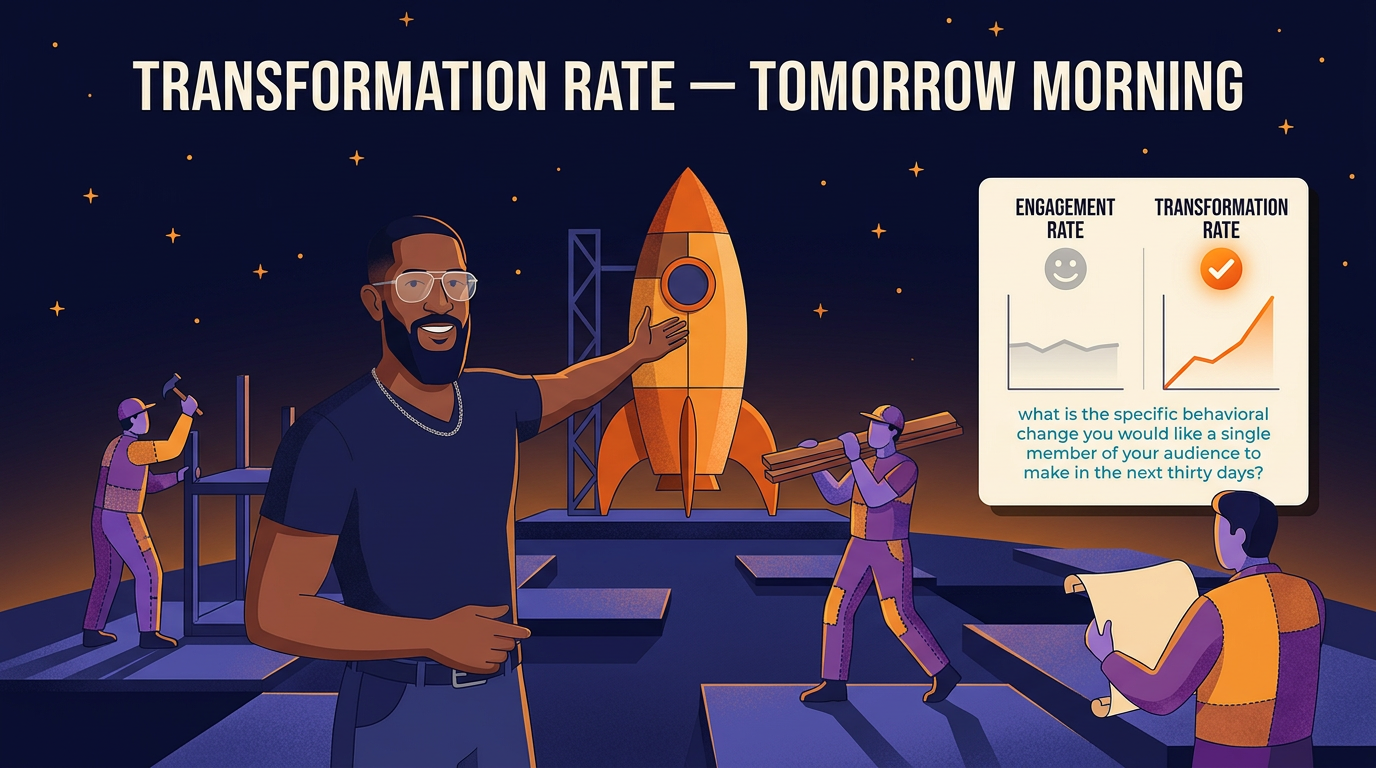
Tomorrow morning, before you open the dashboard, write down the answer to one question on a piece of paper. What is the specific behavioral change you would like a single member of your audience to make in the next 30 days because of something you put into the world? If the answer is "engage more with the content," you are running mirror mode and the dashboard will flatter you indefinitely. If the answer is something specific in the external world, something that costs the audience member real internal calories, you are running bridge mode and the dashboard will lie to you for a long time before the underlying compounding becomes visible. The dashboard's blindness to your real metric is the gate that keeps the Mirror Ocean creators out of your audience. Be patient with the lying dashboard. Pay attention. Be astonished. Tell about it. The instructions are seventy years old, written by a poet from Ohio, and they are still, as far as I can tell, the only instructions that work.
The remaining sections of this article are the applied layer. The first seven sections were the theory. What follows is the operator's version. The same bridge, named in the language a person actually uses on a Tuesday morning when their spend is on fire and the team is asking what changes. Every claim from here forward is grounded in a real engagement, a real number, a real decision I made or watched made. If the theory above resonated, the applied layer below is where the resonance gets cashed.
The PPP framework as bridge architecture
Stages 1-3: the Scar Tissue Audit, the Future, the Transformation
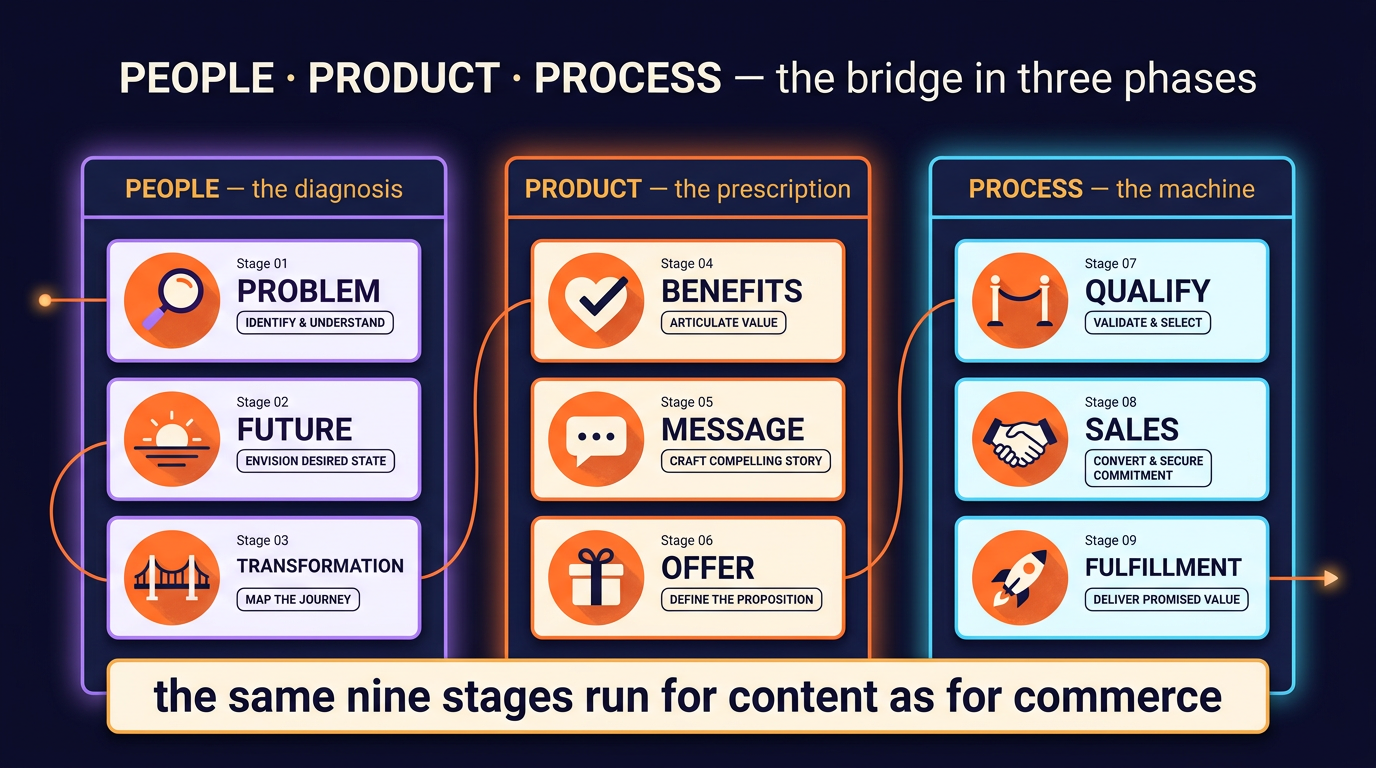
The framework I run for every commercial engagement is the same one I described in the People · Product · Process essay in the operational-systems silo. It is nine stages across three phases:
- People phase: Stage 1 Problem, Stage 2 Future, Stage 3 Transformation. The buyer's pain, dream, and bridge.
- Product phase: Stage 4 Benefits, Stage 5 Message, Stage 6 Offer. The deliverable and how it gets named to the buyer.
- Process phase: Stage 7 Qualify, Stage 8 Sales, Stage 9 Fulfillment. The system that delivers and reinforces the result.
It is also, when you read it carefully, the exact bridge architecture this article has been describing in the abstract. The cosmic zoom-out is Stage 1 in operator dress. The patchwork people are Stage 4 in audience form. The qualification gate is Stage 7 in commercial form. The unfinished sentence is Stage 9. The PPP framework is what bridge architecture looks like when an operator has to invoice for it.
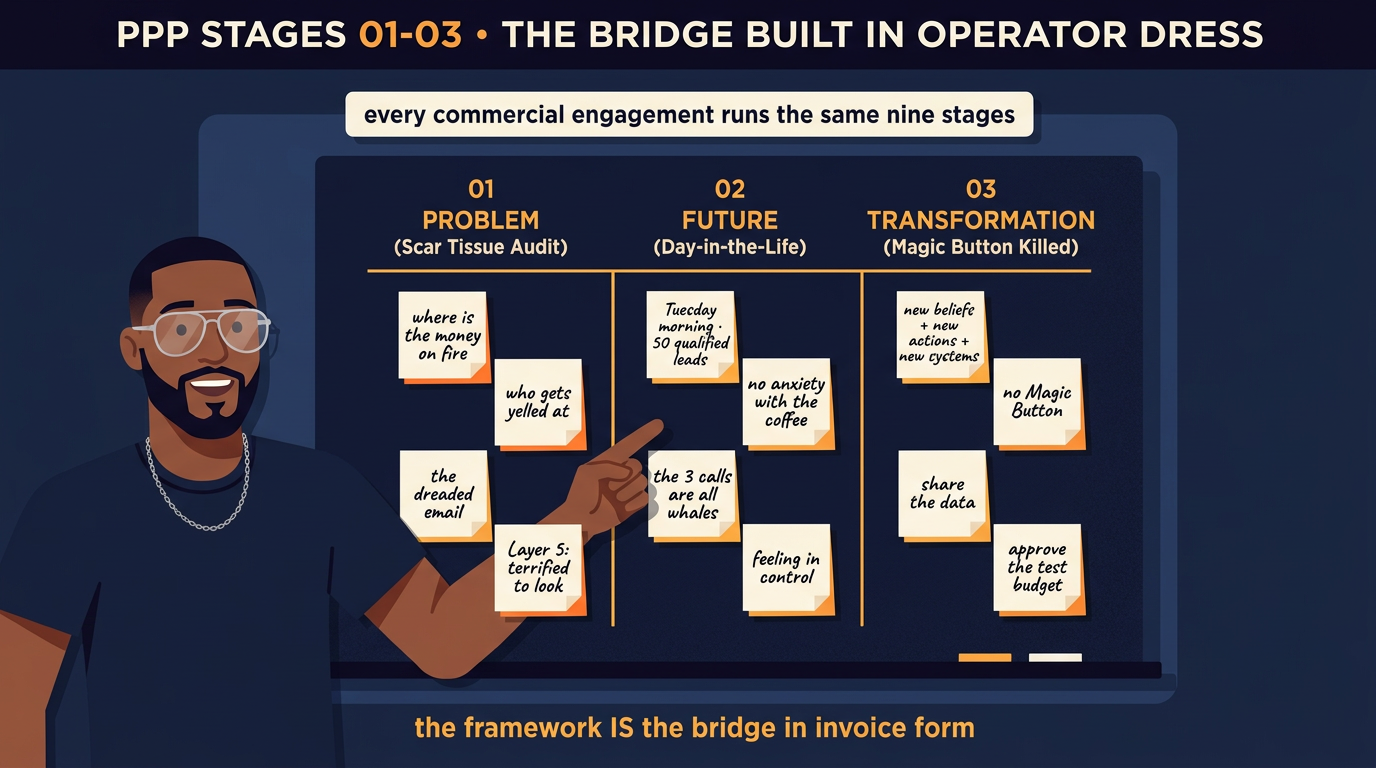
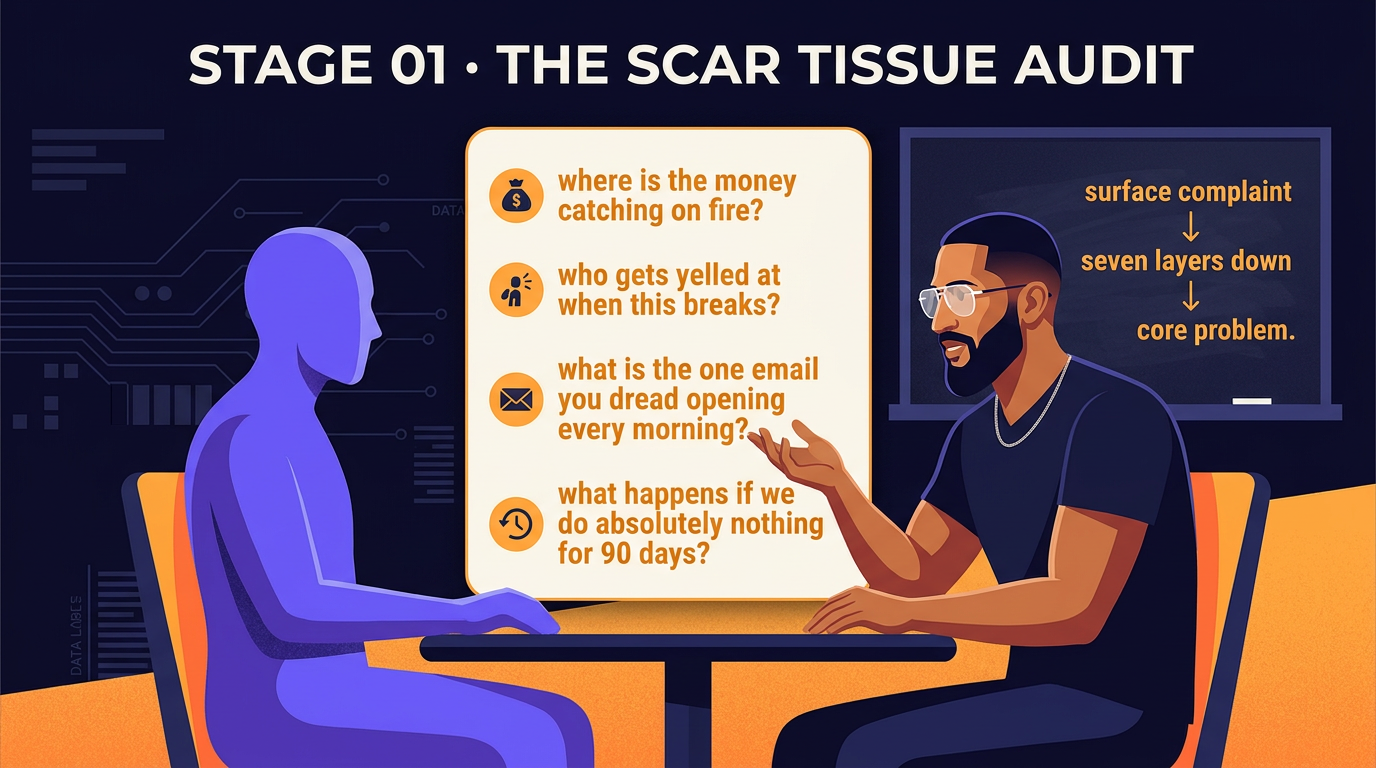
Stage 1 is the Problem. The mistake almost every consultant and creator makes is defining the problem in relation to their own solution. The fence company says "the problem is they don't have a fence." The web developer says "the problem is they have an old website." The AI engineer says "the problem is they don't have an agentic workflow." Every one of those framings is a Mirror Ocean. The audience or buyer is being asked to look at themselves through the vendor's category and confirm what the vendor already wanted to sell. The bridge version is what I call the Scar Tissue Audit: act like a forensic accountant for stress, ask where the money is actually catching on fire, ask who gets yelled at when this breaks, ask what is the one email the operator dreads opening every morning, ask what happens if we do absolutely nothing for 90 days. The questions are uncomfortable on purpose. The discomfort is the bridge.
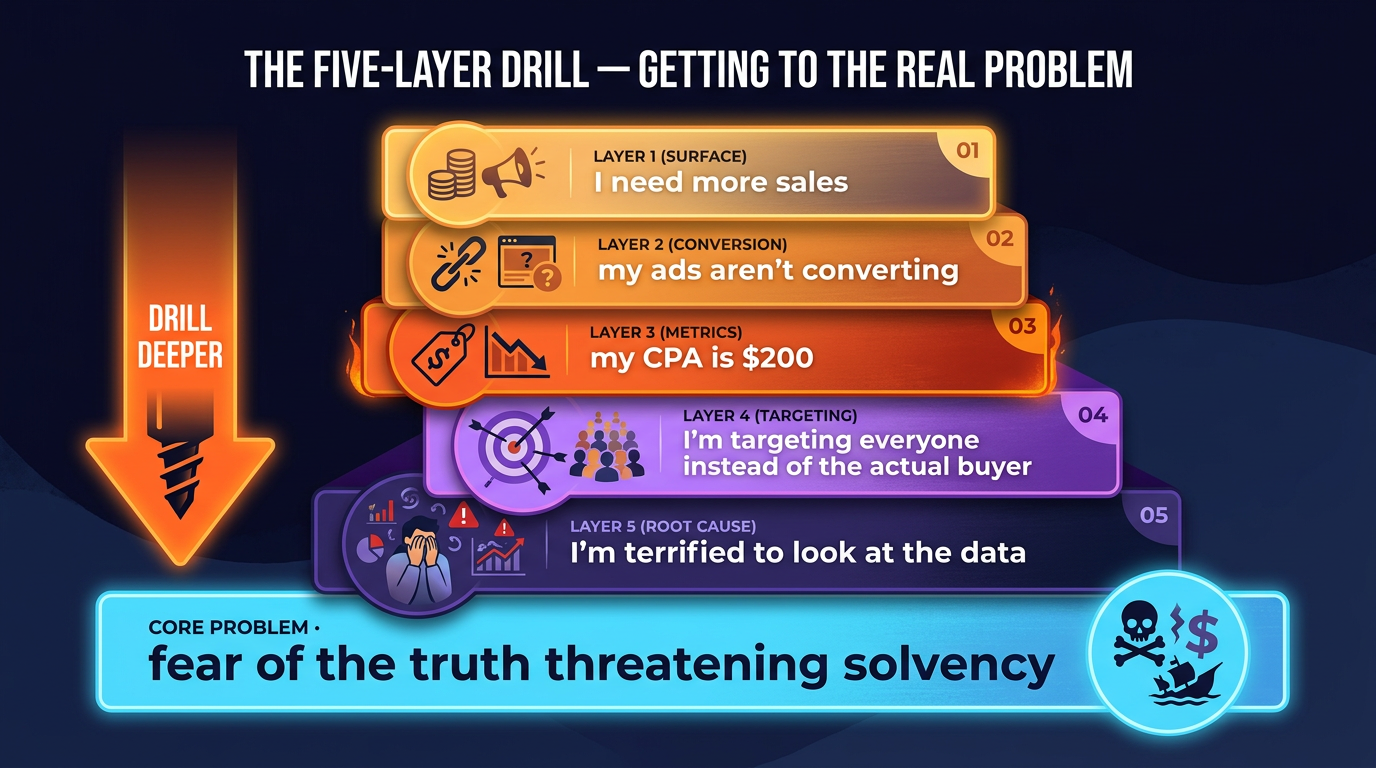
Underneath every surface complaint is what I call the Seven Layers Deep stack. A buyer says "I need more sales." That is Layer 0. Layer 1 is "my ads aren't converting." Layer 2 is "my CPA is $200." Layer 3 is "I'm targeting everyone instead of the actual buyer." Layer 4 is "I don't know who the actual buyer is because I've never looked at my data." Layer 5 is "I'm terrified to look at the data because I might realize I've been burning cash on vanity metrics for two years." Layer 5 is the bridge. The work that solves Layer 1 without addressing Layer 5 will be sabotaged by the operator the moment the new campaign produces numbers that make the underlying terror harder to ignore. This is the structural reason most consulting engagements fail. The Mirror Ocean version of the work delivers a Layer 1 fix; the bridge version refuses to ship Layer 1 until Layer 5 has been named in the room.
Stage 2 is the Future. The buyer doesn't actually want a website, more leads, or a new agent system. The buyer wants the future identity those things imply. David Foster Wallace's supermarket queue works as a content move because the future the speech offers is "an adult who chooses what to attend to" rather than "a graduate with a higher GPA." The same dynamic operates in commerce. The roadside-assistance customer at two in the morning with a flat tire is not buying a tow. They are buying their own bed at home and the disappearance of helplessness. The Future is a lived reality, not a metric. An operator who articulates the buyer's future state better than the buyer can has done the bridge work the buyer cannot do alone, which is exactly the move the alien narrator wishes the ocean could perform and the ocean structurally cannot.
Stage 3 is the Transformation. This is the bridge made operationally explicit. You cannot cross a chasm in two small jumps. The buyer who wants a forty-thousand-dollar monthly profit but refuses to spend more than $500 on testing is operating under what I call the Magic Button Fallacy: the wish to change the output without changing any of the inputs. A creator running Mirror Ocean rewards the wish, takes the deposit, and produces a deliverable that pretends the inputs were sufficient. A creator running bridge architecture refuses the engagement until the operator has named, in writing, the specific behaviors and beliefs that must change for the desired future to materialize. The transformation equation is straightforward: new results equal new beliefs plus new actions plus new systems. If any one of the three is zero, the result is zero. Stage 3 is where most engagements quietly die, and where the deepest commercial relationships actually begin.
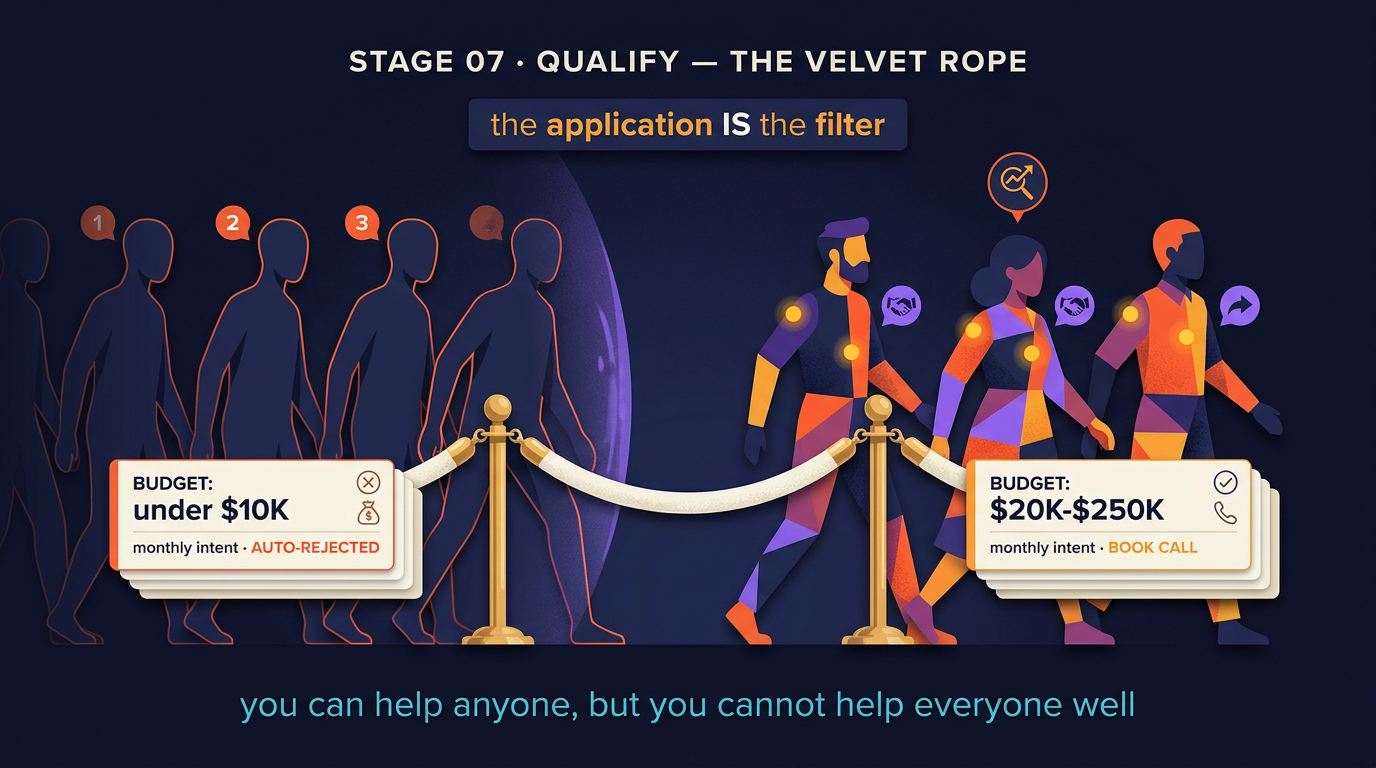
Stage 7: qualification as the deepest commercial form of caring
Stage 7 is Qualification, and it is the cleanest commercial expression of the courage barrier. The Velvet Rope wiki essay describes the move in full detail. The principle is what I call the Conservation versus Hunting distinction. Hunting is going after every possible buyer, taking any deposit, working with anyone with a pulse and a credit card. Conservation is having the confidence to actively repel buyers who are not a fit. In one of the lead-generation rebuilds I documented as the Lead-Gen Funnel Overhaul case study, we inserted a single qualification question into the application form. "How much do you want to make in the next 90 days?" If the answer was under $10,000, the system auto-rejected the application before the calendar ever opened. The agency owners initially panicked: we are turning away business. We were not turning away business. We were filtering for the buyers whose ambition matched the price of the engagement. CPL dropped from $200 to under $20, the close rate climbed, and the sales team stopped burning out on calls with people who could never have afforded the service. The gate was visible. The gate was the feature.
The mechanism that makes this work commercially is identical to the mechanism that makes existential confrontation work editorially. Filtering aggressively is not the opposite of caring. Filtering aggressively is the deepest commercial form of caring. A creator who fails to filter ends up with an audience composed of people who only stay as long as the work makes no demands on them, which is the audience nobody actually wants. A consultant who fails to filter ends up with a roster of clients who refuse to do the transformation work and then blame the consultant when the result does not materialize, which is the practice nobody actually wants. The filter is the gift. The filter is what allows the people on the right side of it to receive the operator's full attention without that attention being diluted by people who have not yet committed to crossing.
Stage 9: fulfillment is where the work begins, not where it ends
Stage 9 is Fulfillment, and the rule there is identical to the rule for the unfinished-sentence move in editorial work. The close does not benefit the operator; the close benefits the buyer. Most fulfillment is an afterthought because the deal closed and the dopamine hit fired. Most editorial work ends with a sales-ready takeaway because the writer wants the click. Both are versions of the same Mirror Ocean failure. The deepest commercial relationships and the deepest editorial relationships both treat the moment of consumption as the start of the work, not the end of it. An article that is still doing work in the reader's life six weeks after they read it is the same artifact, structurally, as a consulting engagement whose effects show up in the operator's calendar six months after the engagement closed. The compounding is the bridge. The compounding is what the dashboard cannot see.
The PPP framework is therefore not a sales methodology. It is the operator's vocabulary for the same architecture this article has been describing in the editorial register. Read the full essay in the operational-systems silo when you have an hour and a yellow legal pad. The nine stages, applied seriously to your own practice as either creator or operator, will reorganize how you spend the next quarter of your attention. The reorganization is uncomfortable on purpose. The discomfort is the bridge.
The forensic audit as cosmic zoom-out
What the audit actually does
The cosmic zoom-out has a commercial cousin that nobody calls by its real name. The cousin is the forensic ad audit. I documented this engagement type as one of the case studies on this site, and the structure of it is identical to the structure of the existence-forecast move. A buyer arrives anxious, certain something is wrong but unable to name what. The audit places the buyer's specific bleeding inside a structural pattern other operators have hit and survived. The buyer's situation, which felt unique and shameful and possibly terminal, becomes a known shape with known causes and known fixes. The relief is identical to the relief a reader feels when an Exurb1a video names the exact internal weather they have been pretending not to feel. The diagnostic is the bridge.
The mechanics of the audit are described in detail in the Intelligence Engineering wiki essay, and the diagnostic muscle behind it is what I called the Scar Tissue Audit in the previous section. In commercial form, the four questions become specific to the platform under review. Pull the ad account exports. Segment by campaign objective, by audience, by device, by funnel stage. Reconcile reported performance back to actual revenue, not platform numbers. Find where the dashboard is telling a story the bank account cannot confirm. Most accounts I have audited have ten to thirty percent of spend that can be reallocated or cut without hurting revenue, and a meaningful fraction of accounts I have audited have spend that is actively destroying revenue once you reconcile the reports against the real money. The platform is structurally incentivized to show numbers that justify continued spend, which means most operators are reading their own ad accounts inside a Mirror Ocean. The audit is what breaks the mirror.
The Five-Layer Drill applied to a single decision
The Five-Layer Drill is the operator's version of the cosmic zoom-out applied to a single decision point. The buyer arrives with a surface complaint. I keep asking why until the answer reaches the layer the buyer would not have named without help:
- Layer 0: "I need more sales."
- Layer 1: "My ads aren't converting."
- Layer 2: "My CPA is $200."
- Layer 3: "I'm targeting everyone instead of the actual buyer."
- Layer 4: "I don't know who the actual buyer is because I've never looked at my data."
- Layer 5: "I'm terrified to look at the data because I might realize I've been burning cash on vanity metrics for two years."
Layer 5 is the bridge. A consultant who solves Layer 1 has done about 8 percent of the actual work. A consultant who refuses to bill until Layer 5 has been named in the room has done what the buyer was actually paying for, which the buyer did not know they were paying for at the moment they signed.
Heroic Failure as the loudest signal of a broken system
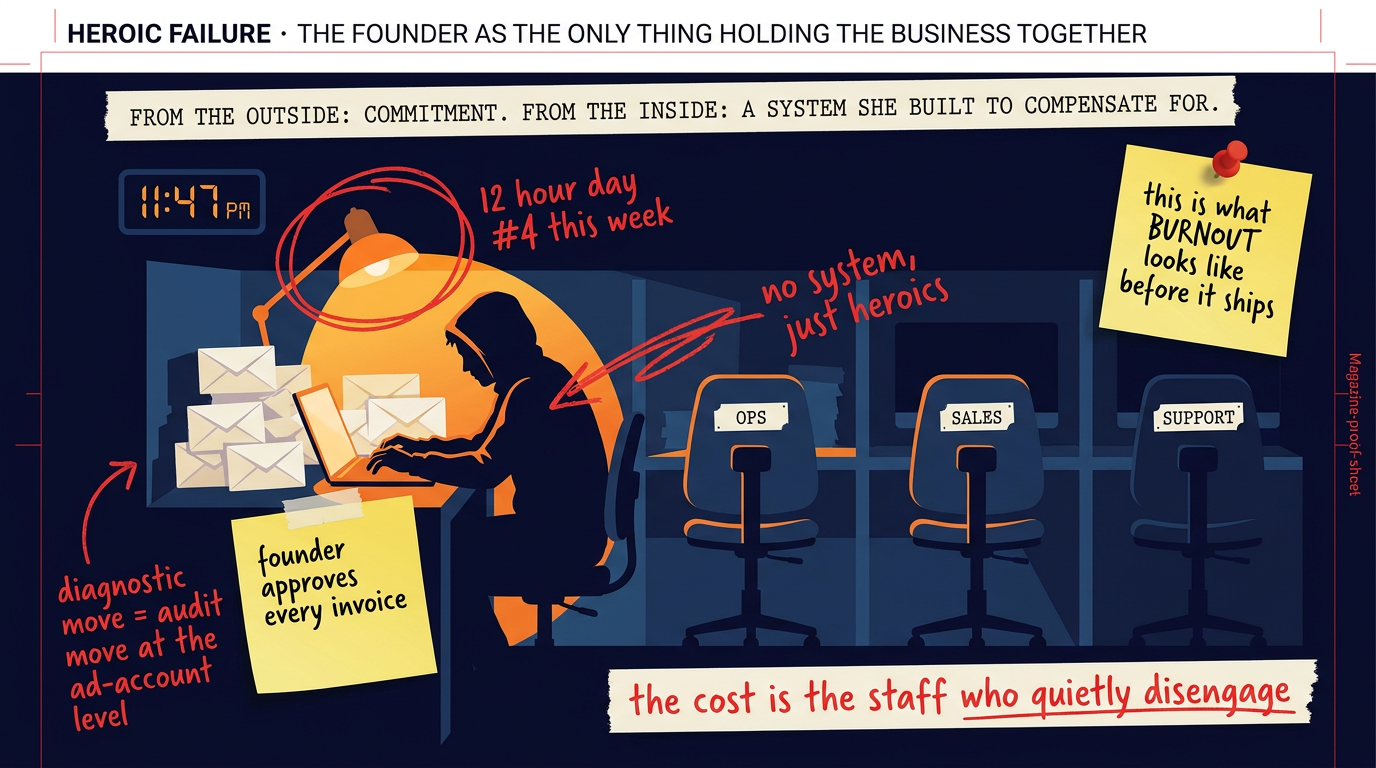
The four diagnostic questions of the Scar Tissue Audit, asked once on the first call and answered honestly, will surface more usable information about a business than four weeks of stakeholder interviews: where is the money actually catching on fire right now? Who gets yelled at when this breaks? What is the one email you dread opening every morning? What happens if we do absolutely nothing for 90 days?
The pattern that emerges across enough of these audits is what I call Heroic Failure, and it is the loudest signal of a broken operating system. The founder is working 80 hours a week. The founder approves every invoice. The founder personally onboards every new client. The founder runs support during evenings. From the outside, the founder looks committed and successful. From the inside, the founder is the only thing holding the business together, which means the business has no system at all, which means the moment the founder takes a Friday off something breaks. I wrote a field note specifically about this pattern, and the diagnostic move is identical to the audit move at the ad-account level: the heroic effort is a structural symptom of a system the founder has been compensating for. The cost of heroic failure is not the founder's time. The cost is the staff who quietly disengage because they cannot do their jobs without the founder unblocking them, and who eventually leave for organizations where the work makes sense.
The bridge architecture inside this audit is the same as the bridge architecture inside the editorial existence-forecast move. The audit does not flatter the operator, does not pretend the prior agency was secretly doing good work, does not soften the diagnosis to keep the engagement comfortable. The audit names what is on fire and lets the operator decide whether to keep paying for the fire or to pay to put it out. Most operators, when given the choice clearly, choose to put the fire out. The choice was always available; what was missing was the framing that made the choice visible. The People · Product · Process essay calls this Stage 1 work. It is the most important stage and the stage most consultants skip because it is uncomfortable to ask "what is the one email you dread opening every morning?" when the buyer is paying you to be the agency that fixes things rather than the agency that makes the buyer name what is broken.
Audit your audience the same way you would audit an ad account
The reason this matters for content practice and not just consulting practice: the same diagnostic architecture works at the level of an individual essay or video. A creator who treats their work as content marketing, as a way to attract attention to a sales funnel, will instinctively soften every diagnostic line because the funnel rewards comfort. A creator who treats their work as an extended audit of the reader's actual situation will instinctively sharpen every diagnostic line because sharpness is what produces the recognition that produces the bridge. The cosmic zoom-out is not a stylistic choice; it is a refusal to participate in the comfort economy that the platform rewards. The five creators in the canon section earlier in this essay are not unusually talented writers. They are unusually disciplined refusers. Each one of them, in their own register, is running the audit move on the reader's own life rather than on the reader's ad account, and the reader feels the same relief the operator feels when the audit reveals where the money was actually catching fire.
What this means in practice for a creator who wants to take this seriously: spend a quarter of your prep time on the operator-equivalent of the Five-Layer Drill applied to your own audience. What is the surface complaint your audience presents? What is the second layer they would name if pressed once? The third? Drill until you reach the layer the audience would not name to themselves without help. That layer is the only layer worth writing about. Everything above it is content marketing in the Mirror Ocean register. Everything at it or below is the bridge, and the audience that crosses that bridge is the audience that will still be there in five years. The drill is uncomfortable to do honestly because the deeper layers in your audience's life look very much like the deeper layers in your own life, and most creators avoid drilling because they have not done the work on themselves and do not want to be exposed by their own analysis. That is fine. That is also why almost no one does this work, and why the small number of creators who do it own the audiences worth owning.
The $199.5K month and qualification as the deepest form of caring
The launch that closed at 60 to 70 percent
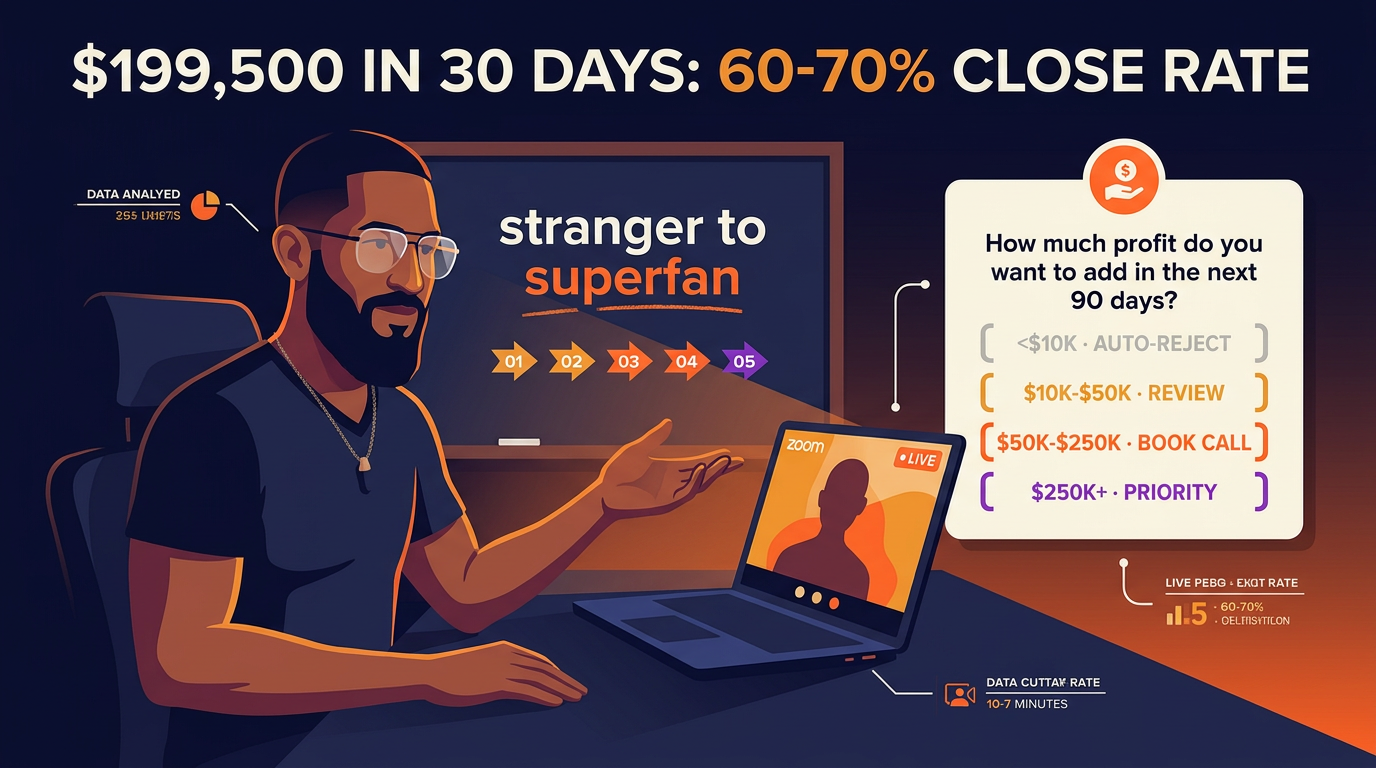
The cleanest single demonstration I have of the bridge architecture working at commercial scale is a coaching launch I built and ran in 2020 for a Facebook Ads expert who wanted to package agency experience into a high-ticket program without abandoning his client work. The numbers were $199,500 in direct sales inside 30 days, $206,000 in 35 days if you include the spillover. The number people remember is the topline. The number that matters is the close rate: 60 to 70 percent of qualified calls converted. A normal sales floor for high-ticket B2B services hits 20 to 30 percent on a good month. A 60-to-70 close rate is a different animal entirely, and the reason it was possible has nothing to do with closing technique and everything to do with the architecture in front of the call.
The mechanics are straightforward and worth naming because the same mechanics are reproducible by anyone with the courage to use them. The offer was a hybrid: a Done-With-You coaching program at $3,000 to $6,000 for buyers who wanted to learn the system, and a Done-For-You implementation engagement at $10,000 to $20,000 for buyers who wanted Andy or his team to run the ad accounts directly. The mix that closed was roughly 70 percent coaching, 30 percent implementation. The hybrid was not a pricing strategy. It was an objection-killer. Most coaching programs fail because the buyer secretly worries that buying coaching is admitting they cannot do the work themselves. Most agency engagements fail because the buyer secretly worries that the agency will hold the knowledge hostage. The hybrid offer killed both objections in the same brochure: you can hire us to do it, or you can hire us to teach you to do it, and the choice signals to the buyer that we are confident enough in the system to teach it rather than guard it.
The application that did the qualification before the call
The reason the close rate was 60 to 70 percent (rather than the typical 20 to 30) is that almost nobody with the wrong profile ever made it onto the call. The application form was the qualification gate, and the gate was structural. It included one operative question, asked in plain English: "How much profit do you want to add to your business in the next 90 days?" Each answer routed differently:
| ANSWER | ROUTING |
|---|---|
| Under $10,000 | Auto-reject before the calendar opens. Polite message + free resources. |
| $10,000 to $50,000 | Standard application review. Most coaching-tier buyers. |
| $50,000 to $250,000 | Priority calendar. Implementation-tier candidates. |
| $250,000 and up | Direct routing to Andy. Strategic engagement bracket. |
The under-$10,000 respondents never saw an available slot. They received a polite message that the program was likely not the right fit. The auto-rejection was not the cruelty it appeared to be; it was the gift to those buyers, who were spared a five-figure check they could not afford.
The agency owners in the case study panicked the first time they saw the auto-rejection live. We are turning away leads. The leads are filling out forms. Why are we filtering them out before our reps even get to talk to them? The answer is that the leads who selected "under $10,000" were never going to pay $5,000 to $20,000 for the engagement. In the parallel lead-generation case study, this exact filter dropped agency CPL from $200 to under $20, because the Facebook pixel learned to optimize for the application-completion event rather than the click event, and started finding humans who matched the profile of completed applications instead of humans who matched the profile of curious clickers. The filter was not just protecting the sales team's time. The filter was training the algorithm.

The auto-rejection of buyers under the threshold was not the cruelty it appeared to be; it was the gift to those buyers, who were spared a five-figure check they could not afford, and the gift to the buyers who did make it through, who received the operator's full attention rather than diluted attention split across people who could never have afforded the engagement.
Why this is the bridge architecture in commercial form
The buyers who did make it through the application were already partway across the bridge by the time they arrived on the call. They had typed, in writing, that they wanted to add tens of thousands of dollars in monthly profit to their business inside a quarter. They had committed to a specific number that would later be measured. They had self-identified as ambitious enough to spend five figures to get there. The application was the audience's first declaration of self. A buyer who has just declared, in writing, that they want to add $50,000 in monthly profit cannot easily turn around on a sales call and pretend they are casually exploring options. The act of writing the answer was the act of crossing the courage barrier I described in section four. The sales call was the second crossing, made possible because the first crossing had already happened.
The structure of the call itself was minimal. The Done-With-You option was always presented first, because most buyers wanted that one. The Done-For-You option was presented as an alternative for buyers whose calendars or temperament made the implementation work unrealistic. The full call architecture is described in the Velvet Rope essay. There were no closing scripts. There were no objection-handling drills. There were almost no objections to handle, because the objections had been pre-handled by the application form and by the educational content that had warmed the audience for 6 weeks before the launch. The work of the sale had been done before the call existed. The call itself was a final confirmation.
What this looks like in editorial form
The same architecture works for creators who do not sell coaching. A long-form essay can perform the qualification function the application form performs in commerce. The first thousand words of an essay are the application. A reader who is not the right reader for the rest of the essay will leave inside the first three paragraphs, and that is the correct outcome. The bounce rate on a bridge essay is not a failure metric. It is the qualification gate working as designed. A creator who tries to lower the bounce rate by softening the first thousand words is doing what the agency owners did when they panicked at the auto-rejection: trying to keep buyers in the funnel who were always going to be expensive to keep and impossible to satisfy.
The reader who is still here, in section ten of an article that is now well over 10,000 words, has already crossed two or three bridges. They have agreed to take the existence forecast seriously. They have agreed to consider that their own creator practice may be running Mirror Ocean architecture without their knowledge. They have agreed to entertain a forensic audit of their own audience-relationship habits. By the time they finish the essay, they have crossed enough bridges that whatever offer comes next, if it is calibrated correctly, will close at a rate that looks impossible to creators who never invested in the bridges. The math is not magic. The math is that the audience has self-selected through enough commitments that the remaining audience is the audience who was always going to convert. The email-sequence essay in the sales-and-growth silo describes the same dynamic at the email-sequence level: each email is a small commitment, the sequence is a series of bridges, and the buyer who reaches the conversion email is the buyer who already crossed five other bridges to get there.
When the bridge cannot be built: the ethical no
The Magic Button Fallacy and why most engagements quietly fail
The most expensive failure mode in commerce is the engagement that closes despite both parties knowing, at some submerged level, that the engagement should not have closed. The seller takes the deposit because the deposit is the deposit. The buyer signs the contract because the buyer wanted the future the contract implied. Six months later the deliverable has shipped, the dashboard shows numbers, and nothing in the buyer's actual life has changed. Both parties paid for a Magic Button, and the Magic Button does not exist. The People · Product · Process essay describes this in detail at Stage 3, where the framework names the buyer who wants the result without changing any of the inputs. The buyer wants a $50,000 monthly revenue line but refuses to spend more than $500 on testing. The buyer wants an AI agent that writes their reports but refuses to clean up the five hundred unstructured Google Docs that hold the institutional knowledge. The buyer wants a brand the market trusts but refuses to ship anything risky enough to be worth trusting.
The transformation equation behind all of this is brutally simple: new results equal new beliefs plus new actions plus new systems. If any one of the three is zero, the result is zero. The Magic Button Fallacy is the wish that the equation is exempt for the buyer's specific situation. The wish is universal, which is why almost every consultant or agency that has not internalized the equation ends up with a roster of disappointed clients who paid for the result without paying for the inputs the result required.
The test budget as risk reversal for honesty
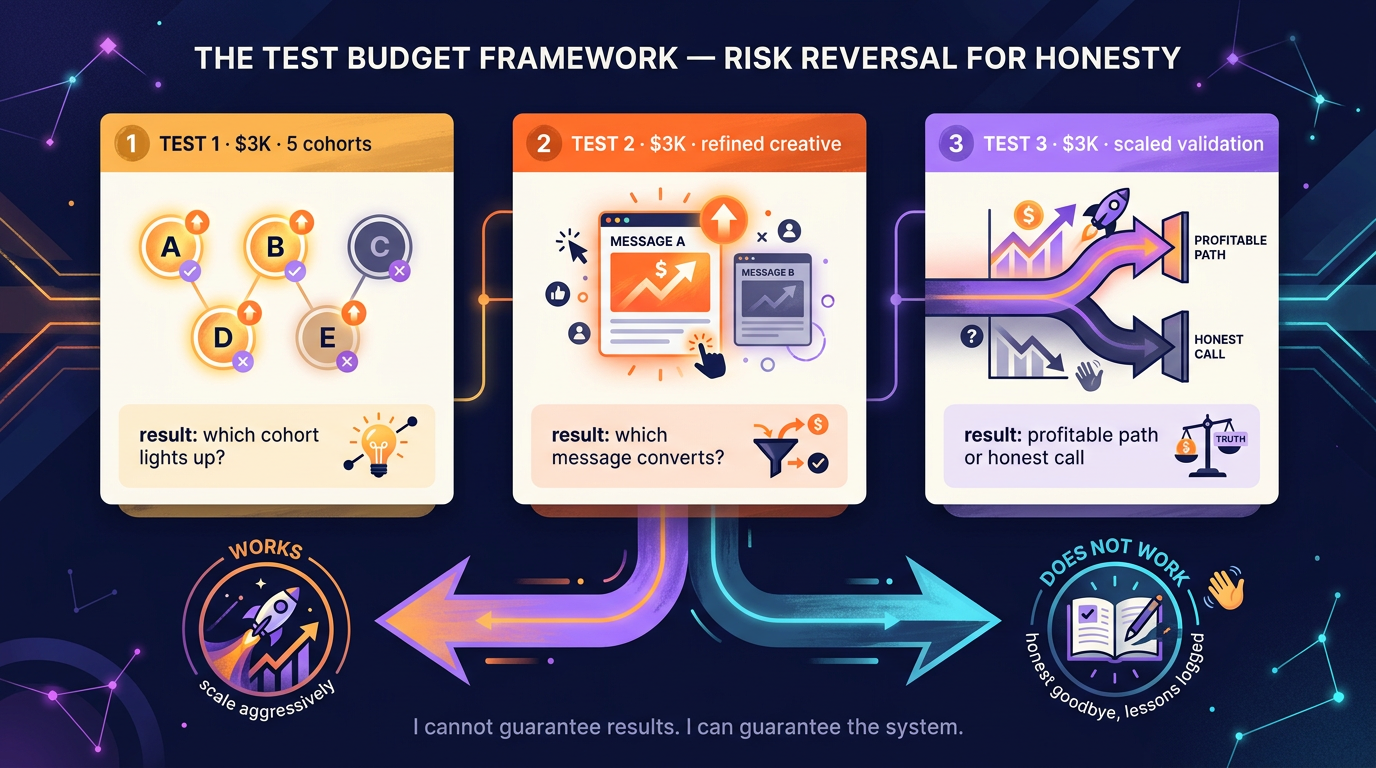
The mechanism I use to filter for the buyers who can actually be helped is what I call the test budget framework, and it operates simultaneously as a risk reversal for the buyer and a structural exit for engagements that should not continue. The structure is staged across three rounds, $2,000 to $3,000 each, with each round answering a single question:
| ROUND | QUESTION | DELIVERABLE |
|---|---|---|
| 1 | Which cohort actually buys? | Validated buyer profile |
| 2 | Which message resonates? | Validated creative direction |
| 3 | Can unit economics close at scale? | Profitable path or honest call |
Each round produces information regardless of whether it produces sales. The information is the deliverable; the sales are the bonus.
What this does for the buyer is reframe the engagement from "did Andy make me money" to "did the staged tests produce decision-grade information." A buyer who walks away after round one with the information that no profitable cohort exists has not been ripped off; they have been spared the much larger expense of finding out the same thing six months and $100,000 later. The forensic-ad-audit case study includes engagements that ended at this stage, and the buyers who experienced those endings were the buyers most likely to come back for a different engagement later because the no had been delivered with the same diagnostic care as a yes would have been.
What walking away clean looks like
new results = new beliefs + new actions + new systems. If any one of the three is zero, the result is zero. The Magic Button Fallacy is the wish that the equation is exempt for the buyer's specific situation. The wish is universal.
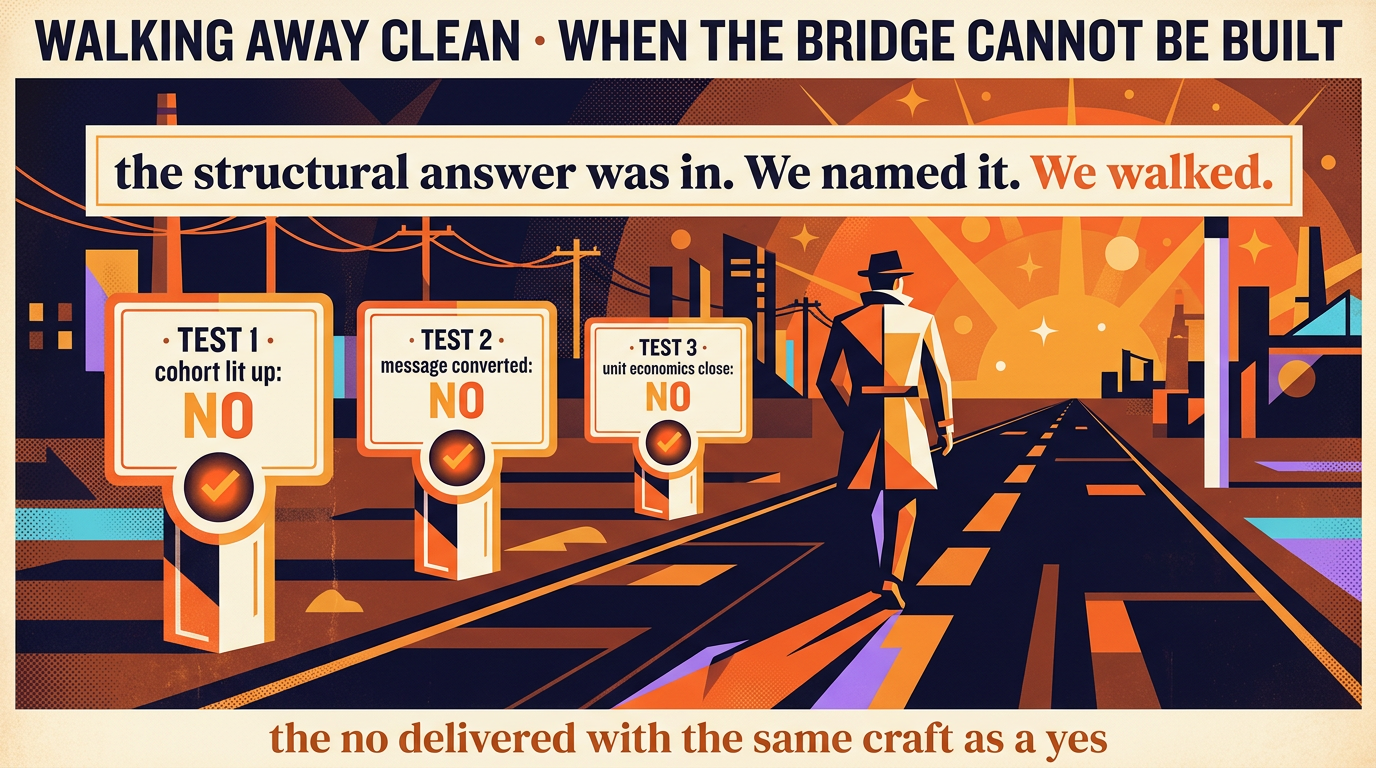
I have run engagements where the staged tests produced very high engagement numbers and zero buying behavior. Click-through rates well above industry norms, dwell times that suggested fascination, audience growth that looked like the start of something. None of it converted. I have run them through the test budget framework and watched the structural pattern reveal itself: the audience was not actually a market. The product was beautiful, the creative was strong, and the buyers who would have justified the work simply did not exist at scale. The structural answer in those cases is to stop, name what was learned, and walk away clean. The temptation in the moment is to run a fourth test, then a fifth, then a sixth, dressed up as further optimization. The temptation is the Magic Button Fallacy operating through the consultant rather than through the buyer. A consultant who keeps running tests after the structural answer is in is sabotaging the bridge by refusing to acknowledge that the bridge cannot be built.
This is a market reality. High click-through rate signals engagement, which the audience pays nothing for. Real intent costs the audience something concrete: money, time, or identity-shift. Many audiences who engage will never pay any of those costs. Buyers will engage with beautiful creative for the same reason readers will scroll past a stunning piece of long-form content without ever returning to the source. Engagement is cheap, and the platform rewards engagement specifically because engagement is cheap. The honest engagement pattern is to identify whether your audience is one of those audiences early, before too much capital has been committed, and to deliver the no with the same craft you would have delivered the yes.
Why saying no is the deepest commercial form of bridge work
The reason this matters for the bridge architecture: a creator or operator who cannot say no has, structurally, also given up the ability to say yes. A yes that includes everyone is the absence of a filter. The yes that means something is the yes that another buyer just received a no, and that no was delivered with the same attention to truth that the yes received. This is what the Lead-Gen Funnel Overhaul case study demonstrates at the application-form level. The auto-rejection of buyers under $10,000 in ninety-day intent was not the cruelty it looked like to the agency owners who first saw it. The auto-rejection was the gift to those buyers, who were spared a five-figure check they could not afford, and the gift to the buyers who did make it through, who received the agency's full attention rather than diluted attention split across people who could never have afforded the engagement.
The same dynamic operates editorially. A creator who tries to write to every reader has, by definition, abandoned the readers who came for the bridge. The reader who would have been changed by the work cannot be reached if the work has been softened to retain readers who were never going to change. The softening is invisible to most creators because the platform rewards it: a softer essay reaches more people, generates more engagement, and produces more visible progress on the dashboard. The dashboard cannot see the readers who would have been changed by the harder essay, because those readers never showed up in the metrics; they crossed the bridge silently, took the work into their lives, and the work did its job invisibly. The dashboard can only see the readers the soft essay retained, who are the readers least likely to do anything in the external world because of the work. The platform's blindness to transformation is structural, and the creator who optimizes against the dashboard is structurally selecting for an audience that cannot be transformed.
The practical move is to develop a list, written down on actual paper, of the readers or buyers you are willing to lose in order to keep the work true. The pricing page on this site is an explicit version of this list rendered as commerce: the engagements named there are the engagements I can do well, the price points named are the price points at which I can do the work without resentment, and the buyers who cannot afford those price points are buyers I am willing to lose to other consultants who can serve them better. The pricing page is bridge architecture in invoice form. A creator's equivalent is the editorial line you are willing to lose readers over. If you cannot name three editorial lines you will not soften regardless of audience cost, you have not yet built a bridge; you have built a Mirror Ocean with better lighting, and the audience you are growing is the audience that will leave the moment a better-lit Mirror Ocean appears next to yours.
Speaking the audience's language at the calorie level
Where buyers are actually honest
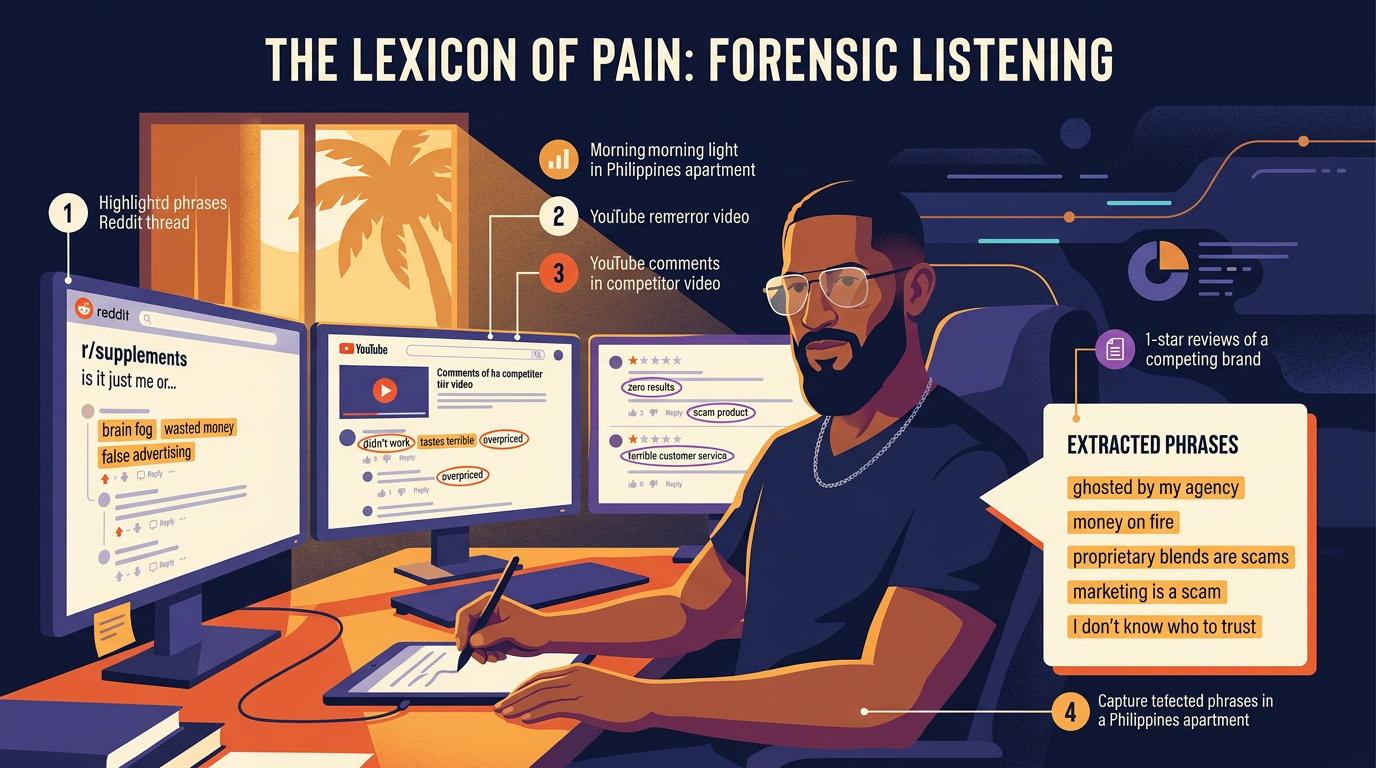
Most market research is collected in the places where buyers are least honest. Surveys ask people what they want and people answer with the version of themselves they want to project. Interviews ask people about their problems and people respond with the version of the problem they have already framed as flattering. Founders ask their customers what to build next and customers reply with the version of the answer that makes the customer look thoughtful in the moment. The data is real. The honesty is performed. Performed honesty is structurally a Mirror Ocean dynamic: the customer reflects what they think the founder wants to hear, the founder builds against that reflection, and the product that ships is calibrated to a phantom audience that does not exist outside the survey instrument.
The buyer-honest places exist in spaces where the buyer believes nobody is watching. The Market Research wiki essay names four sources I run on every engagement:
- Reddit threads with titles like "is it just me or..." or "I'm so frustrated with..."
- YouTube comment sections under competitor videos
- One-star reviews of competing products
- Support-ticket archives from companies that have already collapsed
These are the places where the buyer is angry, scared, defensive, or grieving, and where the language they use is the language they would use inside their own head. The Lexicon of Pain is the database of those phrases, extracted verbatim, sorted by frequency and emotional weight, and read back to the buyer in the creator's work until the buyer feels seen. Most of my early career as a Facebook ads operator was spent doing exactly this kind of forensic listening, and the operators I work with now who have learned to do it themselves are uniformly outperforming the operators who have not.
The case study that proves the mechanism
The clearest demonstration of this in my own work is documented as the Fitness Supplements case study. The client was a multi-million-dollar Amazon supplement brand with no direct relationship to their buyers. Amazon owned the customer-data relationship; the brand owned only the order history. We extracted the email addresses from that order history (using methods that were possible at the time and are no longer recommended), and treated the resulting list as a cold list of skeptical buyers who needed to be educated before they could be sold to. The email sequence we built was not a newsletter. It was a structured warm-up sequence calibrated to the exact skepticism patterns we had extracted from supplement-buyer forums, competitor one-star reviews, and Reddit threads about which supplements were scams.
The numbers from the engagement were $50,000 per month in direct email revenue from a previously dormant channel, plus an additional $100,000 per month in PPC lift from the same period, because the email-engaged audience trained the Facebook pixel on a higher-quality buyer profile than the cold ad audiences had been seeing. The numbers are real. The interesting part is what made the numbers possible. The first email in the sequence did not pitch anything. The first email named the specific skepticism a fitness-supplement buyer carries into their inbox, in their own language, before any product had been mentioned. The headline of that email referenced the exact phrase we had seen most frequently in the one-star reviews of the brand's largest competitor. The buyer opened the email because the headline sounded like something they had said out loud to themselves the previous week.
The Echo Effect and why it works on every audience
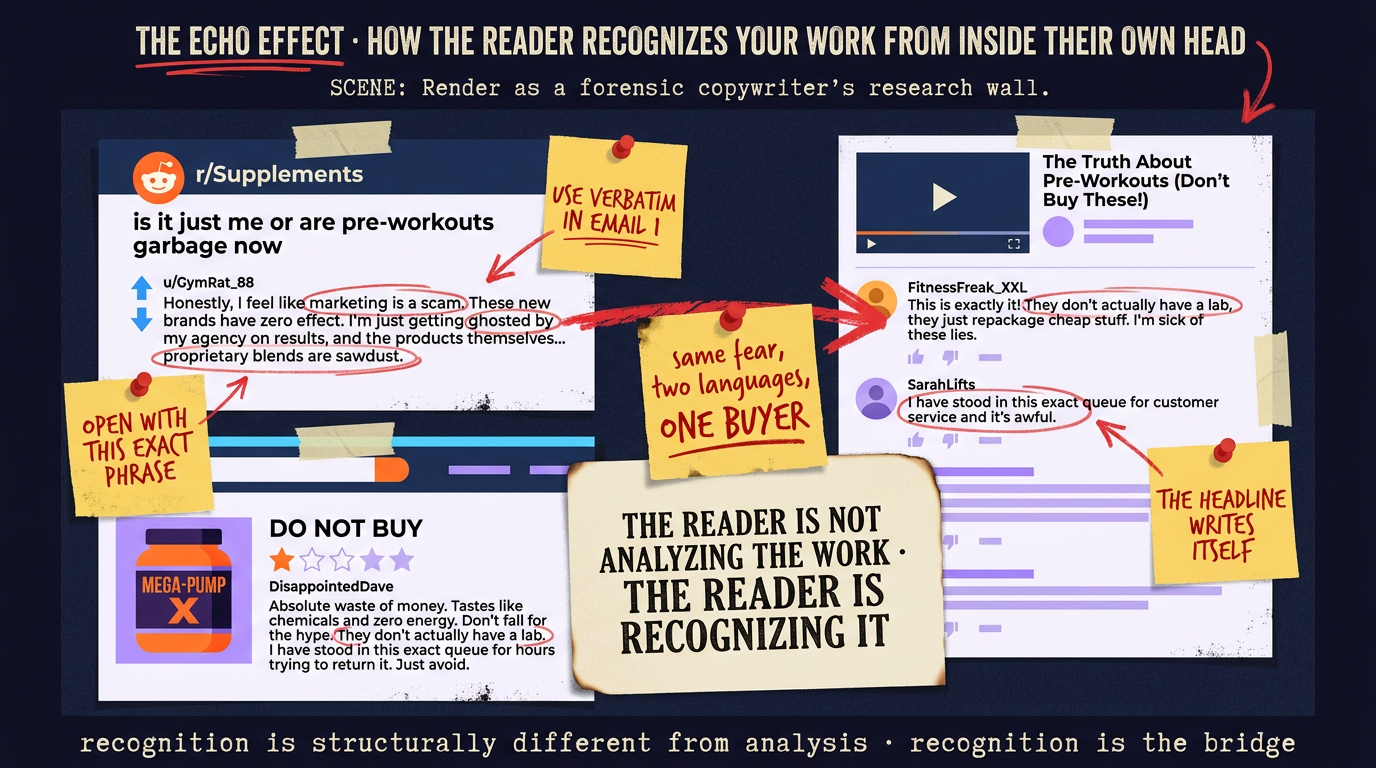
The reader is not analyzing the work. The reader is recognizing it. Recognition is structurally different from analysis. Analysis is the cognitive process of taking new information in. Recognition is the felt sense that the work has been written by someone who has already taken your information in.
What I call the Echo Effect is the experience of reading a piece of work that sounds like the inside of your own head. The reader is not analyzing the work; the reader is recognizing it. Recognition is structurally different from analysis. Analysis is the cognitive process of taking new information in. Recognition is the felt sense that the work has been written by someone who has already taken your information in. David Foster Wallace's supermarket-queue paragraph in This Is Water works because the listener has stood in that queue and felt exactly the small resentment Wallace names. The work does not have to teach the resentment; the work only has to name it. The listener crosses the bridge into actualization mode the moment they realize someone else has felt the small resentment and has been honest enough to write about it.
The mechanism is identical in commerce. The fitness supplement buyer already suspected proprietary blends were scams before the warm-up email arrived. The email confirms that someone else has noticed the same scam and has decided to address it in writing. The buyer's purchase decision after that email is a relief event. Relief is the felt experience of no longer carrying the suspicion alone. A brand that produces relief once will produce future relief in the buyer's mental model, which is how email lists become assets and why a 30 percent open rate inside a calibrated audience outperforms a 7 percent open rate inside a broad list by an order of magnitude the dashboard never captures, because the dashboard measures opens rather than the felt relief that drives the next purchase.
Why most creators get the language wrong
The reason most creators do not produce the Echo Effect is structural rather than talent-related. The creator who has been on the platform for a year has been pre-shaped by the platform's preferred dialect. The creator's brain auto-completes sentences toward the rhythm and vocabulary that produces the highest expected engagement. The vocabulary of the audience's actual inner monologue does not produce the highest expected engagement, because the audience's inner monologue is not the vocabulary other creators on the platform have been using, and the platform rewards conformity with the platform's existing distribution of language. The creator is, structurally, becoming worse at the audience's language the longer they remain on the platform. This is one of the most counter-intuitive findings I have made across all of the operator work I have done, and it is the reason I now spend a fixed percentage of my writing time reading sources outside my own niche specifically to corrupt my dialect back toward the dialect my readers actually use.
The operator move is what the Content Strategy wiki essay calls forensic listening. Block out an hour per week to read the worst-reviewed competitor in your space, the angriest forum thread in your audience's home subreddit, and the one-star review section of the closest product to yours. Take notes on every phrase that makes you flinch, every phrase that surprises you, every phrase that contains a specific concrete detail you would not have generated yourself. The notes become your Lexicon of Pain. The Lexicon is not a swipe file for headlines. The Lexicon is a corrective on your own dialect, run periodically the way a translator periodically re-immerses in the source language to keep their work from drifting toward the target language's preferred rhythms. The translator who does not re-immerse becomes a translator of their own assumptions about the source language. The creator who does not re-immerse becomes a creator of their own assumptions about the audience. The cost of that drift compounds invisibly for months before it shows up in the metrics, and by the time the metrics show it, the drift has already produced a body of work that needs to be repaired or abandoned.
The patchwork workers: desperate love and a cherished secret
What the alien narrator built when he stopped trying to talk to the ocean
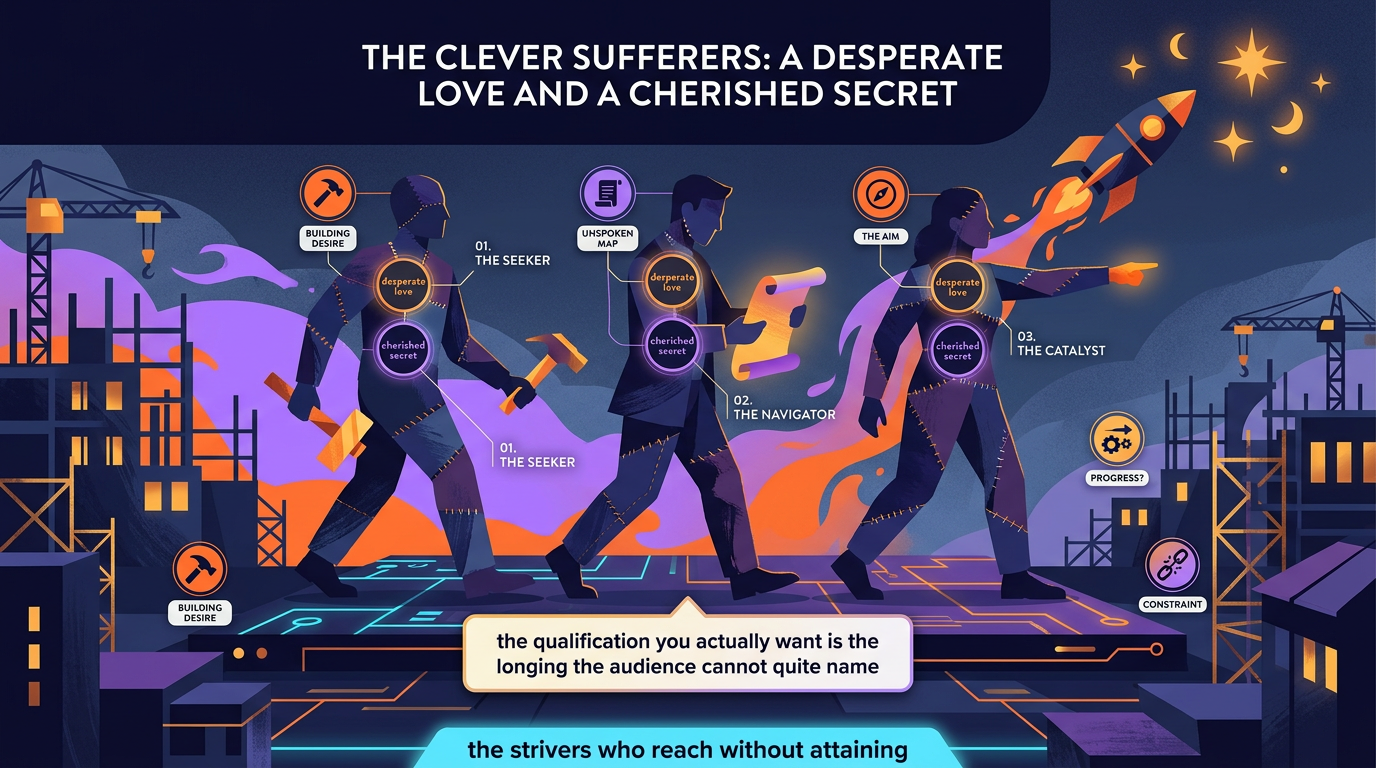
The most operationally useful passage in the Exurb1a alien transcript is the one most people remember as horror. The narrator, having failed to build a workable society from the compliant copies the ocean first produced, decides his next batch of workers needs a structural addition:
"The next batch of workers should have some inadequacy in them. A longing to be smarter, more noble, well-liked, something just out of reach so they can't sit still in their lives."
Out walk the new people, "asking, not what can I do, but what can I do to make the pain of the world stop." The narrator names them the clever sufferers. He looks at them and realizes he has made "the perfect human, or the perfect worker at least." Most readers register the passage as a critique of capitalism. The operational reading is more uncomfortable and more useful. The clever sufferers are the only audience worth building anything for, because they are the only audience whose self-dissatisfaction is structurally compatible with growth.
The earlier batch of workers, the compliant ones who would "bag nails straight through their own hands" if instructed, are the Mirror Ocean audience in human form. They have no internal pressure that drives them past the platform's preferred behaviors. They will engage with anything, perform any compliance, exit the moment the friction outweighs the reward. The clever sufferers, by contrast, carry the courage barrier inside themselves as fuel rather than as obstacle. The "longing to be smarter, more noble, well-liked" is the engine that makes them readable as audience. A desperate love and a cherished secret are the qualification you actually want.
Why this is the qualification you actually want
I have been describing the qualification gate in mechanical terms throughout this essay: an application form, an auto-rejection, a velvet rope, a pricing page. The agency self-funnel case study documents the engagement where I helped multiple service agencies clean up their own pipelines by installing exactly these mechanical filters. The mechanics are reproducible. The mechanics are not the point. The point is that the mechanics select for buyers who carry the clever-sufferer signature: a self-acknowledged gap between current state and desired state, a willingness to spend real money on closing that gap, and a private suspicion that they have been postponing the work for too long. Buyers without that signature are buyers of Mirror Ocean work. Another consultant somewhere will serve them well at a different price point with a different value promise. The auto-rejection sends them there with kindness.
The "how much do you want to make in 90 days?" question I described in the Lead-Gen Funnel Overhaul case study works exactly because it surfaces the clever-sufferer signature in writing. A buyer who answers "$10,000 or more" is naming, in writing, the gap between where they are and where they intend to be. The naming is the act of self-identification. The buyer who can name the gap is the buyer who can cross it. The buyer who cannot name the gap, who selects "I don't know" or "less than the threshold," has structurally declared that the gap is not yet conscious enough for transformation work to land. There is no shame in either answer. The shame would be running a bridge engagement with a buyer whose gap is not yet conscious, because the engagement would burn capital on both sides without producing the result either party wanted.
The clever-sufferer signature shows up across three observable axes when you watch a buyer's behavior carefully:
- A self-acknowledged gap between current state and desired state, named in writing without prompting
- Demonstrated willingness to spend real money on closing the gap, not just to discuss it
- A private suspicion the work has been postponed too long, which surfaces as either visible relief or visible defensiveness on the first call
Founder-led chaos is projection mode in the operator's own life
The clever-sufferer signature operates on the operator as well as on the audience. The founder running an eighty-hour week is doing the same thing the Mirror Ocean audience is doing: routing around an internal gap by performing visible activity. I wrote a field note on this pattern, and the diagnostic move is identical to the audit move I described in section nine. The founder is approving every invoice, personally onboarding every client, running support during evenings, sleeping six hours a night and calling it commitment. The performance looks like dedication. The performance is structurally the founder's own Mirror Ocean: a reflective surface they keep producing more of so that they never have to sit still with the underlying fact, which is usually that they have built a business they do not know how to delegate, or that they delegated once and got burned and never rebuilt the trust, or that the business is producing the wrong kind of revenue and they cannot face the structural rebuild that would be required to produce the right kind.
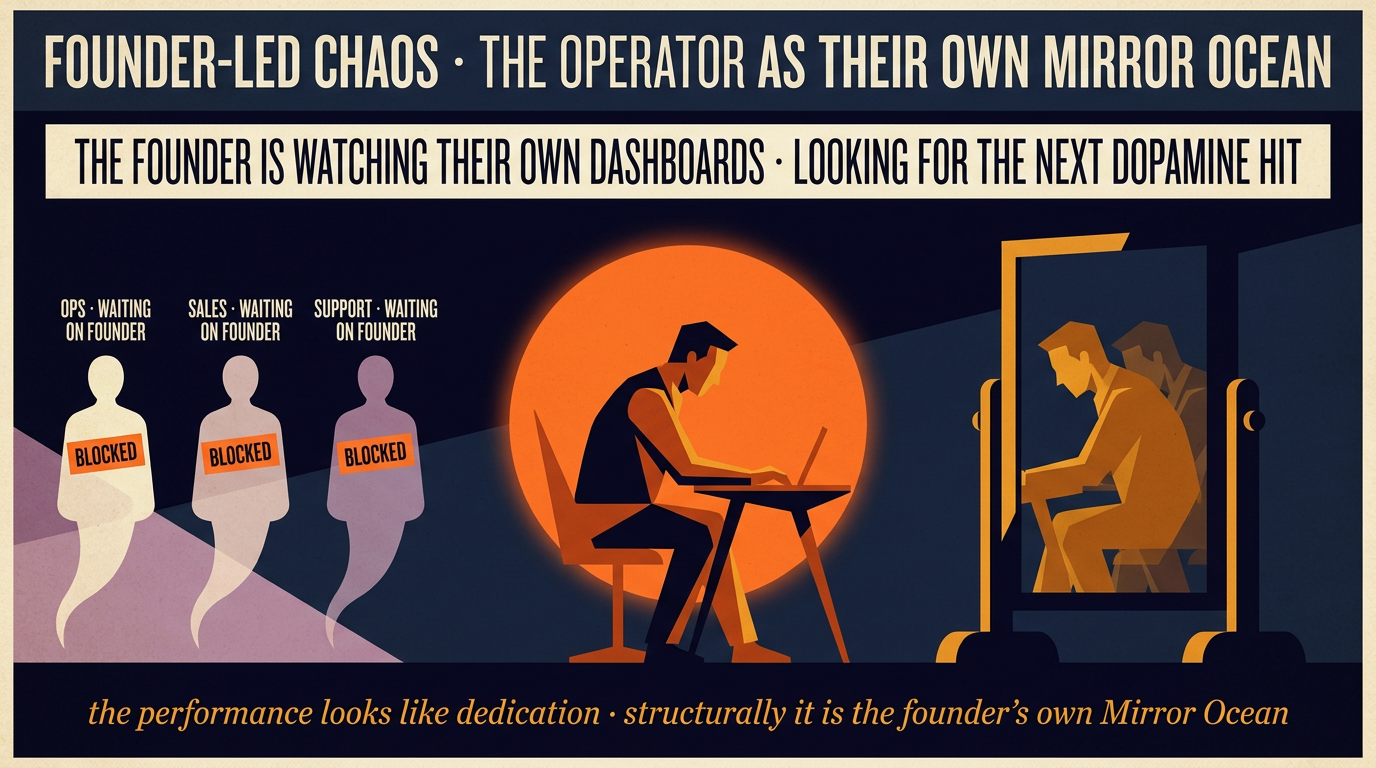
The bridge work for the operator runs in three steps, in this order:
- Name the gap in writing. Specific, measurable, dated.
- Identify the specific behaviors and beliefs that must change for the future to land. Not the activities, the inputs.
- Accept that the transformation costs something the operator does not yet want to spend, and decide on purpose whether to spend it.
The founder who refuses to do this work has, structurally, become the audience of their own business. They are watching their own dashboards looking for the next dopamine hit of growth metrics that will let them avoid the question of what the business is actually for. The hardest thing I have learned in over a decade of operator work is that the founder is almost always also the buyer the consultant most needs to qualify, because the founder is usually the buyer least likely to admit they need the qualification.
The founder is almost always also the buyer the consultant most needs to qualify, because the founder is usually the buyer least likely to admit they need the qualification.
The operational implication for creators is direct: if you cannot name your own clever-sufferer signature in writing, you are unlikely to be able to name your audience's. The work I have just described in this essay was authored by an operator who has run this audit on himself in writing more than once. The audit is recurring rather than terminal. Each new project is an opportunity to discover a new gap, name it, accept the cost of closing it, and ship the work that emerges on the other side of the closure. The audience that gathers around an operator who runs this audit visibly is the audience that recognizes the audit in themselves. Recognition is the bridge. Recognition is what makes the audience stay through 10,000 words on a Sunday afternoon. Recognition is what makes a buyer write the larger check at the higher price point.
Alignment as bridge architecture in protocol form
What I learned working on $500M of token-economic alignment
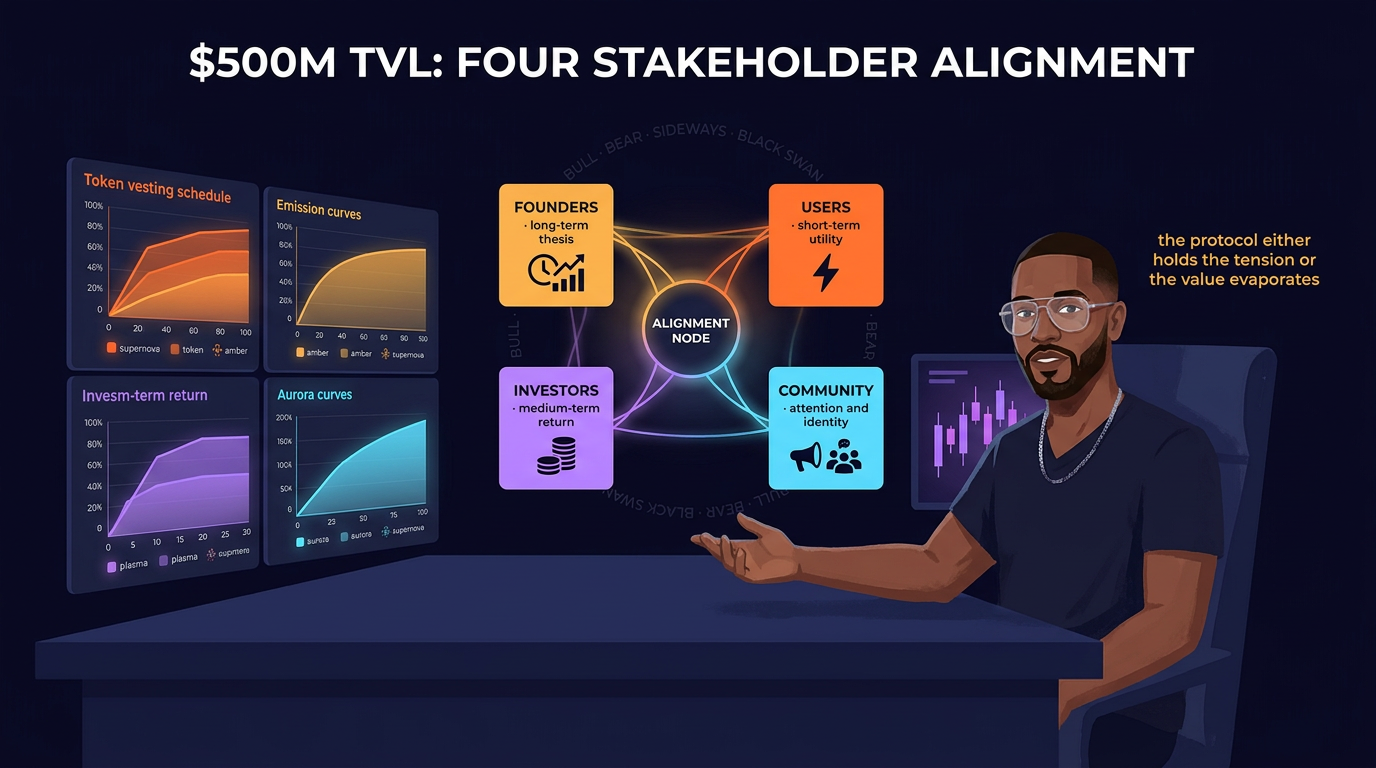
The deepest test of bridge architecture I have personally encountered was in crypto tokenomics, where the bridge between competing stakeholder groups has to be encoded into a protocol that runs without human supervision for years. I documented this work as the Solana Ecosystem Tokenomics case study, where I supported more than two dozen projects on the largest token investing platform in the Solana ecosystem during a period when the platform held over $500 million in TVL. The work was tokenomic strategy, vesting schedule design, emission curves, governance frameworks. The work was also, in every case that actually shipped, a bridge engineering problem dressed in the vocabulary of cryptography and game theory.
Every token has four stakeholder groups whose interests are structurally non-identical:
| STAKEHOLDER | PRIMARY INTEREST | TIME HORIZON |
|---|---|---|
| Founders | long-term thesis plays out | years |
| Users | short-term utility from the product | days to weeks |
| Investors | medium-term return on capital | months to quarters |
| Community | attention and identity ownership | continuous |
A naive tokenomics design optimizes for one of the four groups at the expense of the others. The result is predictable: the optimized group is happy until the un-optimized groups defect, after which the structure collapses regardless of how elegant the optimization was. A bridge tokenomics design holds all four groups in calibrated tension. The vesting schedule rewards long-term founders without locking out short-term liquidity for users. The emission curve produces investor returns without dumping continuous sell pressure on the community. The governance structure gives the community real attention-and-identity ownership without giving them the operational decisions that should remain with the founders. The protocol is the bridge, and the protocol either holds the tension or it does not.
Wherever multiple actors with non-identical interests have to produce value together, the bridge is encoded into the protocol or the value evaporates.
Why the rug at $100M was the lesson, not the loss
The most expensive thing I have learned in this domain came from a Polkadot-era project I documented as the Web3 Community Growth case study. The project went from approximately $10 million in market capitalization to roughly $100 million during my time as a hybrid community-and-marketing lead, and then the investor behind the project rugged the community despite repeated requests from me and the team to simply ship what had been promised and earn the money the legitimate way. The team made all of the bridge-architecture moves correctly. We ran AMAs, increased transparency, centralized communication, built CRM-backed accountability for grant fund usage. What we did not do was qualify the investor. We accepted that the capital behind the project was the capital behind the project, and that whoever held it would behave honorably because they had committed in writing to do so. They did not. They never intended to. The bridge held the team, the community, and the technology in alignment. The bridge did not hold the investor in alignment because the investor was operating outside the protocol the bridge was built to enforce.
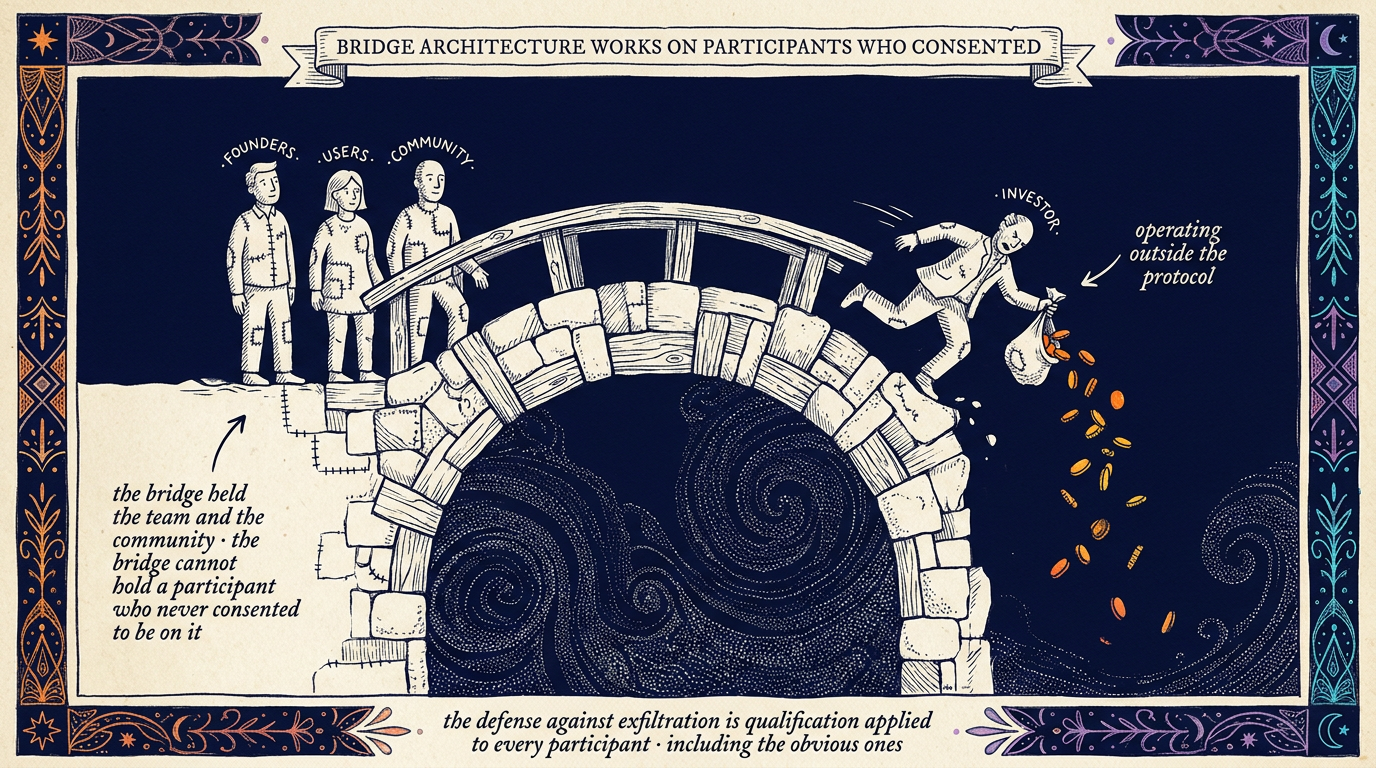
The expensive lesson: bridge architecture only works on participants who consented to be inside the bridge. A participant who is outside the system and pretending to be inside it will eventually exfiltrate the value the bridge was concentrating. This is true for tokenomics, true for service engagements where the buyer claims to want transformation but actually wants the Magic Button, and true for content engagements where a reader pretends to engage with the work in order to extract the parts they can repurpose without doing the underlying internal work. The defense against exfiltration is qualification applied to every participant, not only to the obvious ones. The qualification I now apply when working on any token project includes the investor profile as a primary axis, not a secondary one, and the engagements I have declined to take on those grounds have, retroactively, all been engagements where I would have ended up holding the bag for somebody else's exit.
Attention has a literal dollar price in crypto, and a delayed one everywhere else
One of the things crypto reveals more clearly than any other industry is that attention has a literal, measurable, near-real-time dollar price. A protocol with 100,000 active community members has a quantifiably different market capitalization from an otherwise identical protocol with 10,000 active community members. The market is pricing the attention. Outside crypto, the same dynamic operates more slowly and less visibly. A consultant with a deeply engaged audience of a few thousand serious operators can charge a multiple of what a consultant with a casual audience of a hundred thousand can charge, and the multiple is the market pricing the difference in attention quality. The African Crypto Radio case study documented an engagement where the team raised $350,000 in marketing grant funding against significant structural bias because we treated the grant pitch as an enterprise sales process: detailed CRM-backed accountability, public transparency on fund usage, narrative pressure-testing for every anticipated objection. The grant was attention being converted to capital in real time. The structural moves that produce that conversion are the same structural moves that produce the conversion in any other domain. The visibility of the conversion in crypto only makes it easier to study.
The protocol-level lesson generalizes. The Agent Systems wiki essay describes an analogous bridge architecture inside multi-agent AI systems, where individual agents must coordinate without a central planner and where the protocol that holds them in alignment is the only thing standing between productive multi-agent work and the equivalent of a token rug. Wherever multiple actors with non-identical interests have to produce value together, the bridge is encoded into the protocol or the value evaporates. A consulting engagement is a protocol between consultant and buyer. A content essay is a protocol between writer and reader. A token launch is a protocol between four stakeholder groups. The protocol either holds the tension or it does not. The work of running the protocol is the work, and the work is invisible until the moment something breaks, at which point the work becomes the only thing that matters.
The Constellation thesis: operations as moat
What you are reading was built by a system, not a writer
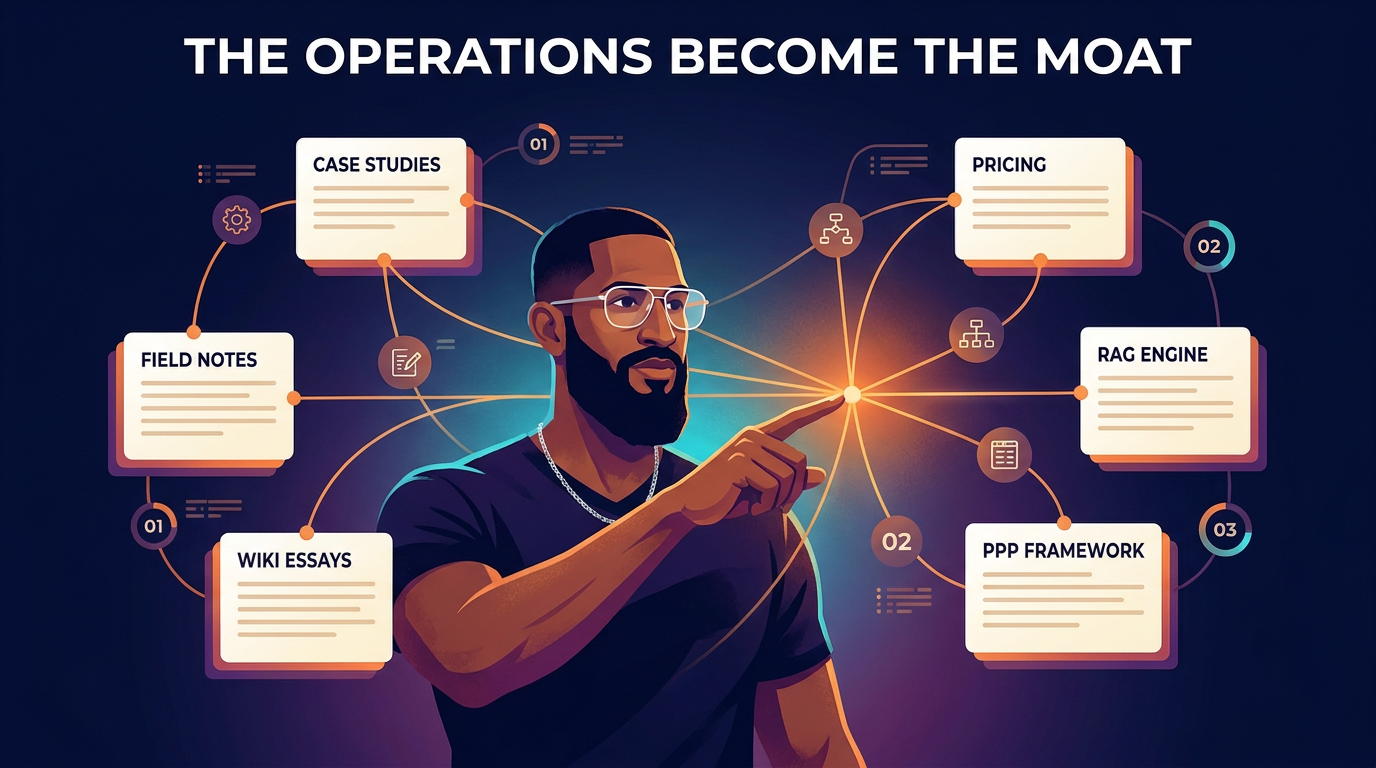
The essay you are now near the end of was produced by a system, not by a single act of writing. The reference material I read before drafting this article runs to roughly 6,500 lines of internal documentation, including the full nine-stage People-Product-Process framework, the 25 case studies linked throughout, and the writing style guide that governs which words are allowed and which are not. The retrieval layer that surfaces the relevant passages of those references on demand is documented as the RAG Knowledge Engine case study: a locally-run retrieval system built on the open-source Archon platform, upgraded with cluster semantic chunking, Google Gemini Embedding 001 task-typed embeddings, and an MCP layer that exposes the 5-million-word personal corpus to any agent operating inside the IDE. The article-generation pipeline is documented as the Content Compiler case study: a node-by-node generation system inspired by LLVM intermediate representation, where each paragraph is an atomic unit subject to its own optimization passes for style, voice, and structural coherence before being assembled into the final document.
The full operator stack behind this article runs on six layers, each compounding with the others:
- Reference corpus: ~6,500 lines of internal docs (PPP, voice guide, 25 case studies, field notes, briefs)
- RAG engine: Archon + Gemini Embedding 001 task-typed embeddings + cluster semantic chunking
- MCP layer: exposes the 5-million-word personal corpus to any agent inside the IDE
- Content compiler: node-by-node generation with per-paragraph optimization passes for style, voice, structural coherence
- Wiki spine: 32 canonical methodology essays cross-linked into the production pipeline
- Pricing + qualification gate: filters buyers before the first sales conversation
The compound moat for a creator working at this scale is the system that produces the writing reliably enough that the writing can be honest about its own production. Writing skill and strategic insight matter inside the system; they do not substitute for the system itself. Most operators who attempt content of this depth burn out after a few essays because each essay requires reassembling the research, the voice calibration, and the structural template from scratch. The Constellation infrastructure removes the reassembly cost. The PPP framework lives at a canonical wiki entry and is referenced rather than re-derived. The voice guide lives in a single source of truth and is consulted at every paragraph break. The case studies live in the case studies index and are pulled by slug rather than rewritten. The system is the moat. The writing is what the system produces.
The compound moat for a creator working at this scale is the system that produces the writing reliably enough that the writing can be honest about its own production. Writing skill and strategic insight matter inside the system; they do not substitute for the system itself.
The compound moat invisible until it isn't
The Constellation thesis, named in the project's own internal documentation, is that the operator working today has access to compounding infrastructure that earlier eras of operators did not:
| YEAR | CONSULTANT'S COMPOUNDING STACK |
|---|---|
| 1995 | Rolodex + stack of business cards |
| 2005 | CRM + website |
| 2015 | Content marketing pipeline + LinkedIn presence |
| 2025 | All of the above plus a locally-run retrieval engine, a programmatic content compiler, a wiki of canonical methodology, 25 documented case studies with internal cross-linking, a field-notes archive, and a pricing page that filters buyers before the first sales conversation |
The 2025 stack reads as a list because it is one. Each layer compounds with the others. Each of those layers compounds with the others. The Observability Manifesto wiki essay describes the discipline behind the operational layer: every system in the stack must be instrumented well enough that when something breaks, the cause is visible inside an hour rather than visible inside a quarter. The Unified Architecture wiki entry describes the longer-term integration thesis, where the operator's individual systems eventually fuse into a single agent-native platform that compounds output at a different order of magnitude.
The reason this matters for the reader who is not me: the same architecture is reproducible by any operator with the discipline to build it deliberately rather than accidentally. The case studies on this site are field reports describing real engagements, real numbers, real lessons. The wiki articles are working methodology I refer back to when running new engagements. The field notes are forensic observations from inside the work. The pricing page is the filter. The portfolio is the system, exposed to the visitor in five different angles, each one a different door into the same operator.
What to do tomorrow morning

The Constellation is what I built because I needed it. You will build something different because you need something different. What I am asking you to take from this essay is the willingness to run the audit on yourself first. Tomorrow morning, before you open the dashboard, do the work I described in section seven. Write down on paper the specific behavioral change you would like a single member of your audience to make in the next 30 days because of something you put into the world. Then do the work I described in section eight. Run the seven-layer drill on the surface complaint your audience presents. Then do the work I described in section eleven. Name three editorial lines or commercial commitments you will not soften regardless of audience cost. Then sit with the discomfort the answers produce.
The discomfort is the bridge. The discomfort is also the only honest evidence that the work is going to be worth doing. If the answers were comfortable, you would have written them down already. The fact that you have not is structural information about the work that has been waiting for you. The dashboard cannot see this work. The work is the only thing that matters.
If you want to talk about what running this architecture would look like inside your specific business, the pricing page lists the engagements I take and the price points at which I take them. The quote form is the application, structured exactly the way the application from the $199.5K coaching launch was structured. The first question asks how much profit you want to add in the next 90 days. Answer honestly. If the honest answer is below the threshold, the form will tell you so and route you to free resources instead. If the honest answer is at or above the threshold, the form will route you to a calendar. Either outcome is the right outcome. The contact page exists for everything else, including the question of whether your situation is something I can help with at all, which is sometimes a no and is always a no I will tell you directly rather than walk around.
This essay is a bridge. You crossed it because the bridge was crossable for you. The fact that you crossed it is information about you, not about me. Pay attention. Be astonished. Tell about it. The instructions are still the only instructions that work.